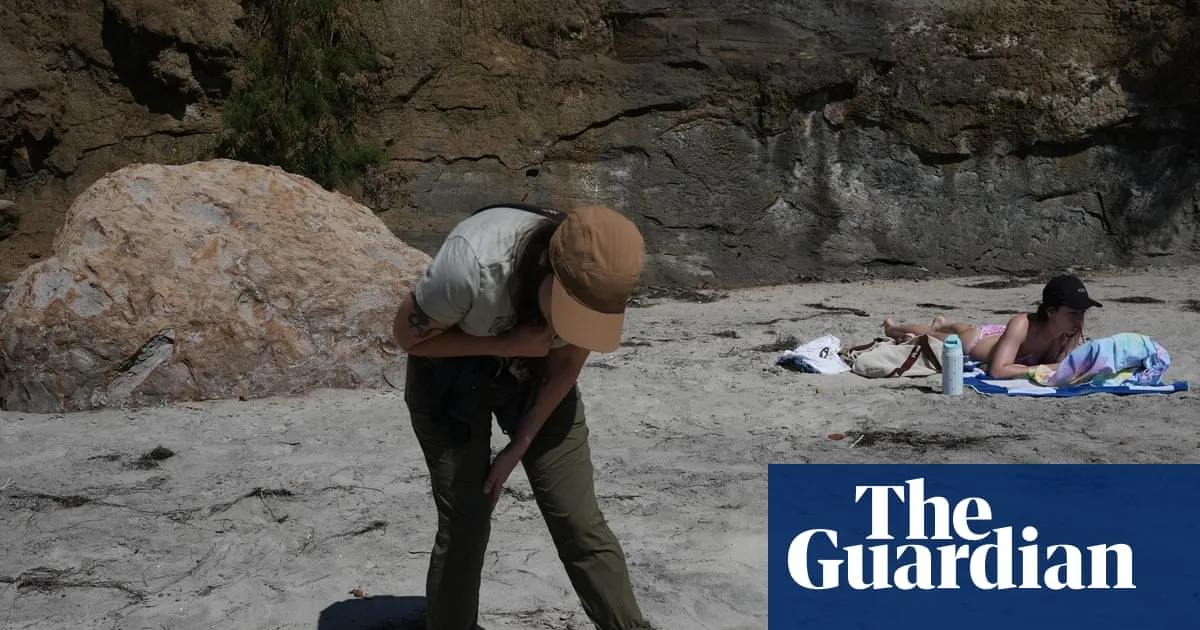
Within minutes of walking on a San Diego beach, marine ornithologist Tammy Russell found the feathered carcasses – one after another.Some were mixed in with washed up kelp. Others were under rocks.Each month, scientists and volunteers conduct surveys of dead seabirds and find what Russell describes as a grim assessment of the impact of a massive marine heat wave that has lingered for months off parts of the California coast.The surveys that have been carried out by various organizations for decades help build a baseline of information on beached sea life to detect threats and their impact.Many seabirds, including California brown pelicans, loons and grebes, starved to death in recent months as record-setting ocean temperatures decreased the band of cold, nutrient-rich surface water where krill, anchovies and sardines thrive near the shore, said Russell, a postdoctoral scholar at the California-san-diego" class="entity-link entity-organization" data-entity-id="29584" data-entity-type="organization">University of California, San Diego, Scripps Institution of Oceanography.“We’ve been seeing cormorants walk to shore and then just die within the hour. I mean one time it happened within 15 minutes, and I’ve never seen that before,” Russell said. “That has been heartbreaking for me and we’re seeing this happening across the whole coast.”Scientists fear the die-off could worsen with the recently formed El Niño, the natural warming of parts of the central Pacific that alters weather worldwide and spikes global temperatures.The US National Oceanic and Atmospheric Administration in June confirmed an El Niño formed and it is expected to grow to historic strength.Die-offs of seabirds occur periodically, and not all the seabird deaths off California this year are tied to the marine heat wave, scientists and wildlife officials say.But such die-offs are becoming more frequent as the planet warms and oceans heat up.‘We don’t know how bad this is going to get’Already a marine heat wave has persisted off parts of the west coast for the past year, marking only the third time on record that such a large section of coastal waters stayed warm for so long, according to Noaa.Scripps measures daily ocean temperatures at 10 coastal stations along the California coast, where their records stretch back over a century. This year, saw three stations break records for 40 days or more, said the director Melissa Carter, who runs the program. The samples are taken in a variety of ways, including off piers by dropping an insulated bucket, or by lifeguards in the early morning surf or researchers off rocky shorelines.Brooke Lafrenz takes a drink of water as she shares a rock with a seabird along Blacks Beach in San Diego. Photograph: Gregory Bull/APRobotic underwater gliders with sensors operating out at sea also recorded high temperatures offshore and at depth during the spring. Dan Rudnick, who runs the Scripps glider program, said the warm temperature anomaly off southern California this spring was comparable to that during the last El Niño in 2023.And that was before the formation of this year’s El Niño, which could stretch into 2027.As cold-water species move deeper and farther north, the marine heat wave coupled with El Niño could further disrupt food webs for sea life from gray whales to seabirds. A similar pattern happened a decade ago.“We don’t know how bad this is going to get,” said Russell, who has written about five species of Booby that are now common off California because of warming ocean temperatures.Seabirds are seeking food in unusual placesWildlife rehabilitation facilities treated hundreds of emaciated birds this spring when the marine heat wave intensified.“It’s not abnormal to see dead birds on the beach, but the quantity of dead birds is unusual,” JD Bergeron, the CEO of International Bird Rescue , a global wildlife conservation organization that runs two aquatic bird rehabilitation centers in California, said in an interview in May.Rescue supervisor Jeni Smith passes an enclosure for rehabilitating seabirds at the SeaWorld Animal Rescue Center. Photograph: Gregory Bull/APBrown pelicans are turning up in inland lakes, Bergeron said.“When birds starve, especially the pelicans, they start to look in unusual places for food,” he said. “They will chase fishing boats, they will go to piers and you end up with birds with fishing line and fish hook injuries.”Many dead or debilitated seabirds examined this year have been young and emaciated, and most have tested negative for avian flu, according to the California department of fish and wildlife. Some had opportunistic infections linked to malnourishment.Krysta Rogers, a senior state environmental scientist, said there may be factors besides warm ocean temperatures. High mortality rates among young Brandt’s cormorants and common murres began after a robust 2025 breeding season, peaking post-winter, and appeared to coincide with the marine heat wave. Those deaths may be mostly due to chicks simply not surviving on their own, she said.But she does not discount the marine heat wave affecting some seabirds, considering an increase this spring in reported deaths from other species and not just young ones.The US Fish and Wildlife Service, which collects data from the dead seabird surveys and others, said they do not have a comprehensive report ready yet.Only a fraction of birds that die at sea wash ashoreIn 2013, a warm water mass nicknamed “the blob” developed off Alaska and stretched south, lingering for years as it wreaked havoc on marine ecosystems all the way to Mexico’s Baja California peninsula. One of the strongest El Niños on record overlapped with it in 2015.Beachgoers pass a dead common murre on a beach near Scripps Pier. Photograph: Gregory Bull/APCarcasses of emaciated common murres showed up on beaches in what biologists say was the largest seabird die-off recorded in the world’s oceans.Common murres look like thin penguins. They can fly miles in search of schools of finger-length fish and can dive and swim nearly 600ft (183m) deep to capture them. However, the birds’ high metabolism means they have to eat a lot. If they don’t eat prey matching 10% to 30% of their body mass daily, they can use up fat reserves and drop to a critical threshold for starvation within three days.Studies show that only a fraction of birds that die at sea wash ashore. It took years for scientists to confirm that more than half of Alaska’s population of common murres, an estimated 4 million birds, died during “the blob,” according to a 2024 study in the journal Science.The species is still struggling to recover.
SRCThe Guardian - World News
LANGEN
LEANCenter-Left
WORDS1 049
ENT11
WED · 2026-07-01 · 19:37 GMTBRIEF NSR-2026-0701-89120
NSR-2026-0701-89120News Report·EN·Environmental
Scientists fear seabird die-off as El Niño looms: ‘We don’t know how bad this is will get’
Scientists are observing a significant die-off of seabirds along the California coast, with many birds starving to death. This phenomenon is attributed to a prolonged marine heat wave that has reduced the availability of prey fish near the shore.
Associated PressThe Guardian - World NewsFiled 2026-07-01 · 19:37 GMTLean · Center-LeftRead · 5 min
The Guardian - World NewsFIG 01
Reading time
5min
Word count
1 049words
Sources cited
4cited
Entities identified
11entities
Quality score
100%
§ 01
Briefing Summary
AI-generatedNEWSAR · AI
Scientists are observing a significant die-off of seabirds along the California coast, with many birds starving to death. This phenomenon is attributed to a prolonged marine heat wave that has reduced the availability of prey fish near the shore. Ornithologists have documented an unusually high number of dead seabirds, including pelicans, loons, and grebes, on beaches. Experts fear this situation could worsen with the formation of El Niño, which is expected to grow to historic strength and further disrupt marine food webs. While seabird die-offs can occur periodically, their increasing frequency is linked to a warming planet and oceans. Wildlife rehabilitation centers have treated hundreds of emaciated birds, some of which are seeking food in unusual inland locations.
Confidence 0.90Sources 4Claims 5Entities 11
§ 02
Article analysis
Model · rule-basedFraming
Environmental
Human Interest
Tone
Mixed Tone
AI-assessed
CalmNeutralAlarmist
Factuality
0.70 / 1.00
Factual
LowHigh
Sources cited
4
Well sourced
FewMany
§ 03
Key claims
5 extracted01
Record-setting ocean temperatures have persisted off the west coast for the past year.
statisticNOAA
Confidence
0.95
02
The warm temperature anomaly off southern California this spring was comparable to that during the last El Niño in 2023.
statisticDan Rudnick
Confidence
0.90
03
Seabirds are starving to death off the California coast due to a marine heat wave decreasing nutrient-rich surface water.
factualTammy Russell
Confidence
0.90
04
Seabird die-offs are becoming more frequent as the planet warms and oceans heat up.
factualscientists and wildlife officials
Confidence
0.85
05
The recently formed El Niño is expected to grow to historic strength and could worsen seabird die-offs.
predictionNOAA
Confidence
0.80
§ 04
Full report
5 min read · 1 049 words§ 05
Entities
11 identifiedKey playerOppositionContextPositiveNeutralNegative
Organizations3
Events1
§ 06
Keywords & salience
10 termsseabird die-off
1.00
el niño
0.90
marine heat wave
0.90
ocean temperatures
0.80
starvation
0.70
nutrient-rich water
0.60
climate change
0.50
scripps institution of oceanography
0.40
california coast
0.40
wildlife officials
0.40
§ 07
Topic connections
Interactive graph No topic relationship data available yet. This graph will appear once topic relationships have been computed.