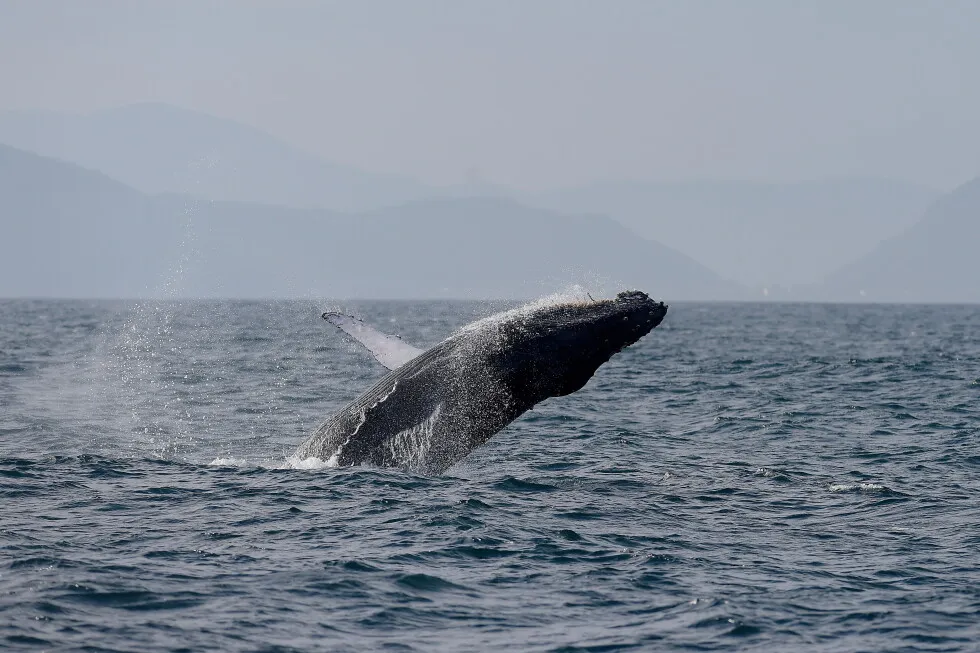
Sightings of humpback whales surge in Rio de Janeiro, fueling demand for whale-watching trips 1 of 5 | A humpback whale breaches off the coast of Rio de Janeiro, Brazil, Tuesday, June 30, 2026. (AP Photo/Dhavid Normando) 2 of 5 | A humpback whale surfaces off the coast of Rio de Janeiro, Brazil, Tuesday, June 30, 2026. (AP Photo/Dhavid Normando) 3 of 5 | A humpback whale dives off the coast of Rio de Janeiro, Brazil, Tuesday, June 30, 2026. (AP Photo/Dhavid Normando) 4 of 5 | A humpback whale breaches off the coast of Rio de Janeiro, Brazil, Tuesday, June 30, 2026. (AP Photo/Dhavid Normando) 5 of 5 | humpback whales surface near a Humpback Whale Project boat during monitoring off the coast of Rio de Janeiro, Brazil, Tuesday, June 30, 2026. (AP Photo/Dhavid Normando) By DIARLEI RODRIGUES and ELÉONORE HUGHES Updated 9:45 PM MESZ, July 1, 2026 Add AP News on Google Add AP News as your preferred source to see more of our stories on Google. Share Share Facebook Copy Link copied Print Email X LinkedIn Bluesky Flipboard Pinterest Reddit Rio de Janeiro (AP) — Sightings of humpback whales off Rio de Janeiro’s coast are surging as they recover from decimation due to commercial whaling, prompting an acceleration in the demand for whale-watching excursions to spot the huge marine creatures during their annual migration. The species’ population has jumped from around 2,000 to around 35,000 in approximately 40 years, close to their population before whaling, said Enrico Marcovaldi, co-founder of the Humpback Whale Project. That means they are increasingly being spotted in Rio’s postcard Guanabara Bay. “It’s wonderful. It shows that the whales are making a recovery, are healthy and thriving, and hopefully they’ll continue to do so,” said Marcovaldi. In 1982, the International Whaling Commission decided that there should be a pause in commercial whaling on all whale species and populations from the 1985/1986 season onward. Louise Raulais, who runs the Rio Ocean Club with her partner Theo Andrade, is among those who see the tourism opportunities in the whales’ resurgence. This year, the company began offering sailboat trips for between five and 10 people to observe the whales. Raulais said they always have a biologist onboard to share information, which can stimulate a desire to protect the whales and the ocean. Mexico’s legendary rescue brigade heads to Venezuela as earthquakes death toll tops 2,200 3 MIN READ Harry Kane sends England into the round of 16 of the World Cup after 2-1 win against Congo 3 MIN READ Why are World Cup refs giving red cards to players covering their mouths when confronting opponents? 2 MIN READ 17 “These animals are so iconic and charismatic that they have the power to transform people, to change the way they see the world,” said Raulais. humpback whales are known for roaming long distances across major oceans in predictable patterns, typically following migration routes learned from their mothers. They feed on krill and small fish in the warmer months and breed in tropical waters over winter. Between June and November, thousands of humpback whales migrate through Brazilian waters, traveling roughly 2,500 miles (4,000 kilometers) from their feeding grounds in the Southern Ocean to breeding and calving grounds off northeastern Brazil. Most gather around the Abrolhos Bank, a coral reef region spanning the coasts of Bahia and Espirito Santo that is one of the South Atlantic’s most biodiverse marine environments. The Humpback Whale Project set up a scientific expedition, scheduled to run from June 26 to July 9, to study the humpback whales’ behavior, size and health, as well as identify their travel route, key gathering areas, and to measure how far offshore the whales pass. “They’re exploring this area,” said Pedro Fróes, a biologist for the Humpback Whale Project who is part of the expedition. “They want to find out whether, in the future, it could become a place for them to rest, to mate, or to give birth to a calf,” Fróes said. Follow AP’s coverage of Latin America and the Caribbean at https://apnews.com/hub/latin-america
SRCAssociated Press (AP)
LANGEN
LEANCenter
WORDS677
ENT12
WED · 2026-07-01 · 19:53 GMTBRIEF NSR-2026-0701-89129
NSR-2026-0701-89129News Report·EN·Environmental
Sightings of humpback whales surge in Rio de Janeiro, fueling demand for whale-watching trips
Sightings of humpback whales off Rio de Janeiro's coast have surged due to the species' recovery from commercial whaling, leading to increased demand for whale-watching tours. The humpback whale population has grown significantly, nearing pre-whaling numbers, resulting in more frequent sightings, even in Guanabara Bay.
Associated Press (AP)Filed 2026-07-01 · 19:53 GMTLean · CenterRead · 3 min
Associated Press (AP)FIG 01
Reading time
3min
Word count
677words
Sources cited
2cited
Entities identified
12entities
Quality score
100%
§ 01
Briefing Summary
AI-generatedNEWSAR · AI
Sightings of humpback whales off Rio de Janeiro's coast have surged due to the species' recovery from commercial whaling, leading to increased demand for whale-watching tours. The humpback whale population has grown significantly, nearing pre-whaling numbers, resulting in more frequent sightings, even in Guanabara Bay. This resurgence is creating tourism opportunities, with companies offering excursions that often include onboard biologists to educate participants about whale conservation. A scientific expedition is currently underway to study the whales' behavior, migration routes, and potential future use of the area for resting and breeding.
Confidence 0.90Sources 2Claims 5Entities 12
§ 02
Article analysis
Model · rule-basedFraming
Environmental
Economic Impact
Tone
Measured
AI-assessed
CalmNeutralAlarmist
Factuality
0.70 / 1.00
Factual
LowHigh
Sources cited
2
Limited
FewMany
§ 03
Key claims
5 extracted01
The International Whaling Commission decided there should be a pause in commercial whaling from the 1985/1986 season onward.
factual
Confidence
0.95
02
The species’ population has jumped from around 2,000 to around 35,000 in approximately 40 years.
statisticEnrico Marcovaldi, co-founder of the Humpback Whale Project
Confidence
0.95
03
Humpback whales are increasingly being spotted in Rio’s Guanabara Bay.
factual
Confidence
0.90
04
Demand for whale-watching excursions has accelerated due to the whales' resurgence.
factual
Confidence
0.90
05
Sightings of humpback whales off Rio de Janeiro’s coast are surging.
factual
Confidence
0.90
§ 04
Full report
3 min read · 677 words§ 05
Entities
12 identifiedKey playerOppositionContextPositiveNeutralNegative
Organizations3
§ 06
Keywords & salience
9 termshumpback whales
1.00
whale watching
0.90
rio de janeiro
0.80
population recovery
0.70
commercial whaling
0.60
annual migration
0.50
marine creatures
0.50
tourism
0.40
humpback whale project
0.40
§ 07
Topic connections
Interactive graph Network visualization showing 13 related topics
View Full Graph Person Organization Location Event|Click node to navigate|Edge numbers = shared articles