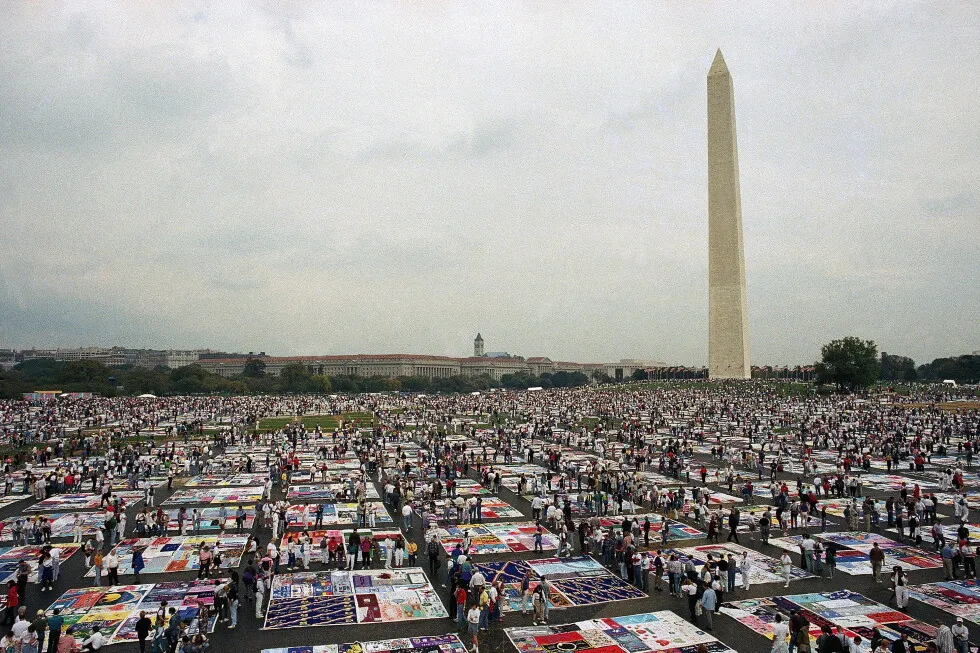
By Cara Anna Updated 7:56 PM MESZ, June 22, 2026 Add AP News on Google Add AP News as your preferred source to see more of our stories on Google. Share Share Facebook Copy Link copied Print Email X LinkedIn Bluesky Flipboard Pinterest Reddit It is more than 50 tons of fabric and compassion, and the Library of Congress describes it as the largest communal art project in the world. The AIDS-memorial-quilt" class="entity-link entity-topic" data-entity-id="156879" data-entity-type="topic">AIDS Memorial Quilt was stitched from the lives of those dying from an epidemic that many in the government and public feared and failed to address. There was stigma and misunderstanding in the earliest days around the most prominent groups affected: men who had sex with men, Haitians and people with hemophilia, a rare blood disorder. Quietly, the virus spread — to wives, to children — showing once again that humanity has no borders. While activists screamed for assistance and once-vibrant loved ones withered in hospital beds from opportunistic diseases, the quilt was born. Panel by panel, handmade by the hundreds and then the thousands, it remembered the people lost. “Everybody told me it was the stupidest thing they’d ever heard of, but I ignored them and kept going and found people who shared the vision,” activist Cleve Jones once told the BBC about his idea. Quilts are traditionally made of castoffs turned into something comforting, he said. He thought an AIDS quilt would be therapy. Each panel measures three feet by six feet, he said — “the approximate size of a grave.” Much more than a piece of furniture, the president’s Resolute Desk has echoed through history 2 MIN READ Americans step out for their nation’s 250th in a proud moment sown with division and doubt 4 MIN READ 82 Trump visits newly built Theodore Roosevelt Presidential Library in North Dakota’s Badlands 5 MIN READ 47 Panels feature personal touches like portraits, nicknames, military ranks, scraps of clothing and care: “Friends for life.” “I miss you constantly.” “Brothers. Beloved sons.” Hearts, rainbows, flowers. The quilt made its debut on the National Mall in Washington in 1987, six years after AIDS was identified. With almost 2,000 panels, it was larger than a football field and helped to make the epidemic impossible to ignore. Visitors walked its expanse, some stunned into silence. The mid-1980s were marked by other feats of collective activism. “We Are the World.” Hands Across America. “Do They Know it’s Christmas?” Farm Aid. So many earnest concerts. The quilt made more gentle noise. In its last complete appearance on the National Mall in 1996, it covered the expanse, the Smithsonian says. That’s a mile long, between the Capitol and the Washington Monument, a lawn with decades of American activism stamped into the ground. The quilt held 40,000 panels. It has almost 50,000 now. The National AIDS Memorial invites people to make more. It’s a reminder there is no cure and the threat remains: Cuts in U.S. foreign aid have reawakened the possibility of AIDS wards in vulnerable places like southern Africa. American Objects These are among the items that have shaped the nation. Here are their stories. Cara Anna Anna is an editor on the AP’s Global Desk. She has reported from Africa, China, Ukraine, Afghanistan and the United Nations. mailto
SRCAssociated Press (AP)
LANGEN
LEANCenter
WORDS544
ENT12
THU · 2026-07-02 · 00:53 GMTBRIEF NSR-2026-0702-89215
NSR-2026-0702-89215News Report·EN·Human Interest
The AIDS Memorial Quilt made a fearful epidemic powerfully human
The AIDS Memorial Quilt, described as the world's largest communal art project, is a massive tapestry of over 50 tons of fabric created to remember individuals lost to the AIDS epidemic. Initiated by activist Cleve Jones, the quilt began as a therapeutic response to the fear and misunderstanding surrounding the epidemic, which initially targeted specific groups but spread to affect wider populations.
Associated Press (AP)Filed 2026-07-02 · 00:53 GMTLean · CenterRead · 3 min
Associated Press (AP)FIG 01
Reading time
3min
Word count
544words
Sources cited
2cited
Entities identified
12entities
Quality score
100%
§ 01
Briefing Summary
AI-generatedNEWSAR · AI
The AIDS Memorial Quilt, described as the world's largest communal art project, is a massive tapestry of over 50 tons of fabric created to remember individuals lost to the AIDS epidemic. Initiated by activist Cleve Jones, the quilt began as a therapeutic response to the fear and misunderstanding surrounding the epidemic, which initially targeted specific groups but spread to affect wider populations. Each three-by-six-foot panel, handmade by thousands, serves as a personal memorial, featuring portraits, names, and heartfelt messages. First displayed on the National Mall in 1987, the quilt's immense size made the epidemic impossible to ignore. Now comprising nearly 50,000 panels, the National AIDS Memorial continues to invite contributions, serving as a reminder of the ongoing threat of AIDS, particularly in vulnerable regions.
Confidence 0.90Sources 2Claims 5Entities 12
§ 02
Article analysis
Model · rule-basedFraming
Human Interest
Social Justice
Tone
Measured
AI-assessed
CalmNeutralAlarmist
Factuality
0.70 / 1.00
Factual
LowHigh
Sources cited
2
Limited
FewMany
§ 03
Key claims
5 extracted01
The quilt held 40,000 panels in its last complete appearance on the National Mall in 1996.
factualSmithsonian
Confidence
1.00
02
The quilt made its debut on the National Mall in Washington in 1987 with almost 2,000 panels.
factual
Confidence
1.00
03
Each panel of the quilt measures three feet by six feet, the approximate size of a grave.
factualCleve Jones
Confidence
1.00
04
The AIDS Memorial Quilt was born out of activism for assistance during the AIDS epidemic.
factual
Confidence
1.00
05
The AIDS Memorial Quilt is described by the Library of Congress as the largest communal art project in the world.
factualLibrary of Congress
Confidence
1.00
§ 04
Full report
3 min read · 544 words§ 05
Entities
12 identifiedKey playerOppositionContextPositiveNeutralNegative
Events5
§ 06
Keywords & salience
10 termsaids epidemic
1.00
aids memorial quilt
1.00
communal art project
0.90
activism
0.80
stigma
0.70
humanizing epidemic
0.70
memory
0.60
public health
0.50
library of congress
0.40
cleve jones
0.40
§ 07
Topic connections
Interactive graph No topic relationship data available yet. This graph will appear once topic relationships have been computed.