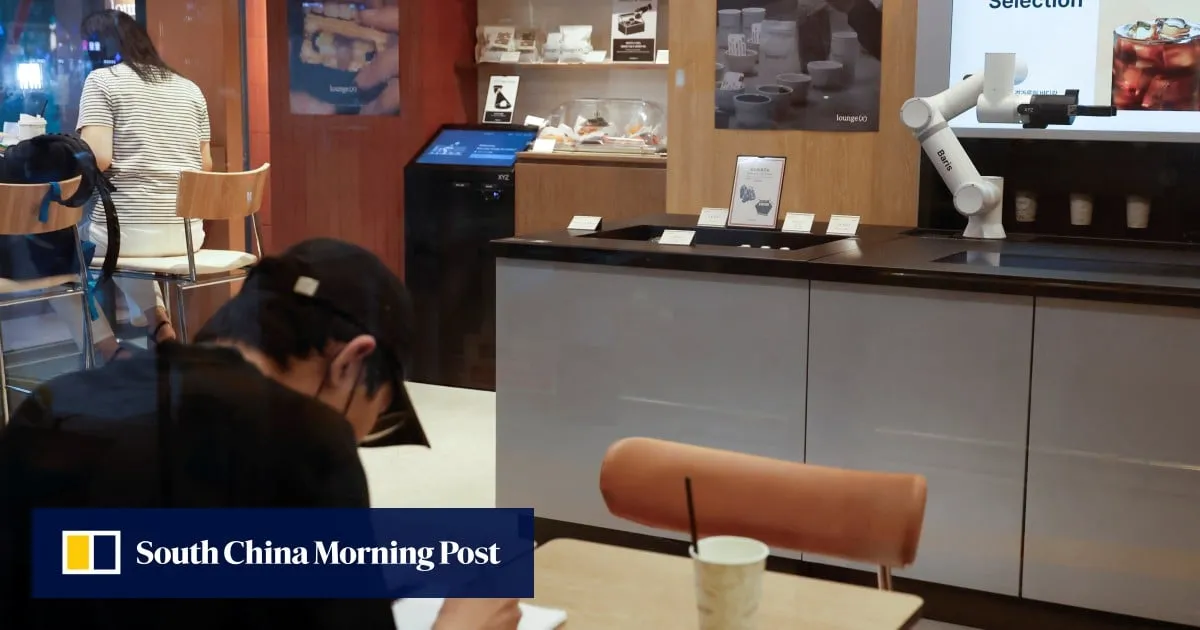
Unstaffed coffee shops, ramen eateries and flower outlets are spreading across South Korea as owners turn to robots and self-service to overcome rising labour costs in a business model that relies on the widespread honesty of users.Such stores, usually open 24 hours, were estimated to number 9,000 nationwide by the end of 2024, the National Fire Agency said, while payments provider Samsung Card said their number probably grew four times by 2025 from 2020.“The population of baristas in their early twenties is drastically declining,” said Kim Dongjin, chief executive of Lounge X, where a robot arm named “Baris” serves paper cups of Americanos and matcha lattes to fill orders from on-site kiosks.His company runs eight such 24-hour coffee shops – entirely unstaffed – across South Korea, most of them in Seoul, the capital, although human employees prepare coffee drinks in four more.A robot arm prepares coffee at a cafe in Seoul. Photo: ReutersStores with no staff are not uncommon globally, with cashier-free grocers in countries such as Britain and the United States, but the concept has spread wider in South Korea to encompass even pet supply stores and clothing boutiques.Owners of such stores cite difficulties in finding suitable staff and rising wage costs as reasons for adopting the model – particularly as rates of petty crime are low in South Korea, where customers are generally rule abiding.
SRCSouth China Morning Post
LANGEN
LEANCenter-Right
WORDS227
ENT12
THU · 2026-07-02 · 02:36 GMTBRIEF NSR-2026-0702-89231
NSR-2026-0702-89231News Report·EN·Technology
Robots to the rescue as South Korea battles severe labour crunch
South Korea is experiencing a significant increase in unstaffed businesses, including coffee shops, ramen eateries, and flower outlets, as owners adopt robots and self-service to address a severe labor crunch. This trend is driven by rising labor costs and difficulties in finding suitable staff.
ReutersSouth China Morning PostFiled 2026-07-02 · 02:36 GMTLean · Center-RightRead · 1 min
South China Morning PostFIG 01
Reading time
1min
Word count
227words
Sources cited
3cited
Entities identified
12entities
Quality score
100%
§ 01
Briefing Summary
AI-generatedNEWSAR · AI
South Korea is experiencing a significant increase in unstaffed businesses, including coffee shops, ramen eateries, and flower outlets, as owners adopt robots and self-service to address a severe labor crunch. This trend is driven by rising labor costs and difficulties in finding suitable staff. These 24-hour stores, which rely on customer honesty, were estimated to reach 9,000 nationwide by the end of 2024, with their numbers potentially quadrupling by 2025 compared to 2020. Companies like Lounge X are deploying robot arms to serve customers, filling a void left by a declining population of young baristas. The spread of unstaffed stores beyond food services to areas like pet supplies and clothing boutiques highlights the widespread adoption of this model.
Confidence 0.90Sources 3Claims 5Entities 12
§ 02
Article analysis
Model · rule-basedFraming
Technology
Economic Impact
Tone
Measured
AI-assessed
CalmNeutralAlarmist
Factuality
0.70 / 1.00
Factual
LowHigh
Sources cited
3
Well sourced
FewMany
§ 03
Key claims
5 extracted01
Unstaffed coffee shops, ramen eateries, and flower outlets are spreading across South Korea.
factual
Confidence
1.00
02
Owners cite difficulties in finding suitable staff and rising wage costs as reasons for adopting the robot/self-service model.
factual
Confidence
0.90
03
The population of baristas in their early twenties is drastically declining.
quoteKim Dongjin (CEO of Lounge X)
Confidence
0.90
04
The number of unstaffed stores was estimated to be 9,000 nationwide by the end of 2024.
statisticNational Fire Agency
Confidence
0.90
05
The number of unstaffed stores probably grew four times by 2025 from 2020.
statisticSamsung Card
Confidence
0.80
§ 04
Full report
1 min read · 227 words§ 05
Entities
12 identifiedKey playerOppositionContextPositiveNeutralNegative
Organizations3
Locations4
§ 06
Keywords & salience
8 termslabour crunch
1.00
robotics
1.00
automation
0.90
self-service
0.80
south korea
0.70
rising labour costs
0.60
unstaffed stores
0.50
robot arm
0.40
§ 07
Topic connections
Interactive graph Network visualization showing 51 related topics
View Full Graph Person Organization Location Event|Click node to navigate|Edge numbers = shared articles