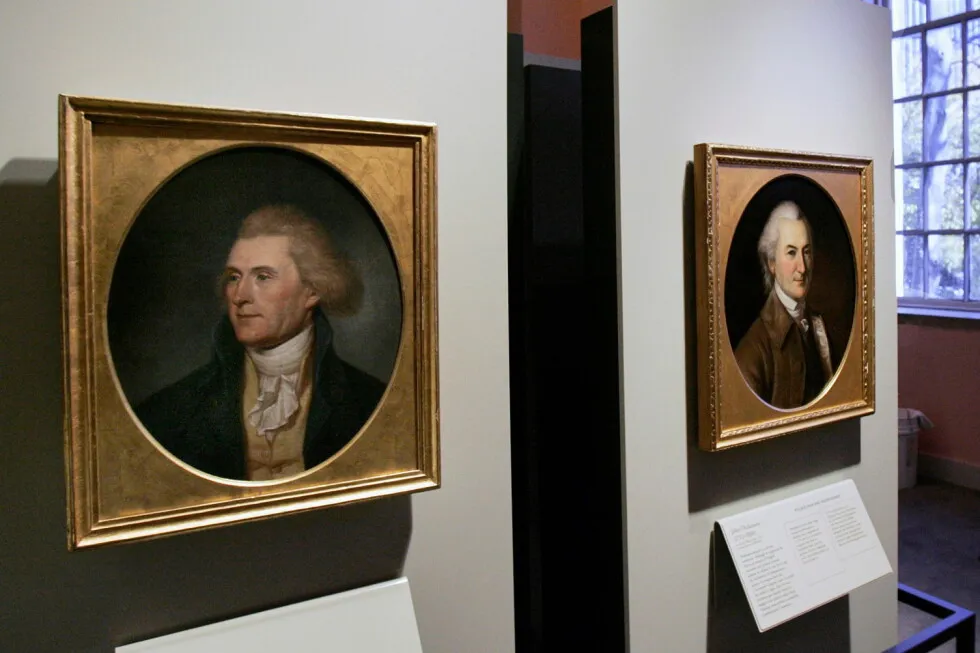
Portraits of a red-headed Thomas Jefferson, left, and John Dickinson, right, by by Charles Willson Peale are seen at the refurbished Second Bank of the United States in Philadelphia on Nov. 26, 2004. (AP Photo/Jacqueline Larma, File) 2026-07-02T04:02:51Z NEW YORK (AP) — For a quarter century, Jane Calvert has been on a mission shared by few scholars of the Revolutionary War era. She has championed a founder mostly remembered, when remembered at all, as the man who wouldn’t sign the Declaration of Independence — the lawyer and statesman John Dickinson. “It has been a constant struggle,” says Calvert, a former associate professor at the University of Kentucky who has written often about Dickinson and is the founder of the John Dickinson Writings Project, which aims to make his works widely available. For much of the country, the 250th anniversary of independence on Saturday is a time for celebrating and debating the country’s birth. But for Calvert and others, it’s also a moment to challenge the lingering image of a man who at times has been ignored, ridiculed or literally cast aside. He was the Revolution’s ‘penman’ Dickinson, a Maryland native who spent much of his life in Delaware and Pennsylvania, was once regarded as among the most important and inspiring founders. His “Letters from a Farmer in Pennsylvania,” a dozen missives published in the 1760s, were widely read attacks against Britain’s right to tax the colonies that helped give Americans a shared sense of identity and purpose. He even wrote the words to one of the country’s first patriotic anthems, “The Liberty Song.” Admirers would call him the “Penman of the Revolution.” But Dickinson also sought peace with Britain well after the first shots were fired at Lexington and Concord. In July 1775, he helped compose the Olive Branch Petition, a call for reconciliation that King George III essentially ignored. When the Continental Congress voted for independence in July 1776, Dickinson and fellow Pennsylvanian Robert Morris abstained. While Morris later signed the Declaration, Dickinson withheld his name. “He wasn’t opposed to independence per se, but he thought it should happen gradually and without bloodshed,” Calvert says. (
SRCAssociated Press (AP)
LANGEN
LEANCenter
WORDS357
ENT12
THU · 2026-07-02 · 04:23 GMTBRIEF NSR-2026-0702-89259
NSR-2026-0702-89259News Report·EN·Human Interest
The Declaration’s forgotten (non)signer: John Dickinson’s missing 1776 signature haunts his legacy
John Dickinson, a prominent lawyer and statesman during the American Revolution, is often remembered for his refusal to sign the Declaration of Independence. While recognized as the "Penman of the Revolution" for his influential writings against British taxation, Dickinson sought reconciliation with Britain and abstained from the vote for independence in July 1776, believing it should occur gradually and without bloodshed.
Associated Press (AP)Filed 2026-07-02 · 04:23 GMTLean · CenterRead · 2 min
Associated Press (AP)FIG 01
Reading time
2min
Word count
357words
Sources cited
1cited
Entities identified
12entities
Quality score
100%
§ 01
Briefing Summary
AI-generatedNEWSAR · AI
John Dickinson, a prominent lawyer and statesman during the American Revolution, is often remembered for his refusal to sign the Declaration of Independence. While recognized as the "Penman of the Revolution" for his influential writings against British taxation, Dickinson sought reconciliation with Britain and abstained from the vote for independence in July 1776, believing it should occur gradually and without bloodshed. Despite his later service in militias and contributions to the Articles of Confederation and the U.S. Constitution, his decision not to sign has historically overshadowed his other achievements. Scholars like Jane Calvert are working to challenge this lingering image and highlight Dickinson's principled stance and broader contributions to the founding of the United States.
Confidence 0.90Sources 1Claims 5Entities 12
§ 02
Article analysis
Model · rule-basedFraming
Human Interest
Political Strategy
Tone
Measured
AI-assessed
CalmNeutralAlarmist
Factuality
0.70 / 1.00
Factual
LowHigh
Sources cited
1
Limited
FewMany
§ 03
Key claims
5 extracted01
Jane Calvert has been on a mission for 25 years to champion John Dickinson.
quoteJane Calvert
Confidence
1.00
02
Dickinson and Robert Morris abstained when the Continental Congress voted for independence in July 1776.
factual
Confidence
0.95
03
Dickinson helped compose the Olive Branch Petition, a call for reconciliation with Britain.
factual
Confidence
0.95
04
Dickinson's "Letters from a Farmer in Pennsylvania" were widely read attacks against Britain's right to tax the colonies.
factual
Confidence
0.95
05
John Dickinson is primarily remembered as the man who wouldn't sign the Declaration of Independence.
factual
Confidence
0.90
§ 04
Full report
2 min read · 357 words§ 05
Entities
12 identifiedKey playerOppositionContextPositiveNeutralNegative
People5
Organizations1
Locations4
§ 06
Keywords & salience
9 termsjohn dickinson
1.00
declaration of independence
0.90
revolutionary war
0.80
founding fathers
0.70
american identity
0.60
reconciliation
0.50
taxation
0.50
olive branch petition
0.40
patriotic anthems
0.40
§ 07
Topic connections
Interactive graph No topic relationship data available yet. This graph will appear once topic relationships have been computed.