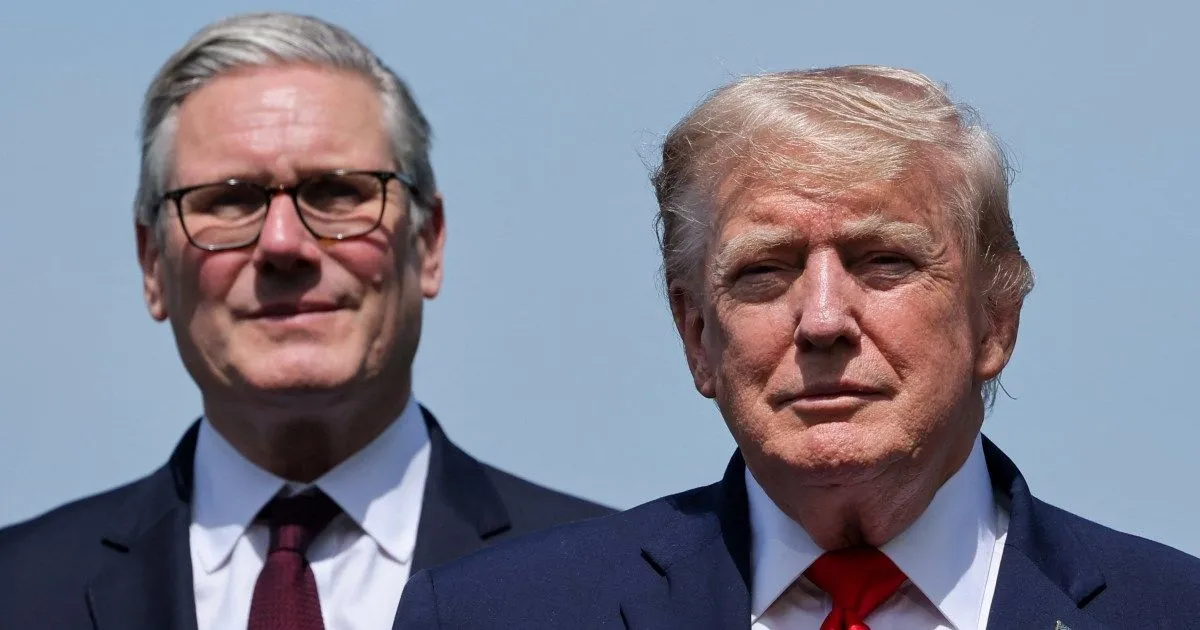
EXPLAINERResearch finds that Pharmaceutical trade deal requiring UK to buy more medicines from US takes away money from other parts of NHS, with deadly effects.US President Donald Trump, right, and British Prime Minister Keir Starmer attend the G7 summit in Evian-les-Bains, France, on June 16, 2026 [Christian Hartmann/Reuters]Published On 2 Jul 2026|Updated: an hour agoResearch published in the British Medical Journal (BMJ) has found that a United Kingdom-United States pharmaceutical deal could cause 229,000 Excess deaths as a result of the diversion of billions of pounds away from Britain’s National Health Service (NHS).In December, the UK and US signed a Pharmaceutical trade deal, under which the US government agreed not to impose tariffs on UK pharmaceutical and medical technology exports for the next three years.Recommended Stories list of 3 itemslist 1 of 3UK bill bans anyone born after 2008 from ever buying tobaccolist 2 of 3UK bans a generation of children from smoking: How it workslist 3 of 3How Iran war has triggered soaring cost of medicinesend of listIn return, the British government committed to increasing NHS spending on new US medicines from 0.3 percent in 2026 to at least 0.6 percent of its gross domestic product (GDP) by 2036. This means that medicine spending overall should increase from 10 percent to 12 percent of the NHS budget.UK politicians defended the deal with Science Minister Patrick Vallance saying in April that the arrangement gives patients across the NHS access to “life-changing new medicines that they previously would have been denied”.“Not only this, but as the first country in the world to benefit from a zero percent tariff on pharmaceuticals to the US, Britain’s life sciences sector will be further boosted,” Vallance argued.But the research published in the BMJ found that the commitment to spend so much more on new branded medicines over the next decade without any increase in NHS funding will “create substantial opportunity costs elsewhere, having a direct effect on population health”.Samuel Cross, a professor in the department of pharmacology and therapeutics at the University of Liverpool, who coauthored the report, said the agreement “benefits pharmaceutical companies and comes at a cost of NHS patients”.“There’s really no way to sugar-coat that. The numbers speak for themselves,” Cross told Al Jazeera.Tim Bierley, campaigner at the UK action group Global Justice Now, said: “This latest research adds to the overwhelming evidence that the Trump medicines deal risks taking a wrecking ball to our health and our economy.“Billions that could be spent on recruiting more NHS staff, cutting GP waiting times, or improving our hospital care are set to be siphoned off by corporate giants in the pharma industry.”Here’s what we know about the report, and what it means for health in the UK:What is in the US-UK deal?The agreement signed on December 1 was hailed as a landmark deal between British Prime Minister Keir Starmer and US President Donald Trump on pharmaceutical trade and pricing.The US agreed not to impose tariffs on UK pharmaceutical and medical exports for the following three years – until January 19, 2029.According to a policy paper published by the British government, the preliminary understanding of the agreement recognised that the US and UK shared a “mutual interest in developing a global medicines system that supports development and commercialisation of new innovations”.What has the research found?In February, Vallance disclosed that funding for the increased spending on medicines would come from the Department of Health and Social Care, which funds the NHS in England, rather than the Treasury.The study in the BMJ forecast that if spending targets are met and the economy grows as forecast by the Office for Budget Responsibility, the NHS would need to spend an extra 1.3 billion pounds ($1.73bn) a year by 2028 – about 25 million pounds ($33.4m) a week. By 2036, this would rise to an extra 8.8 billion pounds ($11.74bn) a year – about 170 million pounds ($227m) a week). Over the course of the agreement, that would add up to about 44.7 billion pounds ($59.7bn) by the end of 2036.“Costs are even higher if the impact on publicly funded adult social care is also considered – modelling of English local authority data indicates that every £1bn [$1.33bn] the NHS must find to fund this deal will increase the costs of adult social care by £118m [$157.5m] because of increases in morbidity and mortality,” the report found.Ultimately, the study predicted, Excess deaths are likely as a result.“Even if we restrict attention to the direct effect of reductions in available NHS expenditure, by 2036 this deal is likely to result in roughly 229,000 Excess deaths – more than during the COVID-19 pandemic between March 2020 and June 2022 (137,000). If the indirect effect on adult social care is also included, the increase in Excess deaths is even greater (291,000),” the report stated.The report added that the findings are “unsurprising” given the existing pressures on the NHS and the “large burden of unmet need in highly cost-effective areas of care”.It also referred to shortfalls in NHS funding and pharmaceutical pricing as “opportunity costs”.Cross said that in health economics, opportunity costs are the “key to all of this”.“In the NHS, we have a finite budget – we’re not made of money – and if you take money away to pay for, in this case, more medicines. then that comes at an opportunity cost of the places that the money has been diverted away from,” he explained.Which health sectors will be worst affected?The research predicted that the greatest number of deaths would occur in cardiovascular, respiratory, gastrointestinal and cancer patients.It added that there will also be broader harm caused to quality of life for patients in those sectors as well as “neurological, endocrine, musculoskeletal, and mental health problems”.“Despite this evidence and reassurances that ‘frontline services’ will be protected, the NHS will need to fund this deal from allocations made six months before the deal was agreed. The evidence suggests that if additional public expenditure was available, it could be more effectively deployed within the NHS itself,” it added.The report also called the government’s claims that the US-UK agreement would encourage pharmaceutical innovation in the country “uncertain”.“Pharmaceutical research and development operate within a global market, of which the UK represents a relatively small share. As such, there is limited evidence that UK domestic pricing materially influences global investment decisions,” the report stated.“Even so, evidence suggests in most cases the UK is already paying more than 100 percent of the long-term value of new medicines; incentivising production of new medicines under this deal will do long-term harm to the public health objective of the NHS,” it added.Cross added that because money has in effect been diverted away from the NHS, there is no way for the government to offset the impact on the service.“If the funds are used to pay for new medicines, we will lose positive health outcomes elsewhere, and that is as simple as that,” he said.He called for the government to release an impact assessment to trigger a public discussion about how good the US-UK deal really is for Britain.Bierley added: “Scandalously, this backroom deal was not subject to any scrutiny in Parliament before being rushed through – and the government refuses to say what impact it will have on the NHS. The next prime minister must change direction, stand up for our NHS, and unpick the mess left by their predecessors.”
SRCAl Jazeera
LANGEN
LEANCenter
WORDS1 229
ENT12
THU · 2026-07-02 · 10:22 GMTBRIEF NSR-2026-0702-89374
NSR-2026-0702-89374News Report·EN·Public Health
An extra 229,000 deaths: Is that the cost of US-UK drugs deal?
A recent study published in the British Medical Journal (BMJ) suggests a UK-US pharmaceutical trade deal, signed in December, could lead to an estimated 229,000 excess deaths. The agreement requires the UK to increase its spending on new US medicines from 0.3% to 0.6% of GDP by 2036, diverting billions of pounds from other NHS services.
Edna MohamedAl JazeeraFiled 2026-07-02 · 10:22 GMTLean · CenterRead · 5 min
Al JazeeraFIG 01
Reading time
5min
Word count
1 229words
Sources cited
3cited
Entities identified
12entities
Quality score
100%
§ 01
Briefing Summary
AI-generatedNEWSAR · AI
A recent study published in the British Medical Journal (BMJ) suggests a UK-US pharmaceutical trade deal, signed in December, could lead to an estimated 229,000 excess deaths. The agreement requires the UK to increase its spending on new US medicines from 0.3% to 0.6% of GDP by 2036, diverting billions of pounds from other NHS services. Researchers argue this commitment, without increased overall NHS funding, creates significant opportunity costs, impacting population health. While UK politicians defended the deal as providing access to life-changing medicines and boosting the life sciences sector, the BMJ research indicates it benefits pharmaceutical companies at the expense of NHS patients and could lead to substantial increases in adult social care costs due to rising morbidity and mortality.
Confidence 0.90Sources 3Claims 5Entities 12
§ 02
Article analysis
Model · rule-basedFraming
Public Health
Economic Impact
Tone
Mixed Tone
AI-assessed
CalmNeutralAlarmist
Factuality
0.70 / 1.00
Factual
LowHigh
Sources cited
3
Well sourced
FewMany
§ 03
Key claims
5 extracted01
The deal requires the UK to increase NHS spending on new US medicines from 0.3% to at least 0.6% of GDP by 2036.
factualUK government
Confidence
0.95
02
A UK-US pharmaceutical trade deal could cause 229,000 excess deaths due to diversion of funds from the NHS.
statisticBMJ research
Confidence
0.90
03
The agreement benefits pharmaceutical companies at the cost of NHS patients.
quoteSamuel Cross
Confidence
0.85
04
Billions could be diverted from NHS staff recruitment, waiting times, and hospital care to the pharma industry.
quoteTim Bierley
Confidence
0.80
05
The deal gives UK patients access to life-changing new medicines they would have otherwise been denied.
quotePatrick Vallance
Confidence
0.75
§ 04
Full report
5 min read · 1 229 words§ 05
Entities
12 identifiedKey playerOppositionContextPositiveNeutralNegative
People3
Organizations3
§ 06
Keywords & salience
9 termsnhs spending
1.00
pharmaceutical trade deal
1.00
excess deaths
0.90
opportunity costs
0.80
national health service
0.70
us-uk relations
0.60
drug costs
0.50
pharmaceutical companies
0.50
population health
0.40
§ 07
Topic connections
Interactive graph Network visualization showing 51 related topics
View Full Graph Person Organization Location Event|Click node to navigate|Edge numbers = shared articles