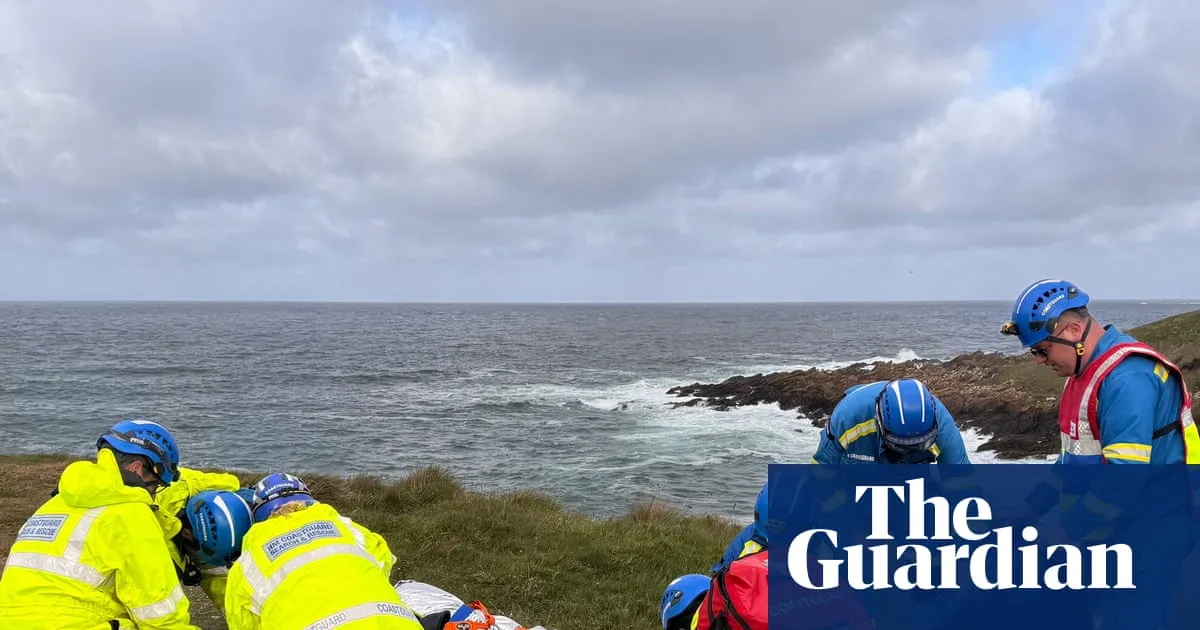
A government minister and a senior official have been accused of misleading MPs over their plans to strip Coastguard officers of their hourly pay.Keir Mather, the maritime minister, was said to have made false claims on Wednesday, while Virginia McVea, the chief executive of the Maritime and Coastguard Agency (MCA), was accused of having done so during a meeting with MPs a week earlier.The claims come as a row over government plans to stop paying coastguards intensifies. On Wednesday, Coastguard officers gathered in Westminster, saying they were “deeply saddened” and calling for a pause to allow negotiations, while MPs questioned Mather in a Westminster-hall" class="entity-link entity-location" data-entity-id="85386" data-entity-type="location">Westminster Hall debate.Officials came up with the scheme after the Court of Appeal confirmed in January that people who have been serving as Coastguard rescue officers (CROs) have been doing so as workers, not volunteers. Lord Justice Bean said this was, in part, because they are paid for their time when on callouts.Rather than recognise their worker status, the Maritime and Coastguard Agency (MCA) has chosen to stop the payments from September, with the aim of being able to begin legally classing CROs as volunteers.The Conservative MP for Isle of Wight East Joe Robertson accused Mather of misleading MPs when he told them the judgment had “changed the legal status of CROs”.He said: “The government and MCA must stop peddling this line,” adding: “It is simply not true and the minister should know better. The court simply found that CROs are already workers, which is hardly surprising considering they get hourly pay and payslips.“The very fact the MCA is working through backdated tax liabilities and backdated pay is an admission that CROs have been workers for some time and the MCA has been in breach of certain obligations. It is the MCA which has now decided to change the CRO’s worker status since the court’s judgment.”The MCA initially claimed its changes were a “mandated consequence” of the judgment. However, it acknowledged on 19 June the “ruling did not specify any specific model the MCA should use”.Nevertheless, McVea was accused of telling a meeting of MPs five days later the judge’s ruling had left the MCA with no choice.“It was a stormy meeting. The MCA were defensive and the MPs were angry on behalf of their volunteers,” said Torcuil Crichton, the Labour MP for Na h-Eileanan an Iar (Western Isles). “That’s not a formula for resolution.”After the talks, the Liberal Democrat MP for Orkney and Shetland Alistair Carmichael said McVea had “tried to mislead MPs”.The MCA did not dispute the accuracy of the account of McVea’s comments, and declined to comment when asked why she appeared to repeat claims her agency had already acknowledged were false.“She seemed to be blaming the Court of Appeal ... All the Court of Appeal decided was that these heroes are workers,” Robertson said.He added that McVea then shifted to claiming “Coastguard rescue officers wanted this”, saying she told MPs the MCA had “done a survey”, and citing a figure of 93% support – also terming it “above 90%” at another point during the meeting.Results of a survey of CROs, seen by the Guardian and not disputed by the MCA, showed no attempt to directly gauge the level of CROs’ support for either the volunteer or the worker model. Instead, CROs were asked how each model would affect their availability.The results suggested the MCA had included people who said they would become less able to respond to calls if they were volunteers, as well as those who replied “other”, among those it told MPs supported the change to a volunteer model. The agency said “survey findings were considered alongside a range of operational, legal, and practical factors”. But it refused to say how.Moreover, the survey results showed that if a similar calculation was applied to the MCA’s worker model, it would have attracted greater support than the agency claimed the volunteer model did. This viewpoint was not presented to MPs, nor did the worker model form part of MCA policy.The MCA has also claimed it would have had to introduce “formal employment requirements and constraints” if it had tried to preserve CROs’ worker status. It has sought to compare that unfavourably with the “flexibility” it says the volunteer model provides – and that Coastguard officers value highly.But, according to the leading employment lawyer, Nigel Mackay, it would have been within the MCA’s power to preserve worker status and flexibility.Mackay, a partner at Leigh Day, said besides increasing the hourly remuneration to meet the minimum wage threshold and including holiday pay, there were few extra requirements the MCA would have been legally bound to introduce. “Effectively, [worker status] is just slightly more expensive,” he said.An MCA spokesperson said: “The Court of Appeal ruling meant we had to change the way the coastguard currently operates. After careful consideration, we judged the volunteer model to be the best option to protect the future of the service, as it allows members more flexibility to continue to serve alongside their primary employment.“We deeply value and recognise the significant service Coastguard rescue officers provide along our coastline and we continue to engage with them throughout this transition.”The Department for Transport has been approached for comment.
SRCThe Guardian - World News
LANGEN
LEANCenter-Left
WORDS866
ENT12
THU · 2026-07-02 · 13:38 GMTBRIEF NSR-2026-0702-89382
NSR-2026-0702-89382News Report·EN·Legal & Judicial
Minister and maritime boss accused of misleading MPs over plan to stop coastguard officers’ pay
Maritime Minister Keir Mather and Maritime and Coastguard Agency (MCA) chief executive Virginia McVea are accused of misleading MPs regarding plans to stop hourly pay for coastguard rescue officers (CROs). This follows a court of appeal ruling confirming CROs are workers, not volunteers, due to their payment for on-call time.
Kevin RawlinsonThe Guardian - World NewsFiled 2026-07-02 · 13:38 GMTLean · Center-LeftRead · 4 min
The Guardian - World NewsFIG 01
Reading time
4min
Word count
866words
Sources cited
5cited
Entities identified
12entities
Quality score
100%
§ 01
Briefing Summary
AI-generatedNEWSAR · AI
Maritime Minister Keir Mather and Maritime and Coastguard Agency (MCA) chief executive Virginia McVea are accused of misleading MPs regarding plans to stop hourly pay for coastguard rescue officers (CROs). This follows a court of appeal ruling confirming CROs are workers, not volunteers, due to their payment for on-call time. The MCA intends to cease payments from September to reclassify CROs as volunteers. MPs allege Mather falsely claimed the judgment changed CROs' legal status, while McVea is accused of telling MPs the ruling left the MCA with no choice. The MCA's survey data used to justify the volunteer model's support is also disputed, with claims that it misrepresented CROs' preferences. Legal experts suggest the MCA could have maintained worker status with minimal additional requirements.
Confidence 0.90Sources 5Claims 5Entities 12
§ 02
Article analysis
Model · rule-basedFraming
Legal & Judicial
Social Justice
Tone
Mixed Tone
AI-assessed
CalmNeutralAlarmist
Factuality
0.70 / 1.00
Factual
LowHigh
Sources cited
5
Well sourced
FewMany
§ 03
Key claims
5 extracted01
Joe Robertson MP accused Keir Mather of misleading MPs by stating the judgment had 'changed the legal status of CROs'.
quoteJoe Robertson MP
Confidence
1.00
02
The court of appeal confirmed in January that CROs have been serving as workers, not volunteers, partly because they are paid for their time when on callouts.
factualarticle
Confidence
0.95
03
The Maritime and Coastguard Agency (MCA) plans to stop hourly payments to coastguard rescue officers (CROs) from September to legally classify them as volunteers.
factualarticle
Confidence
0.95
04
Virginia McVea was accused by Alistair Carmichael MP of trying to mislead MPs about the MCA's choices following the court ruling.
quoteAlistair Carmichael MP
Confidence
0.90
05
A government minister and a senior official are accused of misleading MPs over plans to stop paying coastguard officers hourly.
factualarticle
Confidence
0.90
§ 04
Full report
4 min read · 866 words§ 05
Entities
12 identifiedKey playerOppositionContextPositiveNeutralNegative
People7
Organizations3
§ 06
Keywords & salience
8 termscoastguard officers
1.00
hourly pay
0.90
maritime and coastguard agency
0.90
misleading mps
0.80
worker status
0.70
court of appeal
0.60
government plans
0.50
legal status
0.40
§ 07
Topic connections
Interactive graph Network visualization showing 16 related topics
View Full Graph Person Organization Location Event|Click node to navigate|Edge numbers = shared articles