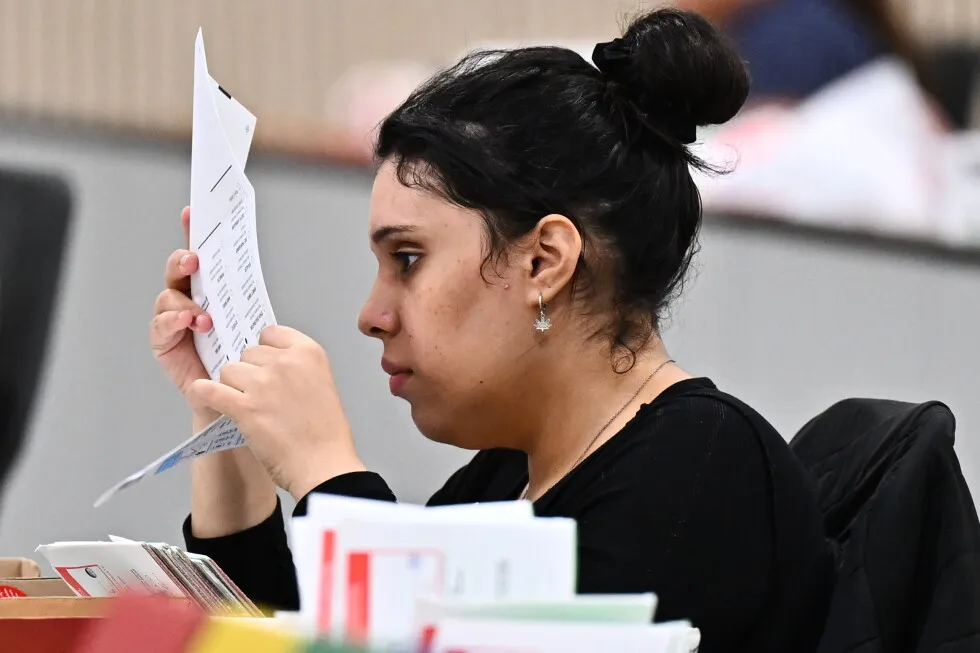
Goal of higher voter turnout remains elusive in California as changes have extended ballot counting 1 of 5 | A worker inspects a ballot at the L.A. County Ballot Processing Center during the California-primary-election" class="entity-link entity-event" data-entity-id="139945" data-entity-type="event">California primary election on Tuesday, June 2, 2026, in City of Industry, Calif. (AP Photo/William Liang) 2 of 5 | Voters cast their ballots at a voting center on the UCLA campus on Tuesday, June 2, 2026, in Los Angeles. (AP Photo/Jae C. Hong) 3 of 5 | A worker sorts ballots at the L.A. County Ballot Processing Center during the California-primary-election" class="entity-link entity-event" data-entity-id="139945" data-entity-type="event">California primary election on Tuesday, June 2, 2026, in City of Industry, Calif. (AP Photo/William Liang) 4 of 5 | A ballot is inspected at a ballot processing center during the California-primary-election" class="entity-link entity-event" data-entity-id="139945" data-entity-type="event">California primary election on Tuesday, June 2, 2026, in Sacramento, Calif.. (AP Photo/Rich Pedroncelli) 5 of 5 | California Republican gubernatorial candidate Steve Hilton holds a newspaper while speaking at a news conference at the San Mateo County elections office Friday, June 5, 2026, in San Mateo, Calif. (AP Photo/Jeff Chiu) By MICHAEL R. BLOOD Updated 4:02 PM MESZ, July 2, 2026 Add AP News on Google Add AP News as your preferred source to see more of our stories on Google. Share Share Facebook Copy Link copied Print Email X LinkedIn Bluesky Flipboard Pinterest Reddit Los Angeles (AP) — California is finally nearing the end of the ballot counting from its June 2 primary, a tediously slow process that is largely the result of multiple changes over the years intended to boost turnout by making voting easier and more accessible. State data and experts who study voting trends suggest those efforts have made no significant improvement in participation, even as California’s drawn-out tabulating has put it in the crosshairs of President Donald Trump and made it a target of those who promote unfounded election conspiracy theories. Turnout hit 40.8% in the June primary, according to preliminary figures from the secretary of state’s office, with counties required to complete their counting by Thursday. While that was an increase over the previous two primary elections, it was below participation levels in several other primaries stretching back to 2000 and nowhere near participation in the 1970s, when primary turnout sometimes topped 70%. Wide gaps also remain in participation by younger voters and voters of color, according to the Center for Inclusive Democracy, a nonpartisan research group. The state’s most consistent voters remain older, white, more affluent homeowners. ‘Awesome.’ ‘Sad.’ ‘Let’s keep democracy going.’ Americans weigh in on state of a 250-year-old nation 5 MIN READ Albanian police use tear gas and pepper spray as Tirana protest turns violent 2 MIN READ The Supreme Court tackled race, history and the law in fraught and reflective major rulings 5 MIN READ The state appears to have seen only incremental progress from its voting changes over the past decade or more, said the center’s director, Mindy Romero. “We haven’t seen significant jumps in turnout,” she said. “We still have very significant disparity in turnout with race and ethnicity. The numbers don’t lie.” Extensive changes have mostly led to longer vote counting Over the years, heavily Democratic California has ushered in a series of changes aimed at driving up voter participation. Those changes have sometimes come with a price, lengthening the time it takes to count ballots. Each envelope containing a mail ballot must match the signature on file, and that takes time. If a signature does not match, election officials are required to give those voters a chance to come in and prove their identity so the ballot will count, further delaying a final tally. In that sense, California’s unusually long vote tally is the result of its own doing. In a report released last month, the nonpartisan California Voter Foundation found that the percentage of California’s ballots counted within two days of Election Day has generally declined over time, from 81% in 2004 to 66% in 2024. That period loosely tracked a steady expansion of mail voting in the state. In a special statewide election last year, nearly 9 of every 10 voters used a mail ballot. Florida, Texas and other big states quickly wrap up vote counting. California is a national laggard, with the outcome in close races sometimes taking weeks to decide. While election officials insist they are focused on accuracy, the extended tabulating period has opened the door for candidates who see their lead slip away to suggest something nefarious is at work. After the June primary, Trump seized on California’s reputation as the national slowpoke in vote counting to renew his long-standing criticism of the state’s elections, while the Republican’s Department of Justice launched an investigation into Los Angeles County’s elections. Even Democratic Gov. Gavin Newsom’s office has lamented the glacial pace of counting. The state’s newly enacted budget includes $29 million to help speed up the state’s long count. “We wish the votes were counted faster, too,” Newsom’s press office wrote on the social platform X last month. Turnout hardly budged after California passed a major participation law One of the most prominent changes came in 2016, with the passage of what was called the Voter’s Choice Act. It was intended to make voting more convenient and increase turnout, especially among younger voters of color. The law set a path toward statewide vote-by-mail and, in some counties, replaced traditional neighborhood polling places with community voting centers and ballot drop boxes. The goal was to free voters from being tied to a single polling location or day. It does not appear the law has had the intended impact. Elections two decades apart give a stark illustration: Turnout for the 2024 presidential election in California was 71%, 5 percentage points lower than turnout for the 2004 presidential election. The 2022 midterms turnout was 51%, the same rate as the midterm election 20 years earlier. A 2025 study by the nonpartisan Public Policy Institute of California concluded that “turnout did not consistently improve or worsen for any racial or ethnic group.” “The effects of the (act) have generally fallen short of the reform’s original goal of a larger and more representative electorate,” the study said. In separate 2025 research, the institute found that whites make up 36% of California’s adult population but comprise 50% of the state’s likely voters. Latinos make up 38% of the adult population but 29% of likely voters. Black residents make up 5% of adults and 4% of likely voters. “You can’t definitely, clearly say the (act) had an overall, positive impact on turnout,” said Romero, the voting researcher, who added that more study was needed. Legislative changes can go only so far to boost turnout There appears to be an emerging consensus that more needs to be done to connect with and motivate infrequent voters, many of them people of color who are often overlooked by campaigns. U.S. Sen. Alex Padilla, a Democrat who was the state’s chief elections officer when the Voter’s Choice Act was signed by Democratic Gov. Jerry Brown, said in a statement that while the state is a leader in voting access “candidates and political parties must do more to motivate voters to get out and vote.” Kim Alexander, president of the California Voter Foundation, said part of California’s challenge is simply contending with the scale of voting. California has 23 million-plus registered voters, more than any other state. That number has increased steadily over two decades, even as turnout has not jumped significantly. The state has at least made gains registering new voters — nearly 85% of eligible voters are registered, compared with 70% two decades ago. That also means more votes to count, another challenge to the timeliness of results. The state has about 7.5 million more voters than it did in 2006. Alexander said a voter’s decision to turn in a ballot can turn on multiple considerations. Primary elections can be seen as optional, with the general election coming in the fall. Even California’s notoriously complex ballots with dozens of races overlapping with state and local ballot initiatives can be a turnoff, she said, overwhelming some would-be voters. Despite all the state’s changes, how people vote can be less important than what motivates them to vote. “The public’s level of trust in government and institutions, who and what’s on the ballot and how well-financed their get-out-the-vote campaigns are, have a much greater impact on voter participation than the election model used,” said Bob Page, Orange County’s registrar of voters. MICHAEL R. BLOOD Blood is a political writer for The AP. Over the years he has filed stories under datelines from Wasilla, Alaska, to Tel Aviv, but he has spent most of his career anchored in AP bureaus in Washington, D.C., New York City and - for the last two decades - Los Angeles. twitter mailto
SRCAssociated Press (AP)
LANGEN
LEANCenter
WORDS1 470
ENT12
THU · 2026-07-02 · 14:23 GMTBRIEF NSR-2026-0702-89428
NSR-2026-0702-89428News Report·EN·Political Strategy
Goal of higher voter turnout remains elusive in California as changes have extended ballot counting
California's efforts to increase voter turnout through easier voting access have resulted in significantly longer ballot counting periods, without a substantial boost in participation. Preliminary figures show the June primary turnout at 40.8%, an increase from recent primaries but below historical levels and still showing disparities by age and race.
Associated Press (AP)Filed 2026-07-02 · 14:23 GMTLean · CenterRead · 6 min
Associated Press (AP)FIG 01
Reading time
6min
Word count
1 470words
Sources cited
2cited
Entities identified
12entities
Quality score
100%
§ 01
Briefing Summary
AI-generatedNEWSAR · AI
California's efforts to increase voter turnout through easier voting access have resulted in significantly longer ballot counting periods, without a substantial boost in participation. Preliminary figures show the June primary turnout at 40.8%, an increase from recent primaries but below historical levels and still showing disparities by age and race. Changes like universal mail-in ballots and extended counting windows, intended to make voting more accessible, mean ballots postmarked by Election Day can arrive up to seven days later and still be counted. This extended process, which requires signature verification and opportunities for voters to resolve discrepancies, leads to California being a national laggard in vote tabulation. Despite these efforts, consistent voters remain older, white, and more affluent, and the state has allocated $29 million to expedite the counting process.
Confidence 0.90Sources 2Claims 5Entities 12
§ 02
Article analysis
Model · rule-basedFraming
Political Strategy
Social Justice
Tone
Measured
AI-assessed
CalmNeutralAlarmist
Factuality
0.80 / 1.00
Factual
LowHigh
Sources cited
2
Limited
FewMany
§ 03
Key claims
5 extracted01
California's June primary turnout was 40.8%, an increase over the previous two primaries but below levels in other primaries since 2000 and far from 1970s levels.
statisticsecretary of state's office
Confidence
1.00
02
The state's most consistent voters are older, white, more affluent homeowners.
factualCenter for Inclusive Democracy
Confidence
0.95
03
Wide participation gaps persist among younger voters and voters of color in California.
factualCenter for Inclusive Democracy
Confidence
0.95
04
California's efforts to boost voter turnout through easier voting access have not significantly improved participation.
factual
Confidence
0.90
05
California's drawn-out ballot tabulation process has made it a target for election conspiracy theories.
factual
Confidence
0.85
§ 04
Full report
6 min read · 1 470 words§ 05
Entities
12 identifiedKey playerOppositionContextPositiveNeutralNegative
Organizations2
Locations6
§ 06
Keywords & salience
8 termsvoter turnout
1.00
ballot counting
0.90
california primary election
0.80
voting accessibility
0.70
election conspiracy theories
0.60
participation levels
0.50
younger voters
0.40
voters of color
0.40
§ 07
Topic connections
Interactive graph Network visualization showing 51 related topics
View Full Graph Person Organization Location Event|Click node to navigate|Edge numbers = shared articles