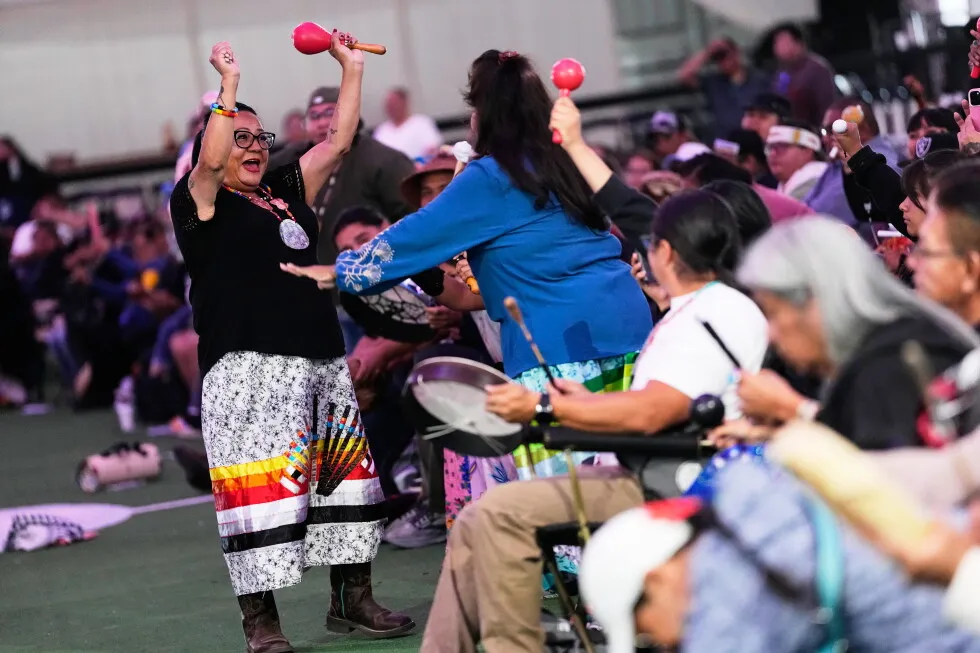
Puyallup Tribe and Canada" class="entity-link entity-organization" data-entity-id="157545" data-entity-type="organization">First Nations in Canada hope World Cup partnerships raise cultural awareness 1 of 5 | Christina Lomaintewa, facing, celebrates with Angie Lucero after their team won a “material game,” a stick game played for objects, before a Stick-Games Tournament hosted by the Puyallup Tribe in partnership with World Cup host city Seattle, Saturday, June 27, 2026, in Tacoma, Wash. (AP Photo/Lindsey Wasson) 2 of 5 | Councillor Charlene Roberds of the Penticton Indian Band holds sticks while explaining the rules of stick-games before a Stick-Games Tournament hosted by the Puyallup Tribe in partnership with World Cup host city Seattle, Saturday, June 27, 2026, in Tacoma, Wash. (AP Photo/Lindsey Wasson) 3 of 5 | A Seattle World Cup host city logo and a Puyallup logo are seen on a large screen before a Stick-Games Tournament hosted by the Puyallup Tribe in partnership with World Cup host city Seattle, Saturday, June 27, 2026, in Tacoma, Wash. (AP Photo/Lindsey Wasson) 4 of 5 | Yangbin Wu, center, greets the opposing team after his won in the first round during a Stick-Games Tournament hosted by the Puyallup Tribe in partnership with World Cup host city Seattle, Saturday, June 27, 2026, in Tacoma, Wash. (AP Photo/Lindsey Wasson) 5 of 5 | A large bracket is shown behind emcee Andre Picard Jr., of the Nez Perce Tribe, during a Stick-Games Tournament hosted by the Puyallup Tribe in partnership with World Cup host city Seattle, Saturday, June 27, 2026, in Tacoma, Wash. (AP Photo/Lindsey Wasson) By HALLIE GOLDEN Updated 7:31 PM MESZ, July 2, 2026 Add AP News on Google Add AP News as your preferred source to see more of our stories on Google. Share Share Facebook Copy Link copied Print Email X LinkedIn Bluesky Flipboard Pinterest Reddit Tacoma, Wash. (AP) — Yangbin Wu shook his fists in rhythm with the thunderous drumming and singing, his face furrowed in concentration, as he held two “bones” in his hands. His opponents in an Indigenous game of guessing, strategy and spirituality pointed to the left. Wrong guess. Wu opened his hands and grinned widely, knowing he scored for his team. The hundreds vying for cash prizes in the Puyallup Tribe of Indians’ Stick-Games Tournament wouldn’t be there if not for another game playing out on a much bigger stage in nearby Seattle and other parts of the U.S., Mexico and Canada: the World Cup. The rare partnership is giving the tribe an opportunity to introduce its language, history, culture that the federal government once tried to eradicate to soccer fans around the world. “It’s pretty cool, with the music and the chanting, it’s like a full sensory experience,” said Wu, a Seattle resident who works in landscaping. The tribe became the first Indigenous group to partner with a World Cup host city after announcing the agreement in 2023, organizers said. Canada" class="entity-link entity-organization" data-entity-id="157545" data-entity-type="organization">First Nations in Canada announced similar partnerships with Vancouver earlier this year, including Musqueam Indian Band, Squamish Nation and Tsleil-Waututh Nation. StubHub sued by fans who say ticket cancellations crushed dreams of going to World Cup 3 MIN READ Germany coach Julian Nagelsmann in firing line at home after early World Cup exit 2 MIN READ Soft-spoken Malik Tillman delivers a loud statement with his bloody sock goal at the World Cup 3 MIN READ Fans have been invited to the tribe’s reservation, which spans about 28 square miles (72.5 square kilometers) south of Seattle, to witness a traditional cultural gathering of dancing and singing that has historically been a part of coastal tribes visiting one another by canoe. A powwow dance displayed colorful regalia in celebration of broader Native American culture. Puyallup also held popular World Cup watch parties. “It means a lot for us to share who we are to the world,” said Connie McCloud, a tribal elder and the heritage division manager. “People learn about Native people from movies and TVs.” But, she said, that “doesn’t represent the people from Puyallup right here in the Pacific Northwest.” The stick games last weekend were a test of endurance that, according to Puyallup’s creation story, determined whether humans or animals ruled over one another. In June, the Puyallup Tribe held a World Cup parade. Those who attended the first match in Seattle saw tribal Chairman Bill Sterud do the coin toss in a game that ended in a 1-1 draw between Belgium and Egypt. Fans have also learned the games are being played on the shared ancestral lands of the many tribes of the Puget Sound Villages in a land acknowledgment broadcast on screen. Tribal members taught fans about wood carving and weaving at the stadium. A World Cup app with games and challenges awards points for visiting the tribe, along with other places, and incorporates the Puyallup language, Lushootseed. In one part of the app, fans have to repeat back “yəhaw”,” which means “let’s go, let’s proceed,” said Amy McFarland, the tribe’s project director for the World Cup. “You can see people walking down the street, saying ”'yəhaw! yəhaw,’” she said. The reservation, which lies along the Puget Sound, blends in with Tacoma, along with several smaller communities. The tribe with some 5,000 members has become a major employer in the county with businesses that include the Emerald Queen Casino. The tribe was also a major player in winning a landmark case in 1974 that affirmed the treaty rights of Northwest tribes to harvest fish. “We’re not surviving, we are thriving,” McFarland said. The tribe’s connection to the World Cup came indirectly from a longtime partnership with Major League Soccer’s Seattle Sounders. The team’s former president of business operations, Peter Tomozawa, later became the CEO of Seattle World Cup 2026. He started brainstorming with the tribe about how to work together for the event that has packed the city with fans. The World Cup ends July 19. Across Washington state, visitors already see cities and waterways named for tribes, signage in Native languages and collections of Indigenous art and businesses. But the new partnership bolstered that visibility for Puyallup. “This is the biggest spotlight that is shining on our region in a very long time. And who gets included in that, who gets highlighted I think is a really important question,” said Leo Flor, chief legacy officer at Seattle’s Local Organizing Committee for FIFA World Cup 2026. “I think our region has answered that in a really important way.” While the tribe is a sponsor for the World Cup Seattle, neither Flor nor the tribe would say what Puyallup contributed financially. Sterud, the tribal chairman, said he’s hopeful economic opportunities arise out of the newfound visibility. The reservation is on the Port of Tacoma, one of the largest container ports in the U.S. “Going into possibly international trade is what we’ve been geared up for,” he said. “We’re developing contacts with these different countries and different organizations to move forward in that respect for economic development.” Josiah Devine Johnson saw ads for the tribe’s World Cup events on buses in Tacoma and decided to check out the Stick-Games Tournament. He tried a “rez burger,” made of fry bread and a burger patty. On the sidelines of the game, he sought to understand its intricacy. The goal is to win all of the sticks by guessing where the unmarked “bones” are hidden in the opposing team members’ hands. “I think that’s incredible, to have their own sport, to be showing that off in combination with what’s going on with the World Cup,” said Devine Johnson, who arrived via shuttle. “I see soccer on TV, but you don’t see this. It felt like something I couldn’t miss.” As Puyallup opens the game to the outside world, one part that won’t be on display is the spiritual aspect, said Puyallup Tribal Council member Amber Hayward. Other tribes have versions of the game as well, used to settle disputes and more commonly played for fun now. Crowds of mostly Indigenous visitors, some from as far away as Canada, Montana and Utah, squared off Saturday in groups across two large tents. Outside, visitors milled around booths with vendors selling intricately beaded earrings and tribal sweatshirts, while children played on bouncy houses and a soccer field. The sun went down, and the game was still going early Sunday. Wu’s team won its first three games, going further than he expected, but then lost two more and was eliminated. “I didn’t think we’d make it out of the first round,” he said. ___ This story is published through the Global Indigenous Reporting Network at The Associated Press.
SRCAssociated Press (AP)
LANGEN
LEANCenter
WORDS1 427
ENT12
THU · 2026-07-02 · 17:53 GMTBRIEF NSR-2026-0702-89460
NSR-2026-0702-89460News Report·EN·Human Interest
Puyallup Tribe and First Nations in Canada hope World Cup partnerships raise cultural awareness
The Puyallup Tribe and First Nations in Canada are partnering with World Cup host cities to increase cultural awareness. The Puyallup Tribe became the first Indigenous group to partner with a World Cup host city, Seattle, in 2023, while First Nations in Vancouver announced similar agreements.
Associated Press (AP)Filed 2026-07-02 · 17:53 GMTLean · CenterRead · 6 min
Associated Press (AP)FIG 01
Reading time
6min
Word count
1 427words
Sources cited
1cited
Entities identified
12entities
Quality score
100%
§ 01
Briefing Summary
AI-generatedNEWSAR · AI
The Puyallup Tribe and First Nations in Canada are partnering with World Cup host cities to increase cultural awareness. The Puyallup Tribe became the first Indigenous group to partner with a World Cup host city, Seattle, in 2023, while First Nations in Vancouver announced similar agreements. These partnerships aim to introduce Indigenous languages, history, and culture to global soccer fans through events like stick-games tournaments, traditional gatherings, and stadium activities. The initiative seeks to provide a more authentic representation of Native people beyond media portrayals. Tribal elders emphasize the importance of sharing their culture, and the tribe hopes these collaborations will foster economic development and international trade opportunities.
Confidence 0.90Sources 1Claims 5Entities 12
§ 02
Article analysis
Model · rule-basedFraming
Human Interest
Social Justice
Tone
Measured
AI-assessed
CalmNeutralAlarmist
Factuality
0.80 / 1.00
Factual
LowHigh
Sources cited
1
Limited
FewMany
§ 03
Key claims
5 extracted01
Yangbin Wu participated in a Stick-Games Tournament where hundreds vied for cash prizes.
factualarticle
Confidence
1.00
02
The Puyallup Tribe hosted a Stick-Games Tournament in partnership with World Cup host city Seattle.
factualarticle
Confidence
1.00
03
The partnerships aim to raise cultural awareness about Indigenous languages, history, and culture.
factualarticle
Confidence
1.00
04
First Nations in Canada, including Musqueam Indian Band, Squamish Nation, and Tsleil-Waututh Nation, announced similar partnerships with Vancouver.
factualarticle
Confidence
1.00
05
The Puyallup Tribe partnered with World Cup host city Seattle, becoming the first Indigenous group to do so.
factualorganizers
Confidence
1.00
§ 04
Full report
6 min read · 1 427 words§ 05
Entities
12 identifiedKey playerOppositionContextPositiveNeutralNegative
Organizations4
Locations5
§ 06
Keywords & salience
9 termsworld cup
1.00
puyallup tribe
1.00
cultural awareness
0.90
first nations
0.80
stick-games tournament
0.80
indigenous game
0.70
partnerships
0.60
seattle
0.50
cultural heritage
0.40
§ 07
Topic connections
Interactive graph No topic relationship data available yet. This graph will appear once topic relationships have been computed.