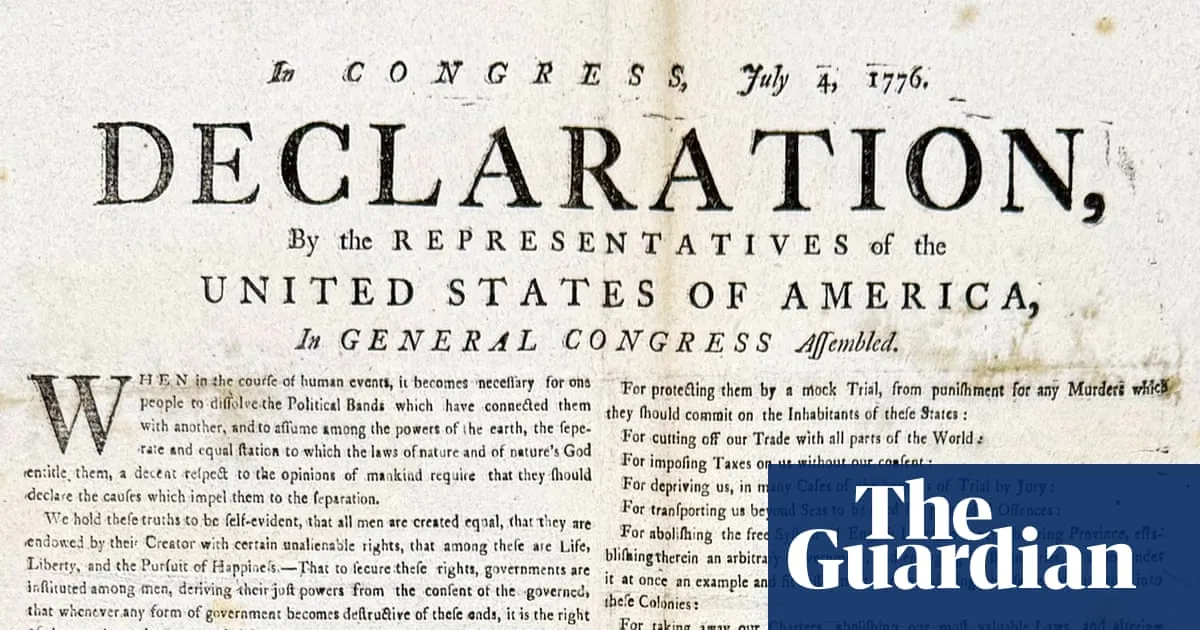
For Michael Scurr, a volunteer at the National Archives in Kew, west London, it was “just a boring old Thursday morning” when he sat down in late May to catalogue a collection of documents from the British national collection that had never previously been recorded in detail.As he opened a volume of 18th-century Royal Navy correspondence, however, Scurr unfolded a document whose opening words he recognised. “In Congress, July 4, 1776. A declaration by the representatives of the United States of America …”What Scurr had found was a “vanishingly rare” copy of an early printing of the US Declaration of Independence, just weeks before this weekend’s 250th anniversary of its signing. He turned to his supervisor, who was sitting opposite, and said: “I think you should come and have a look at this.” It was, he said, “a really thrilling moment”.The document is a copy of the so-called Exeter printing of the declaration, one of just 11 copies to survive and the only one known outside the US. What makes it particularly remarkable, according to Graham Moore, a records specialist at the National Archives, is the “amazingly complete story” of how it came to be in the possession of the Royal Navy, and what that says about how news of the declaration spread as the new nation sought to assert its autonomy.The paper was printed in Exeter, New Hampshire, between 16 and 19 July 1776. Photograph: The National ArchivesThe document was discovered among a collection of papers taken from an American privateer vessel called the Dalton, after it was captured by a British warship off the coast of Spain in December 1776. Though other significant papers were passed on to the Admiralty Court – including the privately owned ship’s commission, personally signed by the Continental Congress president, John Hancock, to attack British vessels on behalf of the fledgling US – the declaration was not. Instead, it would be recorded only as “another document” and forgotten for more than two centuries in the naval archives.The modest sheet of paper was printed in Exeter, New Hampshire, between 16 and 19 July – the time taken for news to spread of the bold declaration first signed in Philadelphia on 4 July. These “broadsides”, like those rattled off by printers in other major cities, “were designed to be printed quickly, distributed fast, and read and consumed by as many people as possible in as short a time as possible,” said Moore. “This is about news in 1776.”Though the Dalton did not dock in Exeter, Moore said it was likely that Eleazer Johnson, the ship’s captain, had bought a copy of the declaration in nearby Portsmouth, New Hampshire, where the ship briefly stopped to pick up more crew.Johnson was a committed American: after his capture, he declared to a court in Plymouth, UK, that he was a citizen of the United States of America, still considered a treasonous statement by the crown. Amanda Bevan, the head of legal records, said she liked to imagine the captain had read the document aloud on deck. “I have this nice image of Eleazar Johnson on the ship … potentially reading out the Declaration of Independence to his 120-man crew of diverse nations to say: ‘This is why we’re doing it, this is why we’re putting our lives at risk, this is why we’re heading out into the ocean to take our chances again.’”American privateer ships had been commissioned by Congress “to attack, seize and take the ships and other vessels belonging to the inhabitants of Great-Britain”; in fact, the Dalton itself was the first American privateer to be captured in European waters.Thanks to other documents in the national collection and elsewhere, we know what happened next – including from the published diary of one of the sailors, Charles Herbert, available online. The crew of 120 men – English, Irish, Scottish, French and Danish sailors as well as those declaring themselves American citizens – included one, Daniel Cottle, who is described in the muster book as being a black man. “This is not uncommon in North America,” said Moore. “It is likely by his role on this privateering ship that he is a free black man in 1776. We do see free black people fighting on both sides of the revolution.”With the rest of the crew, Cottle was transferred to a guard ship and eventually taken to England, where he was held in the Old Mill prison in Plymouth. “That is really where we lose his story,” said Moore. “It’s possible that with more research we’ll be able to follow him a bit further – it’s likely that he came from Newburyport, Massachusetts, where the majority of the Dalton’s crew come from. So there’s definitely more to his story there, and I’d love to uncover more of it if we can.”Saul Nassé, the chief executive of the National Archives and keeper of public records, said the “vanishingly rare” document was “a powerful reminder that the history of the American Revolution is fundamentally transatlantic”.As well as its documentary importance, he said: “It’s the story that makes this copy so important. Not only is it one of 11 in the world, it also has provenance. From a print shop in Exeter, New Hampshire, to a privateer at sea, to its capture, and eventually to being part of our state’s archives. And that kind of provenance is exceptionally rare.”
SRCThe Guardian - World News
LANGEN
LEANCenter-Left
WORDS897
ENT12
THU · 2026-07-02 · 23:01 GMTBRIEF NSR-2026-0703-89551
NSR-2026-0703-89551News Report·EN·Human Interest
‘Vanishingly rare’ copy of US Declaration of Independence found by volunteer in UK archives
A volunteer at the UK's National Archives in Kew discovered a rare copy of the US Declaration of Independence. The document, a "vanishingly rare" Exeter printing, is one of only 11 known surviving copies and the only one located outside the United States.
Esther AddleyThe Guardian - World NewsFiled 2026-07-02 · 23:01 GMTLean · Center-LeftRead · 4 min
The Guardian - World NewsFIG 01
Reading time
4min
Word count
897words
Sources cited
3cited
Entities identified
12entities
Quality score
100%
§ 01
Briefing Summary
AI-generatedNEWSAR · AI
A volunteer at the UK's National Archives in Kew discovered a rare copy of the US Declaration of Independence. The document, a "vanishingly rare" Exeter printing, is one of only 11 known surviving copies and the only one located outside the United States. It was found within 18th-century Royal Navy correspondence, having been taken from the American privateer ship Dalton when it was captured by a British warship in December 1776. The Exeter printing was produced in New Hampshire between July 16-19, 1776, shortly after the declaration's signing. Its presence in British archives provides insight into how news of the declaration spread and its significance during the American Revolution.
Confidence 0.90Sources 3Claims 5Entities 12
§ 02
Article analysis
Model · rule-basedFraming
Human Interest
Diplomatic
Tone
Measured
AI-assessed
CalmNeutralAlarmist
Factuality
0.80 / 1.00
Factual
LowHigh
Sources cited
3
Well sourced
FewMany
§ 03
Key claims
5 extracted01
The ship's captain, Eleazer Johnson, declared himself a citizen of the United States of America after capture.
factualThe National Archives
Confidence
1.00
02
The paper was printed in Exeter, New Hampshire, between July 16-19, 1776.
factualThe National Archives
Confidence
1.00
03
The document was found among papers from the American privateer vessel Dalton, captured by the British in 1776.
factualThe National Archives
Confidence
1.00
04
This Exeter printing of the Declaration is one of 11 surviving copies and the only one known outside the US.
factualGraham Moore
Confidence
1.00
05
A volunteer discovered a rare copy of the US Declaration of Independence in UK archives.
factualMichael Scurr
Confidence
1.00
§ 04
Full report
4 min read · 897 words§ 05
Entities
12 identifiedKey playerOppositionContextPositiveNeutralNegative
Locations7
§ 06
Keywords & salience
8 termsdeclaration of independence
1.00
historical document
0.90
us history
0.80
archival discovery
0.70
rare printing
0.60
news dissemination
0.50
royal navy
0.50
american revolution
0.40
§ 07
Topic connections
Interactive graph No topic relationship data available yet. This graph will appear once topic relationships have been computed.