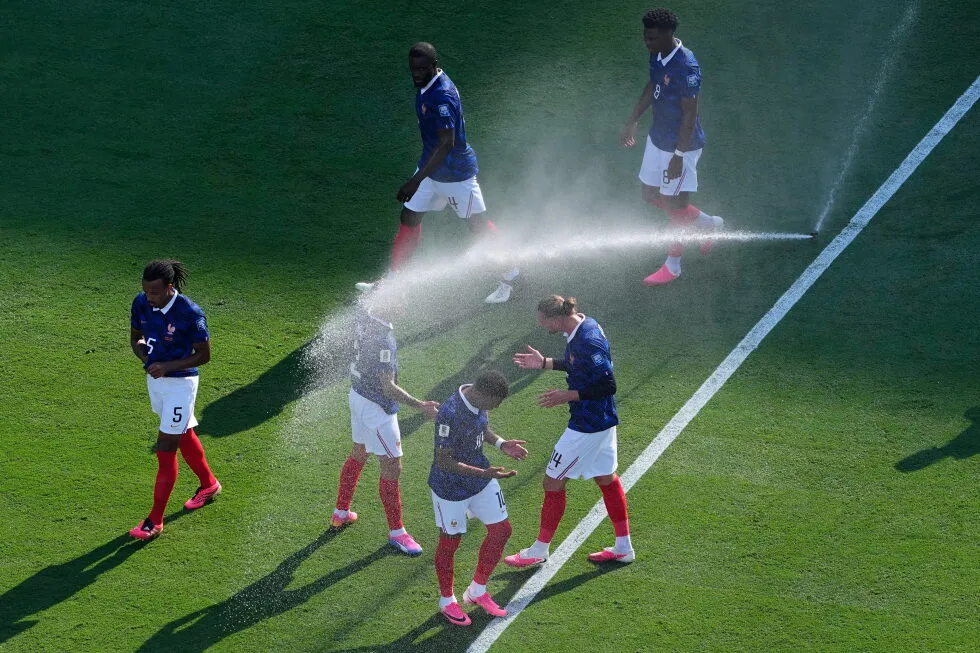
Eastern heat on July 4 threatens World Cup players and fans 1 of 6 | French players cool off from field sprinklers during the World Cup round of 32 soccer match against Sweden in East Rutherford, N.J., near New York, Tuesday, June 30, 2026. (AP Photo/Petr David Josek) 2 of 6 | France supporters cool down with a fan before the World Cup round of 32 soccer match between France and Sweden in East Rutherford, N.J., near New York, Tuesday, June 30, 2026. (AP Photo/Frank Franklin II) 3 of 6 | Argentina’s Lionel Messi, right, and Rodrigo De Paul splash water on themselves to cool down during a training session on the eve of their World Cup round of 32 soccer match against Cape Verde, in Fort Lauderdale, Fla., Thursday, July 2, 2026. (AP Photo/Rebecca Blackwell) 4 of 6 | Meghana Jalagam uses a fan to keep cool from the hot weather during a World Cup soccer match between the United States and Bosnia and Herzegovina at a watch party Wednesday, July 1, 2026, in Detroit. (AP Photo/Paul Sancya) 5 of 6 | Egypt players hydrate and cool down as the weather nears triple digits during a training session in Dallas, Thursday, July 2, 2026, ahead of the team’s World Cup soccer match against Australia. (AP Photo/Tony Gutierrez) 6 of 6 | France’s Lucas Digne cools during the hydration break during the World Cup round of 32 soccer match between France and Sweden in East Rutherford, N.J., near New York, Tuesday, June 30, 2026. (AP Photo/Seth Wenig) 1 of 6 | French players cool off from field sprinklers during the World Cup round of 32 soccer match against Sweden in East Rutherford, N.J., near New York, Tuesday, June 30, 2026. (AP Photo/Petr David Josek) 1 of 6 French players cool off from field sprinklers during the World Cup round of 32 soccer match against Sweden in East Rutherford, N.J., near New York, Tuesday, June 30, 2026. (AP Photo/Petr David Josek) Add AP News on Google Add AP News as your preferred source to see more of our stories on Google. Share 2 of 6 | France supporters cool down with a fan before the World Cup round of 32 soccer match between France and Sweden in East Rutherford, N.J., near New York, Tuesday, June 30, 2026. (AP Photo/Frank Franklin II) 2 of 6 France supporters cool down with a fan before the World Cup round of 32 soccer match between France and Sweden in East Rutherford, N.J., near New York, Tuesday, June 30, 2026. (AP Photo/Frank Franklin II) Add AP News on Google Add AP News as your preferred source to see more of our stories on Google. Share 3 of 6 | Argentina’s Lionel Messi, right, and Rodrigo De Paul splash water on themselves to cool down during a training session on the eve of their World Cup round of 32 soccer match against Cape Verde, in Fort Lauderdale, Fla., Thursday, July 2, 2026. (AP Photo/Rebecca Blackwell) 3 of 6 Argentina’s Lionel Messi, right, and Rodrigo De Paul splash water on themselves to cool down during a training session on the eve of their World Cup round of 32 soccer match against Cape Verde, in Fort Lauderdale, Fla., Thursday, July 2, 2026. (AP Photo/Rebecca Blackwell) Add AP News on Google Add AP News as your preferred source to see more of our stories on Google. Share 4 of 6 | Meghana Jalagam uses a fan to keep cool from the hot weather during a World Cup soccer match between the United States and Bosnia and Herzegovina at a watch party Wednesday, July 1, 2026, in Detroit. (AP Photo/Paul Sancya) 4 of 6 Meghana Jalagam uses a fan to keep cool from the hot weather during a World Cup soccer match between the United States and Bosnia and Herzegovina at a watch party Wednesday, July 1, 2026, in Detroit. (AP Photo/Paul Sancya) Add AP News on Google Add AP News as your preferred source to see more of our stories on Google. Share 5 of 6 | Egypt players hydrate and cool down as the weather nears triple digits during a training session in Dallas, Thursday, July 2, 2026, ahead of the team’s World Cup soccer match against Australia. (AP Photo/Tony Gutierrez) 5 of 6 Egypt players hydrate and cool down as the weather nears triple digits during a training session in Dallas, Thursday, July 2, 2026, ahead of the team’s World Cup soccer match against Australia. (AP Photo/Tony Gutierrez) Add AP News on Google Add AP News as your preferred source to see more of our stories on Google. Share 6 of 6 | France’s Lucas Digne cools during the hydration break during the World Cup round of 32 soccer match between France and Sweden in East Rutherford, N.J., near New York, Tuesday, June 30, 2026. (AP Photo/Seth Wenig) 6 of 6 France’s Lucas Digne cools during the hydration break during the World Cup round of 32 soccer match between France and Sweden in East Rutherford, N.J., near New York, Tuesday, June 30, 2026. (AP Photo/Seth Wenig) Add AP News on Google Add AP News as your preferred source to see more of our stories on Google. Share Updated [hour]:[minute] [AMPM] [timezone], [monthFull] [day], [year] LOS ANGELES (AP) — Saturday’s afternoon knockout round game between France and Paraguay in Philadelphia could be this World Cup tournament’s hottest, posing dangers to the region as well as athletes and tens of thousands of fans in the open-air stadium.A heat wave is expected to continue across the eastern and central U.S. through the end of the week, with peak heat indexes — which combine air temperature with humidity — between 100 F to 115 F (37.78 C to 46.11 C), according to the National Weather Service. High night temperatures will bring little relief and records could be broken. Earlier this week, French players cooled off from temperatures that hit 90 F (32.22 C) with field sprinklers during their match against Sweden in New Jersey.Concerns about extreme heat during the games in the U.S., Canada and Mexico have been growing for months, with some scientists saying that FIFA’s heat safety guidelines are “inadequate” and “impossible to justify,” even for heat acclimatized players. For spectators, that could mean games are slower and less intense. The world has warmed roughly 1.26 F (0.7 C) in the last three decades since the U.S. last hosted the World Cup, according to the climate monitoring group Berkeley Earth. Global temperature increases intensify and make heat waves and other severe weather more common. 3 MIN READ 4 MIN READ 3 MIN READ The humid heat engulfing the country, as well as parts of Canada, would’ve been “virtually impossible” without climate change, scientists with the World Weather Attribution said Friday. The 2022 World Cup tournament in Qatar was moved from summer to winter because of the extreme heat threat, and last year, temperatures soared at the Club World Cup. The soccer players’ global union warned that extreme heat would likely be a bigger problem at this and the next World Cups. One of the hottest World Cup games was in 1994 in Orlando, Florida, when temperatures hit 110 F (43.33 C). Heat is a leading killer of athletesHeat hits people from both their surroundings as well as while their bodies warm during exercise. That makes it harder to cool down when it’s really hot and humid, said Bharat Venkat, director of the Heat Lab at the University of California, Los Angeles.“So when you’re exerting yourself on a particularly hot day, the likelihood of experiencing heat related illness or even death is much higher,” he said. Intense exercise on a sizzling day can lead to extreme fatigue, impaired performance, headache, irritability, nausea, dizziness, cramping and dehydration, all symptoms of exertional heat illness. Exertional heat stroke requires immediate medical attention and is the third leading cause of death in athletes.When the wet bulb globe temperature — which includes temperature, humidity, cloud cover and wind — reaches above about 95 F (35 C), people lose their ability to cool off quickly, said Ryan Calsbeek, professor of biological sciences at Dartmouth College, and “the physiological mechanisms just break down.” Heat-induced confusion could also influence a player’s decisions and could determine a match’s outcome, he said. Are FIFA’s heat safety rules enough?Mandatory three-minute hydration breaks midway through each half are to protect players, and referees, from extreme heat illness. But they’ve sparked criticism from different groups: some say they’re interrupting the game’s flow and give coaches a chance to shift momentum in their team’s favor, while some scientists have said the breaks should be longer to allow players to meaningfully cool and rehydrate when heat is extreme. Matches outdoors during peak heat hours have also been limited, and those expected in warmer windows are prioritized for covered stadiums, FIFA said. FIFA’s guidelines say a match could be postponed if the wet bulb globe temperature reaches 89.60 F (32 C). But that temperature is “so extreme that in the military, at our basic training facilities in America, if it reaches 32, it’s black flag and all training has to be canceled and stopped,” said Douglas Casa, CEO of the University of Connecticut’s Korey Stringer Institute.Temperatures are forecast over 100 F (37.78 C) during Saturday’s game in Philadelphia. The player’s union FIFPRO, as well as the American College of Sports Medicine, has called for matches to be delayed at 82.40 F (28 C) for safety. Players can train for heat stress during exerciseGuilherme Passos monitors and prepares Brazil’s national team for extreme heat as a sport scientist at the Brazilian Football Federation.He’s helped the team acclimate to the U.S. heat. “If you expose them straight to the hottest time of the day you can lose a bit of training quality,” he said. They use saunas or hot baths as they heat train during the competition. When Brazil hosted the World Cup in 2014, Passos said, players covered less distance and reduced high-speed running, and instead increased their technical and tactical precision. “Soccer players are a really unique mix of athletic attributes,” said Calsbeek. “They have to have extreme endurance and explosive speed. And then on top of that, they have to make really critical decisions. All of those different facets of the sport will be affected by the temperature.” But soccer players aren’t the only ones at risk. Many soccer fans are drinking alcohol and watching the World Cup. In heat, doing that is risky. Cities and stadiums have increased access to shade, cooling areas and water, and medical personnel are stationed in FIFA Fan Festivals and around stadiums. “People are going to be dehydrated, super excited, and not wanting to leave the match,” said Calsbeek. “We’re likely to see, in those extreme temperatures, spectators pay the price as well.”___The Associated Press receives support from the Walton Family Foundation for coverage of water and environmental policy. The AP is solely responsible for all content. For all of AP’s environmental coverage, visit https://apnews.com/hub/climate-and-environment Pineda writes about water, climate and the environment in Latino communities across the U.S. McDermott is a reporter on the Associated Press Climate and Environment team. She focuses on the transition to clean energy.
SRCAssociated Press (AP)
LANGEN
LEANCenter
WORDS1 869
ENT12
FRI · 2026-07-03 · 07:23 GMTBRIEF NSR-2026-0703-89658
NSR-2026-0703-89658News Report·EN·Public Health
Eastern heat on July 4 threatens World Cup players and fans
A severe heatwave is impacting the eastern and central United States, with heat indexes expected to reach 100-115°F, posing risks to World Cup players and tens of thousands of fans attending matches in open-air stadiums. Scientists attribute the intensity of this heatwave to climate change, noting that global temperatures have risen since the U.S.
By
DORANY PINEDA and JENNIFER McDERMOTTAssociated Press (AP)Filed 2026-07-03 · 07:23 GMTLean · CenterRead · 8 min
Associated Press (AP)FIG 01
Reading time
8min
Word count
1 869words
Sources cited
0cited
Entities identified
12entities
Quality score
100%
§ 01
Briefing Summary
AI-generatedNEWSAR · AI
A severe heatwave is impacting the eastern and central United States, with heat indexes expected to reach 100-115°F, posing risks to World Cup players and tens of thousands of fans attending matches in open-air stadiums. Scientists attribute the intensity of this heatwave to climate change, noting that global temperatures have risen since the U.S. last hosted the World Cup. Concerns about FIFA's heat safety guidelines, which include mandatory hydration breaks, have been raised, with some scientists deeming them inadequate. The extreme heat can lead to exertional heat illness, a leading cause of death in athletes, and can also affect spectators. Cities and stadiums are implementing measures like increased shade, cooling areas, and medical personnel to mitigate the risks for both participants and attendees.
Confidence 0.90Claims 4Entities 12
§ 02
Article analysis
Model · rule-basedFraming
Public Health
Human Interest
Tone
Measured
AI-assessed
CalmNeutralAlarmist
Factuality
0.80 / 1.00
Factual
LowHigh
Sources cited
0
No named sources
FewMany
§ 03
Key claims
4 extracted01
World Cup matches and training sessions are taking place in various cities across the Eastern region.
factual
Confidence
1.00
02
Players and fans are using various methods to cool down during matches and training sessions.
factual
Confidence
1.00
03
Temperatures are nearing triple digits in some locations during World Cup events.
factual
Confidence
0.90
04
Extreme heat on July 4th poses a threat to World Cup players and fans.
factual
Confidence
0.90
§ 04
Full report
8 min read · 1 869 words§ 05
Entities
12 identifiedKey playerOppositionContextPositiveNeutralNegative
Locations9
§ 06
Keywords & salience
8 termsworld cup
1.00
heat
0.90
extreme weather
0.80
players
0.70
fans
0.70
cooling down
0.60
hydration
0.50
soccer match
0.40
§ 07
Topic connections
Interactive graph Network visualization showing 51 related topics
View Full Graph Person Organization Location Event|Click node to navigate|Edge numbers = shared articles