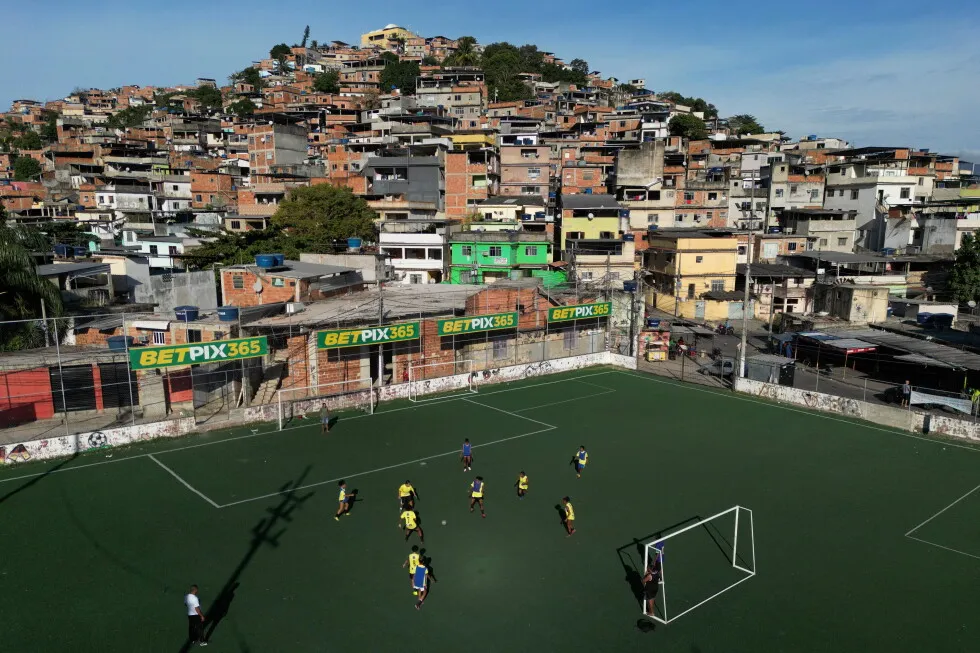
As World Cup fever grips Brazil, scrutiny mounts over its sports betting industry 1 of 2 | Betting company s adorn a soccer field during a training program in the Complexo do Alemao favela, in Rio de Janeiro, Brazil, July 1, 2023. (AP Photo/Bruna Prado, File) 2 of 2 | A dog crosses a street decorated with Brazilian flags and streamers in the national soccer team colors in the Cidade Estrutural neighborhood of Brasilia, June 17, 2026, ahead of Brazil’s World Cup match. (AP Photo/Eraldo Peres, File) By ELÉONORE HUGHES Updated 7:26 PM MESZ, July 3, 2026 Add AP News on Google Add AP News as your preferred source to see more of our stories on Google. Share Share Facebook Copy Link copied Print Email X LinkedIn Bluesky Flipboard Pinterest Reddit Rio de Janeiro (AP) — When World Cup season descends upon soccer-mad Brazil, green and yellow banners decorate restaurants, bars and apartment buildings, streets are painted with flags and soccer balls, and discussions of the beloved national team’s games are ubiquitous. But this year, another topic has taken center stage: the prevalence of ads for bets on the games, even as the country grapples with a surge in gambling which leaves some with crippling debt and has led to the number of people seeking care for addiction more than doubling in the past five years, according to Brazil’s health ministry. Since the FIFA World Cup began, the percentage of Brazilians placing bets has more than tripled, rising from 11% in May before the tournament kicked off to around 35% at the end of June, said Brazilian fintech company Klavi in a study based on a sample of 1.2 million people. s extending beyond traditional commercial breaks to include live presenter endorsements and real-time odds promotions have sparked a fresh wave of indignation, with politicians across the political spectrum calling for tighter controls. Conservative candidate Keiko Fujimori wins Peru’s presidential election in a runoff 1 MIN READ Puppy love as dog walker turns his pack of 13 into Argentina jersey-clad World Cup followers 2 MIN READ As her 180-day mandate expires, Venezuela’s acting leader defends quake response 3 MIN READ When sports betting was made legal in 2018, rampant advertising and sponsorship coupled with an unregulated market resulted in a turmoil that prompted the government to usher in new regulations in 2023. Earlier this week Brazil’s Finance Minister Dario Durigan said the government would announce new measures to increase regulation. In a statement to The Associated Press on Thursday, Brazil’s Finance Ministry said it had asked two media outlets and four betting operators to provide explanations regarding content that may have breached laws. Authorities also ordered the immediate suspension of any s found to be in violation of the current regulations, the ministry added. Brazil has become the third-biggest market in the world for sports betting, following the U.S. and the U.K., a report by data analysis company Comscore said in 2023. Betting and gambling are estimated to cost Brazilian society 38.8 billion reais ($7 billion) annually and increase suicide and depression, according to a 2025 study by the non-profit Institute of Studies for Health Policies. “We are witnessing a humanitarian tragedy unfolding in Brazil,” said Sen. Eduardo Girão during a public hearing on the problem at the Senate on Thursday. The issue has prompted musicians such as Gilberto Gil and Caetano Veloso to participate in a campaign demanding stricter laws. Michael Marcos, a 22-year-old transport inspector from Brazil’s northeastern state of Alagoas, is among those who suffered from anxiety due to betting last year. He decided to take a six-month break, before picking the habit up again during the World Cup. “Watching Brazil play is already an emotional experience. But if I bet 1000 reais ($200) on them, the emotion will be even greater because there’s an accompanying tension to do with whether I’m going to win or lose money,” he said. To limit the impact on his mental health, Marcos is only betting on teams — such as France — he thinks are very likely to win. So far, he says his strategy has worked out for him. Nonetheless, he plans on stopping at the end of the tournament. CazéTV, a streaming platform on YouTube and the only channel with rights to all 104 games in Brazil, has faced particular scrutiny. The platform has featured traditional adverts for bets, but CazéTV’s commentators have also promoted betting during the games, blending advertising with commentary of the action on the pitch. “Betting is intended for people aged 18 and over. But when it is embedded in content (…) anyone can be exposed to it, including children, teenagers, and other vulnerable groups. The exposure becomes indiscriminate,” said Carolina Terra, a professor at the University of Sao Paulo’s communications and arts school. Brazil’s National Consumer Secretariat, a branch of the Justice Ministry, opened an investigation into possible irregularities during CazéTV’s broadcasts of the World Cup on June 24. Shortly afterwards, the country’s advertising self-regulator opened three proceedings regarding betting offers read aloud by presenters and commentators. It then recommended suspending the ads. In a statement, CazéTV said that it would adopt a more specific and conservative approach to betting brand integrations and follow a more traditional advertising format, adding that its advertising complies with Brazilian legislation. Gustavo Freitas, a 34-year-old who works in advertising, said he has bet around $200 since the World Cup began, a ten-fold increase from what he normally bets during a month. Freitas said he doesn’t see it as a form of income, but as a pastime. “No one believes they’re going to become rich playing videogames on weekends. It’s the same for betting,” he said. “The problem is thinking that you’re going to find the perfect formula and forgetting the old saying (…): the bank always wins.” Follow AP’s coverage of Latin America and the Caribbean at https://apnews.com/hub/latin-america
SRCAssociated Press (AP)
LANGEN
LEANCenter
WORDS981
ENT12
FRI · 2026-07-03 · 17:53 GMTBRIEF NSR-2026-0703-89809
NSR-2026-0703-89809News Report·EN·Public Health
As World Cup fever grips Brazil, scrutiny mounts over its sports betting industry
Brazil is experiencing a surge in sports betting, with the percentage of Brazilians placing bets tripling during the World Cup. This rise has intensified scrutiny over the industry due to concerns about addiction, crippling debt, and increased demand for addiction treatment.
Associated Press (AP)Filed 2026-07-03 · 17:53 GMTLean · CenterRead · 4 min
Associated Press (AP)FIG 01
Reading time
4min
Word count
981words
Sources cited
4cited
Entities identified
12entities
Quality score
100%
§ 01
Briefing Summary
AI-generatedNEWSAR · AI
Brazil is experiencing a surge in sports betting, with the percentage of Brazilians placing bets tripling during the World Cup. This rise has intensified scrutiny over the industry due to concerns about addiction, crippling debt, and increased demand for addiction treatment. Politicians are calling for tighter controls, and the Finance Ministry has announced new regulatory measures, including investigating media outlets and betting operators for potential law breaches and ordering the suspension of violating advertisements. The widespread promotion of betting, even integrated into live commentary, has raised alarms about exposing vulnerable groups, leading to investigations and recommendations for ad suspension. This situation highlights Brazil's position as the third-largest sports betting market globally, with significant societal costs estimated annually.
Confidence 0.90Sources 4Claims 5Entities 12
§ 02
Article analysis
Model · rule-basedFraming
Public Health
Legal & Judicial
Tone
Measured
AI-assessed
CalmNeutralAlarmist
Factuality
0.80 / 1.00
Factual
LowHigh
Sources cited
4
Well sourced
FewMany
§ 03
Key claims
5 extracted01
Authorities ordered the immediate suspension of any s found to be in violation of current regulations.
factualBrazil’s Finance Ministry
Confidence
1.00
02
Brazil's Finance Ministry has asked two media outlets and four betting operators for explanations regarding content that may have breached laws.
factualBrazil’s Finance Ministry
Confidence
1.00
03
Brazil has become the third-biggest market in the world for sports betting.
statisticComscore
Confidence
1.00
04
The percentage of Brazilians placing bets has more than tripled since the FIFA World Cup began, rising from 11% to around 35%.
statisticBrazilian fintech company Klavi
Confidence
1.00
05
The number of people seeking care for gambling addiction in Brazil has more than doubled in the past five years.
statisticBrazil’s health ministry
Confidence
1.00
§ 04
Full report
4 min read · 981 words§ 05
Entities
12 identifiedKey playerOppositionContextPositiveNeutralNegative
Organizations1
Locations6
§ 06
Keywords & salience
8 termssports betting industry
1.00
world cup
0.90
gambling addiction
0.80
regulation
0.70
brazil
0.60
advertising
0.50
finance minister
0.40
health ministry
0.40
§ 07
Topic connections
Interactive graph Network visualization showing 51 related topics
View Full Graph Person Organization Location Event|Click node to navigate|Edge numbers = shared articles