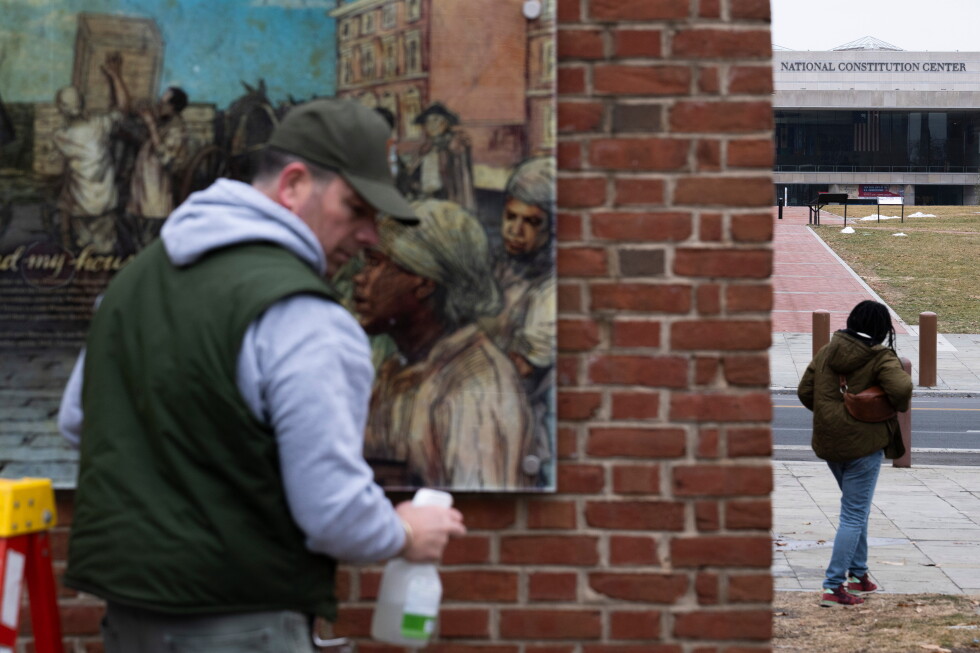
Panels that were part of an exhibit on slavery at the President’s House Site in Independence National Historical Park are reinstalled, Feb. 19, 2026, in Philadelphia. (AP Photo/Joe Lamberti, File) Updated [hour]:[minute] [AMPM] [timezone], [monthFull] [day], [year] An appeals court ruled Friday that President Donald Trump’s administration can reinstall interpretive panels that critics say whitewash the history of slavery at the site of President George Washington’s home in Philadelphia.The signs would be in the same area where the Declaration of Independence was adopted on July 4, 1776. A message seeking comment was left Friday with the National Park Service.The new educational panels were designed to replace ones put up in 2010 that told the story of how nine slaves lived in the home along with George and Martha Washington in the 1790s, when Philadelphia was briefly the nation’s capital.Their removal stemmed from Trump’s 2025 executive order calling for federally owned or controlled historic sites not to display information to “disparage Americans past or living” and to focus on the “greatness of the achievements and progress of the American people.” Friday’s ruling from a three-judge panel of the U.S. 3rd Circuit of Appeals, which is based in a courthouse across an intersection from the President’s House site, was a technical one to allow implementation of a ruling made last month. 3 MIN READ 2 MIN READ 3 MIN READ That ruling — by one judge Trump nominated, one nominated by former President George W. Bush and one chosen by former President Barack Obama — said a lower court was wrong to force the federal government to take down its new panels. The government asked Thursday for the go-ahead to put them back up, saying that the panels were ready to install and that they should go up “without further delay.” The administration has said in court filings that its information also discusses slavery.Advocates, academics and officials have been concerned for months that the version that complies with Trump’s order could give a history that downplays the pain in the nation’s past in favor of a more triumphant view.A government website with images of the new panels shows they would still have information on enslaved people who lived in the home, plus details on the abolitionist movement, how the Constitution treated slavery, the end of slavery in Pennsylvania and how Washington and his successor, John Adams, viewed and treated slavery, as well as information about the 20th century Civil Rights movement. The replacement panels do not include some of detail in the earlier ones, such as a map of slave trade routes and a timeline on slavery. They also avoid critical headlines such as “The Dirty Business of slavery.” The City of Philadelphia, which sued over removal of the previous information, is trying to put the brakes on the new installation. The city on Friday asked the appeals court to recall its order from earlier in the day — at least long enough to allow the city to respond to the request Trump’s administration made on Thursday.Philadelphia said in its filing that it would be hurt if the new panels go back up: “The President’s House is a site of exceptional importance to Philadelphia and the Nation, developed through years of federal-local collaboration to tell a historically significant and long-suppressed story.”About half the previous panels were reinstalled earlier this year before a court ordered that work to stop.
SRCAssociated Press (AP)
LANGEN
LEANCenter
WORDS566
ENT12
FRI · 2026-07-03 · 20:23 GMTBRIEF NSR-2026-0703-89852
NSR-2026-0703-89852News Report·EN·Legal & Judicial
Court says the US can install historical panels at the site of Washington’s Philadelphia home
An appeals court has ruled that the Trump administration can reinstall interpretive panels at the site of George Washington's former home in Philadelphia. These new panels are intended to replace earlier ones that detailed the lives of nine enslaved people who lived there.
By
GEOFF MULVIHILLAssociated Press (AP)Filed 2026-07-03 · 20:23 GMTLean · CenterRead · 3 min
Associated Press (AP)FIG 01
Reading time
3min
Word count
566words
Sources cited
3cited
Entities identified
12entities
Quality score
100%
§ 01
Briefing Summary
AI-generatedNEWSAR · AI
An appeals court has ruled that the Trump administration can reinstall interpretive panels at the site of George Washington's former home in Philadelphia. These new panels are intended to replace earlier ones that detailed the lives of nine enslaved people who lived there. The removal of the original panels stemmed from a Trump executive order directing historic sites to focus on American achievements rather than information that might "disparage Americans." While the administration states the new panels also discuss slavery, critics are concerned they downplay its painful history. The City of Philadelphia, which sued over the removal of the previous information, is attempting to halt the reinstallation, arguing it would undermine years of federal-local collaboration to tell a historically significant story.
Confidence 0.90Sources 3Claims 5Entities 12
§ 02
Article analysis
Model · rule-basedFraming
Legal & Judicial
Social Justice
Tone
Measured
AI-assessed
CalmNeutralAlarmist
Factuality
0.80 / 1.00
Factual
LowHigh
Sources cited
3
Well sourced
FewMany
§ 03
Key claims
5 extracted01
The government claims the new panels also discuss slavery, the abolitionist movement, and the Constitution's treatment of slavery.
factualAdministration
Confidence
1.00
02
The City of Philadelphia is attempting to prevent the installation of the new panels.
factual
Confidence
1.00
03
The new panels replace ones put up in 2010 that detailed the lives of nine slaves at the home.
factual
Confidence
1.00
04
Critics argue the new panels whitewash the history of slavery at the President's House Site.
quoteCritics
Confidence
1.00
05
An appeals court ruled that the Trump administration can reinstall interpretive panels at the site of George Washington's home in Philadelphia.
factualU.S. 3rd Circuit of Appeals
Confidence
1.00
§ 04
Full report
3 min read · 566 words§ 05
Entities
12 identifiedKey playerOppositionContextPositiveNeutralNegative
People5
Organizations2
Locations3
Topics1
§ 06
Keywords & salience
10 termsslavery
1.00
historical panels
0.90
president's house site
0.80
george washington
0.70
philadelphia
0.60
appeals court ruling
0.60
historical interpretation
0.50
donald trump administration
0.50
national park service
0.40
abolitionist movement
0.40
§ 07
Topic connections
Interactive graph Network visualization showing 51 related topics
View Full Graph Person Organization Location Event|Click node to navigate|Edge numbers = shared articles