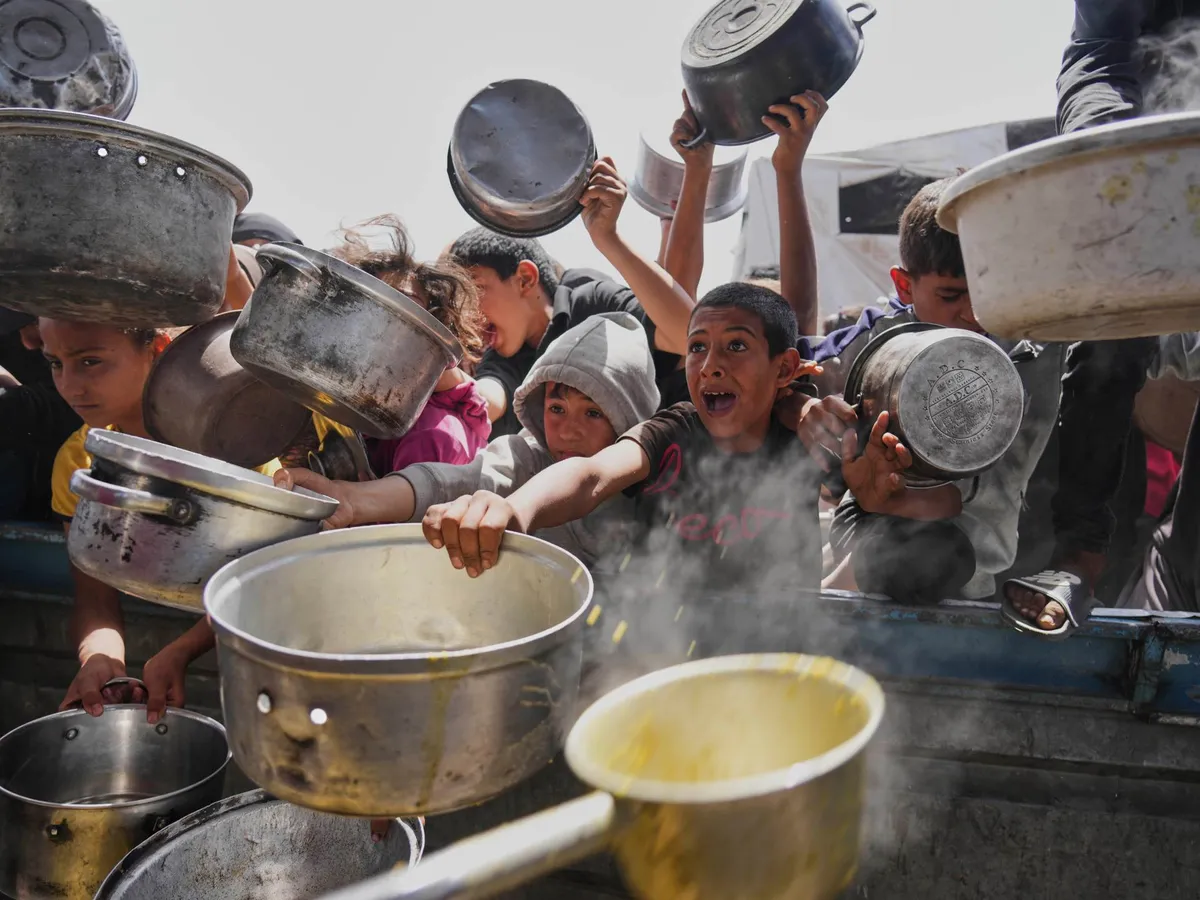
After a genocidal war and famine, leading Israeli politicians say they are now ready to settle Gaza.Palestinian children struggle to get donated food at a community kitchen in Khan Younis, Gaza [File: Abdel Kareem Hana/AP]Published On 4 Jul 2026Israeli Prime Minister Benjamin Netanyahu and his far-right Finance Minister Bezalel Smotrich have offered the clearest signal yet that they are considering the establishment of new Jewish settlements on what remains of the Gaza Strip after almost three years of their country’s genocidal war against Palestinians in the enclave.Last Monday, Smotrich, who made his continued participation in the ruling coalition conditional on being granted increased control over Israel’s settlement enterprise, told reporters that his ministry had prepared plans for three settlements in northern Gaza, and that all that was needed to move forward was the green light from Netanyahu.Recommended Stories list of 4 itemslist 1 of 4Billions flow between EU institutions and Israel, despite Gaza genocidelist 2 of 4Gaza’s first women’s amputee football team reclaims the pitch after warlist 3 of 4Israel’s Smotrich calls for settlements, ‘conquest’ of Gaza Striplist 4 of 4Israeli opposition signal foreign policy change in style, but not substanceend of listThe following day, Netanyahu came close to providing it. Speaking on Israel’s staunchly right-wing Channel 14, he refused to rule out the prospect of settlements in Gaza.“The question is whether you prefer to do or to talk,” the prime minister replied cryptically when asked whether the establishment of settlements was a possibility. “And yes, I prefer not to address it.”Israel’s current settlements – in the occupied West Bank and occupied East Jerusalem – are illegal under international law.In clearing the way for any future settlements in Gaza – and for what Netanyahu euphemistically told Channel 14 viewers was the “voluntary migration” of its remaining population, a process widely characterised by international jurists as ethnic cleansing – Israel has killed more than 73,000 of its occupants.At the same time, Israel has been accused by United Nations-backed experts of deliberately imposing a famine on survivors in Gaza and, most recently, of furthering its genocide in Gaza through the deliberate targeting of children.The degree to which preparations are under way for the physical establishment of any settlements in Gaza – which previously had 21 illegal settlements before the Israeli government decided to dismantle them in 2005 – is difficult to ascertain. The area north of Gaza City has been largely razed by Israel, with its deliberate campaign to demolish Palestinian homes and institutions, destroying almost everything not hit with bombs from the air.Supporters of settlements in Gaza see that now empty land as a perfect opportunity to cement a buffer between Israel and Gaza.With elections due in Israel, it is beneficial for politicians such as Smotrich and Netanyahu to insinuate that this is now the plan.“The Israeli public has been subjected to almost endless incitements to genocide since October 7,” said Neve Gordon, an Israeli professor at Queen Mary University of London. “People who watch legacy media in Israel have no understanding of the level of destruction in Gaza, or the kind of suffering that has gone on there.“There are even spots, tourist spots, where some people in Israel go to watch the bombing. This is the constituency that statements like Smotrich’s are designed to appeal to. These are the people who would like to see more settlements in Gaza, but that doesn’t mean we shouldn’t take it seriously ” he said. “[But] this isn’t just rhetoric. There is a definite and consistent push from across much of Israel’s politics to resettle the Gaza Strip.”A history of ethnic cleansingA growing number of hardline religious Israelis have been seeking to resettle the Gaza Strip since the 2005 disengagement. Since then, analysts and historians have described concerted efforts by those supporting settlements to capture the institutions of Israeli public life, gaining dominant voices in the education system, the media and other areas of government.Right-wing Nachala movement settlers march near the border, advocating for the resettlement of the Gaza Strip [File: Erik Marmor/Getty Images]Organisations such as the far-right settler group Nachala have openly championed the resettlement of the enclave. Months into Israel’s genocidal war, Nachala held a conference explicitly promoting Israel’s return to Gaza, entitled ”Settlement Brings Security and Victory”. It was attended by numerous government ministers, including Smotrich and National Security Minister Itamar Ben-Gvir.Despite what critics describe as his success in establishing settlements on a scale unparalleled since the 1990s, Smotrich continues to struggle in the polls. His Religious Zionist party may not secure enough votes in the next election – which must be before the end of October – to meet the minimum threshold to get into parliament. That perhaps explains why Smotrich is eager to inflate the prospects of settlements in Gaza and attract more support from the Israeli right-wing.The irony is curious for observers such as Orly Noy, the editor of the Hebrew-language Local Call magazine.Smotrich “has been the most effective member of the cabinet in promoting the interests of the settlers in the West Bank”, she said. “He has really made a revolution in that sense,” referring to the judicial, economic, and infrastructure overhauls initiated under Smotrich’s watch, that he appears to be receiving little credit for among his base.The stakes for Netanyahu are potentially more dramatic, analysts pointed out. Currently on trial on multiple corruption charges, the PM faces a jail sentence if found guilty.Similarly, anger over his apparent determination not to hold an independent inquiry into his own government’s failings in the October 7 attack runs high, perhaps giving him a reason to suggest that he will move forward with building settlements and expelling Palestinians from Gaza.Israeli Knesset member and the only Jewish politician expected to resist potential settlement in Gaza, Ofer Cassif [File: Ahmad Gharabli/AFP]“Look, if you want to distinguish yourself from the rest of the field ahead of the election, your time is now,” political analyst Ori Goldberg said. “This is your moment, and, if you want to propose imposing further hardship onto Palestinians, there is absolutely no Jewish member of [parliament] – apart from the [left-wing member of parliament] Ofer Cassif – who is going to oppose you.“People don’t care anymore,” he said of the chances of the settlement of Gaza receiving any resistance from Israelis. “There’s just nothing [on the suffering in Gaza]. People have grown indifferent. There’s just a big black hole.”ComplicityWhile the Israeli government may have no domestic qualms when it comes to building settlements in Gaza, it does have to contend with the international backlash – and that may be why the project does not move beyond the planning stage.But would Israel face any real lasting consequences from building settlements in Gaza?In the eyes of many, the Israeli government’s freedom to act comes from the unwavering diplomatic and military support of the US, as well as the financial support of Europe which, despite its occasional criticism, remains Israel’s foremost trading partner.“In terms of international reaction,” author and fellow at the European Council on Foreign Relations, Hugh Lovatt said of the prospect of settlement in Gaza, “from 2023 onwards we’ve seen the greatest expansion of settlements since the [1990s] Oslo Accords, as well as plans to render the two-state solution obsolete”.“And, while there’s been some criticism, there’s been very little action,” Lovatt said. “I don’t know if that would be any different were it to happen in Gaza. It’s true that Gaza has been the focus of a great deal of international – and specifically US – attention since the ceasefire that the West Bank has not.”However, whether that attention would act as a check on Israel’s attempts to expand its settlements is unclear.“Would Israel risk such a blatant move to block Trump’s Gaza plan? I’m not sure,” he said of the US president’s plan for Gaza, which while heavily criticised for allowing Israel to continue its presence in the Palestinian territory, makes no mention of Israeli settlements.
SRCAl Jazeera
LANGEN
LEANCenter
WORDS1 317
ENT12
SAT · 2026-07-04 · 05:41 GMTBRIEF NSR-2026-0704-89932
NSR-2026-0704-89932News Report·EN·Human Rights
Could Israel really build settlements in Gaza?
Leading Israeli politicians, including Prime Minister Benjamin Netanyahu and Finance Minister Bezalel Smotrich, have indicated readiness to establish new Jewish settlements in Gaza. Smotrich stated his ministry has prepared plans for three settlements in northern Gaza, awaiting Netanyahu's approval.
Simon Speakman CordallAl JazeeraFiled 2026-07-04 · 05:41 GMTLean · CenterRead · 6 min
Al JazeeraFIG 01
Reading time
6min
Word count
1 317words
Sources cited
3cited
Entities identified
12entities
Quality score
100%
§ 01
Briefing Summary
AI-generatedNEWSAR · AI
Leading Israeli politicians, including Prime Minister Benjamin Netanyahu and Finance Minister Bezalel Smotrich, have indicated readiness to establish new Jewish settlements in Gaza. Smotrich stated his ministry has prepared plans for three settlements in northern Gaza, awaiting Netanyahu's approval. Netanyahu himself has not ruled out the prospect of settlements, responding cryptically when questioned. This comes after nearly three years of conflict, which has resulted in significant Palestinian casualties and accusations of famine and genocide. While the extent of physical preparations is unclear, proponents see the largely destroyed northern Gaza as an opportunity for a buffer zone. The push for resettlement is seen by some as an appeal to a specific political constituency, but also as a consistent effort within Israeli politics.
Confidence 0.90Sources 3Claims 5Entities 12
§ 02
Article analysis
Model · rule-basedFraming
Human Rights
Political Strategy
Tone
Sensational
AI-assessed
CalmNeutralAlarmist
Factuality
0.60 / 1.00
Mixed
LowHigh
Sources cited
3
Well sourced
FewMany
§ 03
Key claims
5 extracted01
Israel's current settlements in the occupied West Bank and East Jerusalem are illegal under international law.
factualArticle
Confidence
1.00
02
Prime Minister Benjamin Netanyahu refused to rule out the prospect of settlements in Gaza when asked by Channel 14.
quoteBenjamin Netanyahu
Confidence
0.95
03
Finance Minister Bezalel Smotrich stated his ministry has prepared plans for three settlements in northern Gaza.
quoteBezalel Smotrich
Confidence
0.95
04
Leading Israeli politicians, including PM Netanyahu and Finance Minister Smotrich, are considering establishing new Jewish settlements in Gaza.
factualArticle
Confidence
0.90
05
Israel has killed more than 73,000 occupants in Gaza.
statisticArticle
Confidence
0.85
§ 04
Full report
6 min read · 1 317 words§ 05
Entities
12 identifiedKey playerOppositionContextPositiveNeutralNegative
Locations5
§ 06
Keywords & salience
9 termsgaza settlements
1.00
israeli politicians
0.90
genocidal war
0.80
ethnic cleansing
0.70
bezalel smotrich
0.60
benjamin netanyahu
0.60
famine
0.50
international law
0.50
voluntary migration
0.40
§ 07
Topic connections
Interactive graph Network visualization showing 51 related topics
View Full Graph Person Organization Location Event|Click node to navigate|Edge numbers = shared articles