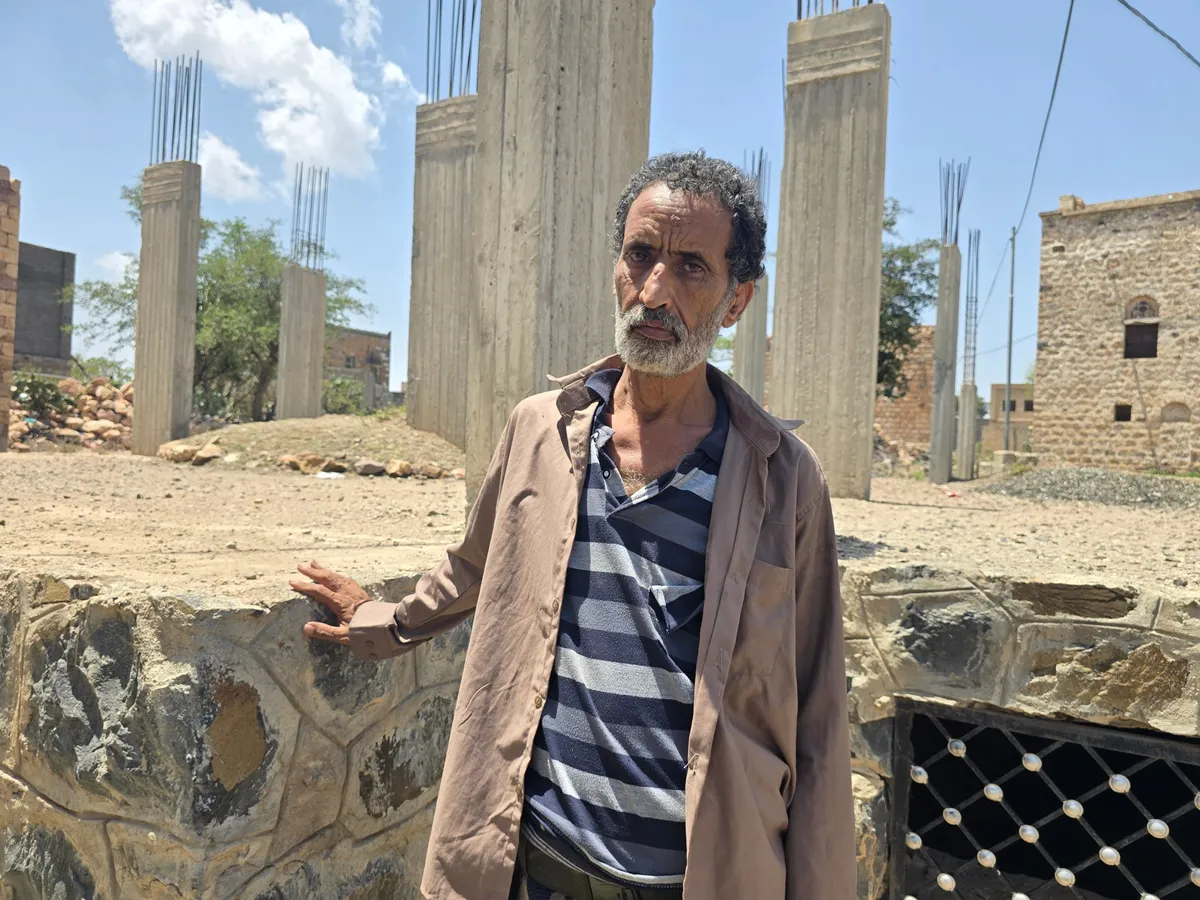
Yemen’s health professionals have been leaving the country in search of higher income and a safer working environment, with foreign doctors making up part of the shortage.Ahmed Nagi, who is in his 50s, can barely walk without a cane and cannot access the medical care he needs [Nasser al-Sakkaf/Al Jazeera]Published On 4 Jul 2026Taiz, Yemen – Ahmed Nagi, a Yemeni man in his 50s, had worked for more than 30 years as a porter in al-Turbah market in Taiz governorate before disaster struck.By helping shoppers carry goods from stalls to their cars, he earned enough money to provide a decent living for his family of seven. But all this all changed two years ago, when he was stuck down with liver complications, leaving him unable to continue his work.Now, Nagi can hardly move without the aid of a walking stick, which he relies on whenever he leaves the house. Being out of work, he also cannot afford to pay for the medicine he should be taking to treat his condition.“I was told by doctors, who are not liver specialists, that my liver isn’t functioning properly, but they weren’t sure if that is the root problem. It has left me barely able to walk, and sometimes I can’t move at all,” Nagi told Al Jazeera English.“Generous people provided me with medicine for a few months, but I didn’t recover, and my health is worsening every day,” he said.From a poor family, Nagi was only able to afford care at a local hospital, but he was told that to treat his condition properly, he would need to seek specialised care at a medical centre in the capital, Sanaa, or Aden.For a man reliant on the charity of others to put food on his table, paying for medical treatment in another governorate is nearly impossible.“Travelling to Aden or Sanaa requires a lot of money, and I am unemployed. But I pray to God every day and hope someone will help me get better one day,” he added.Yemen suffers from a severe shortage of skilled health workers, with 18 percent of districts across the country completely lacking doctors, according to the World Health Organization (WHO). Many of the nation’s most qualified health professionals left Yemen long ago, in search of better opportunities abroad.Yemenis who can afford medical care overseas now travel to Egypt, Jordan, India and other countries for treatment. Those without funds have no option but to seek treatment at home – but nearly 12 years of war and other challenges have seen a massive brain drain from Yemen, decimating the country’s health sector.Ahmed Nagi was struck down with a liver condition, leaving him unable to work and afford proper medical treatment [Nasser al-Sakkaf/Al Jazeera]Losing an eye, risking the otherTaha Nabil, 45, from al-Shimayateen district in Taiz governorate, has suffered from a cataract in his right eye, and like Nagi, has been unable to find the right treatment in his area.With no ophthalmologist working nearby, he managed to save enough money for surgery with an eye specialist in Taiz, but even then he was to become a victim of the brain drain.“I thought the surgery would be straightforward, and I didn’t hesitate to do it, but I later regretted the decision,” Nabil told Al Jazeera. “Before the surgery, my vision was just blurry, but afterwards, I lost sight in that eye completely.”After seeking care for his cataract, he is now seeking an ophthalmologist who can restore the vision in his right eye, but finding a qualified medical professional and the $4,000 to cover the costs of treatment are proving a difficult task.“I don’t know of any Yemeni ophthalmologists who can truly help me, and seeking proper medical care costs a fortune these days,” Nabil added. “Before 2015, there were doctors who could have treated this, but many of them have left the country, leaving patients stranded without proper healthcare.”With proper medical attention unaffordable, Nabil has no choice but to adapt to daily life using just one eye.“Ophthalmologists have warned me that the vision in my left eye will also deteriorate if I don’t receive proper treatment, but that is simply out of my hands.”Brain drainThe impact on the country’s healthcare has been profound. Today, Yemen’s physician ratio stands at a mere 0.1 doctors per 1,000 people, according to the World Bank, far below the regional average of 1.1. By comparison, the global average is 1.9, and the Arab world sits at 1.2. Other fragile, conflict-affected regions average about 0.5.Driven by years of war and severe shortages in funding, the collapse of Yemen’s healthcare system has left at least 20 million Yemenis – nearly half the population – without access to basic medical care. At least half of health facilities are entirely non-functional, critically hindering the country’s ability to respond to recurring outbreaks of diseases like cholera and diphtheria.Dr Ismail al-Hamoudi, the deputy director of the Public Health and Population Office in Taiz governorate, said the acute shortage of specialised medical personnel has severely restricted access to essential healthcare for thousands of residents.“Around 41 percent of the medical staff in Taiz have been displaced or have left the country entirely. This has placed immense pressure on the remaining medical personnel who are trying to maintain services,” al-Hamoudi told Al Jazeera.Dr Abdulkareem Mubarak, deputy director of the National Programme at the Ministry of Health in Aden, said that a brain drain of qualified health personnel is the main reason behind Yemen’s severe medical staffing crisis.Taha Nabil, 45, who completely lost sight in his right eye, risks going entirely blind if he cannot access the medical care he needs [Nasser al-Sakkaf/Al Jazeera]“There are numerous factors driving the migration of our qualified medical staff, with low income and irregular salary payments being chief among them. The current pay simply does not allow medical professionals to provide for their families,” Mubarak told Al Jazeera.A lack of basic medical supplies, non-functioning equipment and frequent electricity blackouts have also deeply frustrated healthcare workers, many of whom feel unable to perform their duties properly under such challenging conditions.“While the ministry cannot afford the high salaries needed to convince qualified professionals to stay in Yemen, it has been doing its best to find alternative solutions. This includes partnering with humanitarian organisations to provide financial incentives for the remaining medical staff,” Mubarak said.Recruitment of foreign medicsAs an emergency measure and to fill gaps in critical and specialised medical care, hospitals have started to recruit foreign doctors, including from Syria.“Recruiting foreign staff isn’t the ultimate solution, as it is highly costly, but it does help fill the void and allows for the transfer of knowledge from foreign medical professionals to their Yemeni counterparts,” Mubarak said.On June 12, two Syrian doctors, Samer Ahmed Hassan and his wife Dr Samaher al-Mousa, were caught in crossfire and died after a gunman opened fire on guards at the Aden governor’s residence.Remarkably, despite the fraught security situation, Syrian doctors continue to arrive in Yemen, working in public and private hospitals across the country.Dr Ahmed, a Syrian orthopaedist working in Taiz governorate, who wanted to use a pseudonym for security reasons, said stories of brain drain in Yemen were one reason he left Syria for the country three years ago.“I had heard about the dire shortage of medical personnel in Yemen, so I was eager to come and help provide Yemenis with the medical care they so desperately need,” he told Al Jazeera.Although the influx of foreign doctors is alleviating pressure on Yemeni medical professionals, it is still not enough to significantly bring down medical bills, and doctors are still working tirelessly. Ahmed said he is carrying out around ten major operations a month, more than double the number a surgeon would typically work on.Despite the instability, Ahmed says he has no intention of joining the hundreds of other Syrian doctors seeking work in Europe and the Gulf.Nabil, who lost sight in his right eye, said he had heard of a specialist Syrian doctor capable of treating his condition, but the continued shortage of specialists means the bill will likely be more than he can afford.“It seems there are Syrian ophthalmologists who could help me, but I simply cannot afford the cost of the surgery,” Nabil said.
SRCAl Jazeera
LANGEN
LEANCenter
WORDS1 367
ENT12
SAT · 2026-07-04 · 13:38 GMTBRIEF NSR-2026-0704-90006
NSR-2026-0704-90006News Report·EN·Public Health
Brain drain leaves Yemen’s health sector in tatters and millions helpless
Yemen's healthcare sector is severely weakened by a significant brain drain, with skilled health professionals leaving the country for better income and safer environments. This exodus has left millions of Yemenis, like Ahmed Nagi and Taha Nabil, unable to access essential and specialized medical care.
Nasser Al-SakkafAl JazeeraFiled 2026-07-04 · 13:38 GMTLean · CenterRead · 6 min
Al JazeeraFIG 01
Reading time
6min
Word count
1 367words
Sources cited
1cited
Entities identified
12entities
Quality score
100%
§ 01
Briefing Summary
AI-generatedNEWSAR · AI
Yemen's healthcare sector is severely weakened by a significant brain drain, with skilled health professionals leaving the country for better income and safer environments. This exodus has left millions of Yemenis, like Ahmed Nagi and Taha Nabil, unable to access essential and specialized medical care. The World Health Organization reports that 18 percent of districts lack doctors, and the physician ratio is a mere 0.1 per 1,000 people, far below regional and global averages. Years of conflict and underfunding have rendered half of Yemen's health facilities non-functional, impacting the nation's ability to combat disease outbreaks and leaving approximately 20 million people without basic medical services.
Confidence 0.90Sources 1Claims 4Entities 12
§ 02
Article analysis
Model · rule-basedFraming
Public Health
Human Interest
Tone
Mixed Tone
AI-assessed
CalmNeutralAlarmist
Factuality
0.70 / 1.00
Factual
LowHigh
Sources cited
1
Limited
FewMany
§ 03
Key claims
4 extracted01
18 percent of districts across Yemen completely lack doctors, according to the World Health Organization (WHO).
statisticWorld Health Organization (WHO)
Confidence
1.00
02
Yemen suffers from a severe shortage of skilled health workers due to a massive brain drain.
factual
Confidence
0.90
03
Ahmed Nagi, a Yemeni man in his 50s, cannot afford necessary medical care for his liver complications.
quoteAhmed Nagi
Confidence
0.90
04
Yemen's health professionals are leaving the country due to seeking higher income and safer working environments.
factual
Confidence
0.90
§ 04
Full report
6 min read · 1 367 words§ 05
Entities
12 identifiedKey playerOppositionContextPositiveNeutralNegative
Organizations2
Locations7
Events1
§ 06
Keywords & salience
10 termsbrain drain
1.00
health sector
1.00
yemen
0.90
healthcare access
0.80
medical care
0.70
health professionals
0.70
skilled health workers
0.60
war
0.50
shortage of doctors
0.50
taiz
0.40
§ 07
Topic connections
Interactive graph Network visualization showing 51 related topics
View Full Graph Person Organization Location Event|Click node to navigate|Edge numbers = shared articles