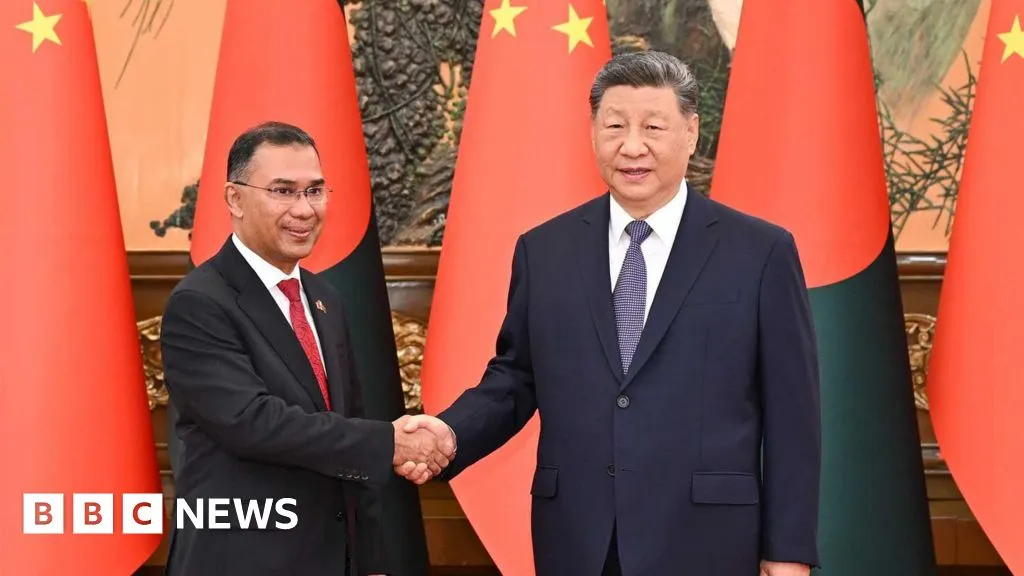
ANIBangladesh Prime Minister Tarique Rahman held talks with Chinese President Xi Jinping during his recent trip to BeijingBangladesh's new government has sought greater Chinese investments and partnership to revive a stuttering economy, even as it attempts to re-balance ties with neighbouring India.Bangladeshi Prime Minister Tarique Rahman went to Malaysia and China in his first overseas official visit last month, signalling the direction of Dhaka's foreign policy.Analysts say the choice of destinations reflects Dhaka's effort to recalibrate its strategic priorities. While Rahman first visited Malaysia, his trip to China is seen as the more significant.India has historically been the traditional port of call for newly-elected South Asian leaders. Some in India have viewed Rahman's China visit as a message to Delhi which has maintained close ties with the ousted Bangladeshi leader Sheikh Hasina.Among several bilateral agreements, Rahman's outreach to Beijing for help managing the Teesta River and a deal to develop a special economic zone near Mongla port have attracted particular attention.These are closely watched in Delhi as the two Asian giants compete for influence in Bangladesh.Relations between Dhaka and Delhi turned frosty after the overthrow of prime minister Sheikh Hasina in August 2024 in a mass uprising. She fled the country and took refuge in Delhi.Diplomatic ties remained strained after the interim government led by Muhammad Yunus took office, with India avoiding high-level visits.After Rahman took over following a landslide victory for his Bangladesh-nationalist-party" class="entity-link entity-organization" data-entity-id="5960" data-entity-type="organization">Bangladesh Nationalist Party (BNP) in February, both sides have taken initiatives to reset their ties."There is no doubt there has been a relative relaxation of tensions between the two countries," former Indian foreign secretary Shyam Saran told the BBC."The cross-border economic activities are gradually returning to normal and India is also issuing tourist visas to Bangladeshis," he said.Passenger bus services between India and Bangladesh have partially resumed after an 18-month gap. Services now operate between Kolkata and Dhaka, and between Dhaka and Agartala. When the war in the Middle East broke out earlier this year and hit global fuel supplies, Delhi sent thousands of tonnes of emergency fuel via the cross-border Friendship Pipeline to Bangladesh.Last month, India's new High Commissioner to Dhaka, Dinesh Trivedi, took charge. In a rare move, Delhi elevated him to cabinet rank, signalling its intent to reset bilateral ties.Despite diplomatic tensions and the two countries imposing tit-for-tat restrictions on trade when the interim government was in power, bilateral trade last year stood at around £13bn, mostly in India's favour.Nevertheless, the rapprochement between Dhaka and Delhi is not as expected and there are continuing irritants in the bilateral relationship.A strong anti-India sentiment, mainly for supporting Hasina, and attempts by the Indian Border Security Force to push people, who they deem as illegal immigrants, into Bangladesh have triggered controversy and anger in Dhaka.Bangladeshi officials say India has pushed in thousands of people, mainly Bengali-speaking Muslims, in recent years without following any due repatriation process.AFP via Getty ImagesBangladeshi officials say India has pushed in thousands of people, mainly Bengali-speaking Muslims, in recent years without following any due repatriation processBangladeshi analysts further point out that the alleged inflammatory comments against Bangladesh during India's West Bengal state elections by Hindu-nationalist politicians are sending mixed signals to Dhaka."All these things got high visibility and created public dissatisfaction in Bangladesh which in a way reflected on Dhaka's thinking process," says Humayun Kabir, a former Bangladeshi diplomat."The Bangladeshi government didn't look at these issues or positive indications," he adds.In May, the Hindu nationalist BJP ousted the regional Trinamool Congress in West Bengal, ending its nearly 16-year rule in the Bangladesh-bordering state. West Bengal and Bangladesh share linguistic, cultural and ethnic ties.Any Chinese role in managing the Teesta River is a sensitive security issue for India. The river is shared by India and Bangladesh, whose efforts to reach a water-sharing agreement have stalled for years. During Rahman's visit to Beijing, Bangladesh said the two sides agreed to conduct a joint technical feasibility study on managing the river.Experts say the river needs dredging, desilting and measures to restore its flow for agriculture."Any Chinese involvement in any project close to our border will always be a matter of concern. So, we would certainly not welcome that at all," Saran says.India and China have a decades-long border dispute. A brief war in 1962 ended in a humiliating defeat for India, and more recent border clashes have claimed lives on both sides. Any Chinese role in the project would bring it closer to the strategically vital Siliguri Corridor, or "Chicken's Neck" - the 22km (14-mile) strip linking India's mainland to its seven north-eastern states.Bangladeshi officials say previous governments also invited India to join the Teesta project, but Delhi took too long to decide. They argue China has the expertise and financial resources to deliver a project of this scale.Beijing has stepped in to allay India's concerns."I would like to stress that China-Bangladesh cooperation does not target any third party and should be free from third party influence," Chinese Foreign Ministry Spokesperson Guo Jiakun told reporters in Beijing during Rahman's recent visit.China is already Bangladesh's biggest defence supplier, accounting for more than 70% of its arms imports. Dhaka also owes Beijing more than $6bn (£4.5bn).During Rahman's visit, China also offered to develop the China-Myanmar-Bangladesh Economic Corridor - connecting China's Yunnan province to the two countries.India has long viewed South Asia as its sphere of influence, but China has steadily expanded its footprint in Bangladesh, Sri Lanka and the Maldives.India's efforts to rebuild ties with Bangladesh's new government are complicated by the continued presence in Delhi of deposed prime minister Sheikh Hasina, whose extradition Dhaka has sought.Hasina was convicted in absentia of crimes against humanity over a crackdown on student-led protests that left hundreds dead. She denied the charges and was sentenced to death by a special tribunal last year."As long as Hasina is in Delhi, it may be somewhat difficult politically for Rahman to come to India," says Saran.But some experts say Rahman may still visit Delhi as India remains too important a neighbour - economically and strategically - for Dhaka to ignore.India, too, knows that stable ties with Bangladesh are vital to security in its north-east, where several ethnic separatist groups operate.For Rahman, balancing Dhaka's ties with the two regional powers is going to be a delicate diplomatic balancing act.Follow BBC News India on Instagram, YouTube, Twitter and Facebook.
SRCBBC News - World
LANGEN
LEANCenter
WORDS1 053
ENT12
MON · 2026-07-06 · 00:02 GMTBRIEF NSR-2026-0706-90338
NSR-2026-0706-90338News Report·EN·Political Strategy
Bangladesh courts China even as ties with India improve
Bangladesh's new government, led by Prime Minister Tarique Rahman, is seeking increased Chinese investment and partnership to boost its economy. This comes as Dhaka works to improve relations with neighboring India, which had become strained after the overthrow of the previous government.
2 hours agoShareSaveAdd as preferred on GoogleAnbarasan EthirajanGlobal Affairs CorrespondentBBC News - WorldFiled 2026-07-06 · 00:02 GMTLean · CenterRead · 5 min
BBC News - WorldFIG 01
Reading time
5min
Word count
1 053words
Sources cited
2cited
Entities identified
12entities
Quality score
100%
§ 01
Briefing Summary
AI-generatedNEWSAR · AI
Bangladesh's new government, led by Prime Minister Tarique Rahman, is seeking increased Chinese investment and partnership to boost its economy. This comes as Dhaka works to improve relations with neighboring India, which had become strained after the overthrow of the previous government. Rahman's recent overseas visits to Malaysia and China signal a recalibration of Bangladesh's foreign policy priorities. While relations with India are showing signs of improvement, including the resumption of bus services and emergency fuel aid, irritants remain, such as anti-India sentiment and border issues. China's potential involvement in managing the Teesta River, a sensitive issue for India, is a particular point of attention.
Confidence 0.90Sources 2Claims 5Entities 12
§ 02
Article analysis
Model · rule-basedFraming
Political Strategy
Diplomatic
Tone
Measured
AI-assessed
CalmNeutralAlarmist
Factuality
0.70 / 1.00
Factual
LowHigh
Sources cited
2
Limited
FewMany
§ 03
Key claims
5 extracted01
Relations between Dhaka and Delhi became strained after the overthrow of Prime Minister Sheikh Hasina in August 2024.
factual
Confidence
0.95
02
Passenger bus services between India and Bangladesh have partially resumed, operating between Kolkata and Dhaka, and Dhaka and Agartala.
factual
Confidence
0.90
03
Bangladesh's new government is seeking greater Chinese investments and partnership to revive its economy.
factual
Confidence
0.90
04
Bilateral trade between Bangladesh and India stood at around £13bn last year, mostly in India's favour.
statistic
Confidence
0.85
05
Prime Minister Tarique Rahman's visit to China is seen as more significant than his prior visit to Malaysia.
factualAnalysts
Confidence
0.80
§ 04
Full report
5 min read · 1 053 words§ 05
Entities
12 identifiedKey playerOppositionContextPositiveNeutralNegative
People5
Organizations1
§ 06
Keywords & salience
10 termsbangladesh foreign policy
1.00
china investment
0.90
india bangladesh relations
0.90
strategic priorities
0.80
economic partnership
0.70
regional influence
0.60
special economic zone
0.50
teesta river management
0.50
tarique rahman
0.40
xi jinping
0.40
§ 07
Topic connections
Interactive graph Network visualization showing 16 related topics
View Full Graph Person Organization Location Event|Click node to navigate|Edge numbers = shared articles