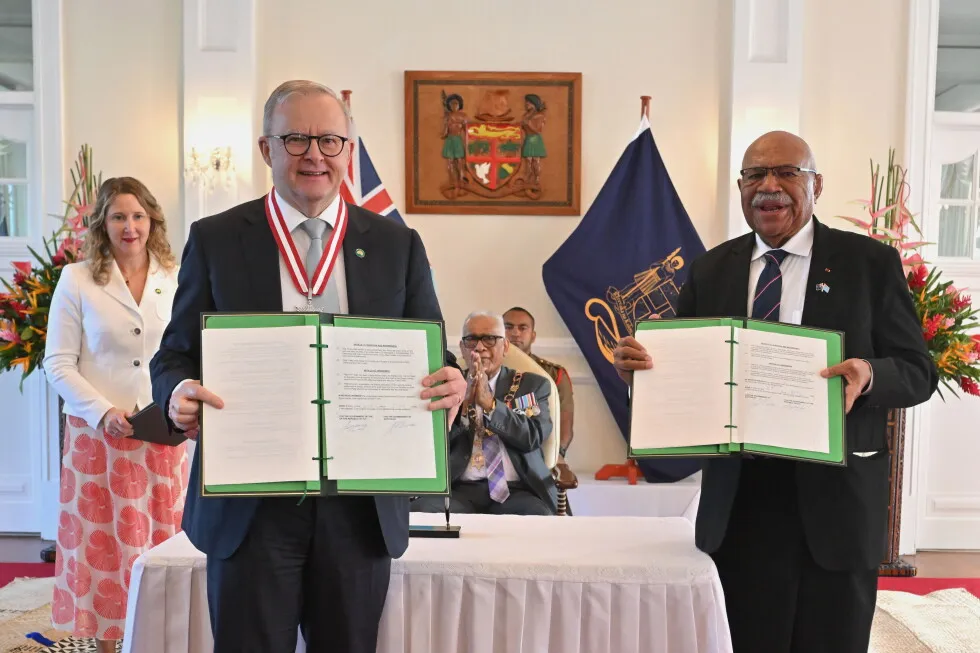
Australia and Fiji seal a new mutual defense pact in a push to counter China in the Pacific 1 of 2 | Australia’s Prime Minister Anthony Albanese, left, and Fiji’s Prime Minister Sitiveni Rabuka display a new bilateral defense alliance they have just signed at State House in Suva, Fiji, Monday, July 6, 2026. (Mick Tsikas/AAP Image via AP) 2 of 2 | Australia’s Prime Minister Anthony Albanese, left, and Fiji’s Prime Minister Sitiveni Rabuka are offered kava, a traditional Fijian drink, during welcome a ceremony in Suva, Fiji, Monday, July 6, 2026. (Mick Tsikas/AAP Image via AP) By ROD MCGUIRK Updated 6:57 AM MESZ, July 6, 2026 Add AP News on Google Add AP News as your preferred source to see more of our stories on Google. Share Share Facebook Copy Link copied Print Email X LinkedIn Bluesky Flipboard Pinterest Reddit MELBOURNE, Australia (AP) — Australia and Fiji on Monday signed a new bilateral defense alliance in a second major diplomatic win within a year for Australian Prime Minister Anthony Albanese against Chinese influence in the South Pacific. Albanese and his Fijian counterpart Sitiveni Rabuka signed the Ocean of Peace Alliance in Fiji’s capital Suva. They also signed an economic treaty, the Vuvale Union, under which Australia will invest more than 1 billion Australian dollars ($693 million) in its island neighbor over a decade. The alliance is Fiji’s first mutual defense treaty. It is Australia’s fourth, following a treaty with the United States and New Zealand signed in 1951 and the bilateral treaty signed with Papua New Guinea last year. “The Ocean of Peace Alliance introduces a mutual defense obligation and there’s no higher obligation than to come to each other’s aid at a time of need,” Albanese told reporters. Rabuka did not expect a negative reaction from Beijing to the new treaties. “I do not expect China to have any severe pushback on either government. And I believe that they will welcome the understanding that is between Australia and Fiji,” Rabuka told reporters. Trump won big spending promises from NATO last year. This week in Turkey, he’ll try to enforce them 5 MIN READ Canada to decide between German, South Korean submarine bids on Monday 1 MIN READ Trump to meet with Ukraine’s Zelenskyy and Syria’s al-Sharaa during the NATO summit 2 MIN READ “It does not threaten Fiji’s relationship with China nor Australia’s relationship with China,” he added. Rabuka said the new bilateral agreements were anchored on three central pillars: deeper security cooperation, enhanced economic integration and strengthened people-to-people connection. “This is a clear affirmation of Australia’s sustained commitment to the stability, resilience and prosperity of the Blue Pacific region at a time of global uncertainty,” Rabuka said. “These treaties reflect our shared understanding of the evolving and interconnected challenges that are facing our region,” he added. Australia has been attempting to shore up its role as the security partner of choice in the region since 2022 when China struck a secretive security treaty with the Solomon Islands. That deal raised fears of a Chinese naval base being built in the South Pacific. Albanese will fly to the Solomons on Tuesday to meet with his counterpart Matthew Wale after the two nations agreed to further discussions on a security pact. Wale said while visiting Australia last month that his new government would review the deal with Beijing. On Wednesday, Albanese will host Papua New Guinea Prime Minister James Marape and Tongan Prime Minister Fatafehi Fakafānua in the Australian city of Brisbane. The Australian defense treaty with Papua New Guinea, the country’s nearest neighbor, takes effect Wednesday. Australia and Vanuatu last week signed a long-awaited bilateral security and economic treaty that prevents China creating a military base on that island nation. Albanese signed the so-called Nakamal Agreement with his Vanuatu counterpart, Jotham Napat, in the Australian capital nine months after the Vanuatuan government rejected an earlier draft. Vanuatu had feared the deal would limit its ability to attract infrastructure investment. China expressed concern last week that the Nakamal Agreement may be targeted at Beijing. ROD MCGUIRK McGuirk covers Australian and South Pacific news for The Associated Press. He is based in Melbourne. mailto
SRCAssociated Press (AP)
LANGEN
LEANCenter
WORDS695
ENT12
MON · 2026-07-06 · 05:23 GMTBRIEF NSR-2026-0706-90385
NSR-2026-0706-90385News Report·EN·Diplomatic
Australia and Fiji seal a new mutual defense pact in a push to counter China in the Pacific
Australia and Fiji have signed a new bilateral defense alliance, the "Ocean of Peace Alliance," and an economic treaty, the "Vuvale Union," in Suva, Fiji. This alliance is Fiji's first mutual defense treaty and Australia's fourth.
Associated Press (AP)Filed 2026-07-06 · 05:23 GMTLean · CenterRead · 3 min
Associated Press (AP)FIG 01
Reading time
3min
Word count
695words
Sources cited
2cited
Entities identified
12entities
Quality score
100%
§ 01
Briefing Summary
AI-generatedNEWSAR · AI
Australia and Fiji have signed a new bilateral defense alliance, the "Ocean of Peace Alliance," and an economic treaty, the "Vuvale Union," in Suva, Fiji. This alliance is Fiji's first mutual defense treaty and Australia's fourth. The agreements aim to deepen security cooperation, enhance economic integration, and strengthen people-to-people connections between the two nations. Australian Prime Minister Anthony Albanese stated the alliance establishes a mutual defense obligation, while Fijian Prime Minister Sitiveni Rabuka expressed that the treaties do not threaten Fiji's or Australia's relationships with China. These pacts are part of Australia's broader effort to counter Chinese influence in the South Pacific, following similar recent security agreements with Vanuatu and an upcoming defense treaty with Papua New Guinea.
Confidence 0.90Sources 2Claims 5Entities 12
§ 02
Article analysis
Model · rule-basedFraming
Diplomatic
National Security
Tone
Measured
AI-assessed
CalmNeutralAlarmist
Factuality
0.80 / 1.00
Factual
LowHigh
Sources cited
2
Limited
FewMany
§ 03
Key claims
5 extracted01
The new bilateral agreements are anchored on deeper security cooperation, enhanced economic integration, and strengthened people-to-people connection.
quoteSitiveni Rabuka
Confidence
1.00
02
Fiji's Prime Minister does not expect a negative reaction from Beijing regarding the new treaties.
quoteSitiveni Rabuka
Confidence
1.00
03
The Ocean of Peace Alliance introduces a mutual defense obligation.
quoteAnthony Albanese
Confidence
1.00
04
Australia and Fiji also signed an economic treaty, the Vuvale Union, with Australia investing over 1 billion Australian dollars in Fiji over a decade.
factual
Confidence
1.00
05
Australia and Fiji signed a new bilateral defense alliance called the Ocean of Peace Alliance.
factual
Confidence
1.00
§ 04
Full report
3 min read · 695 words§ 05
Entities
12 identifiedKey playerOppositionContextPositiveNeutralNegative
Locations7
§ 06
Keywords & salience
10 termscounter china
1.00
mutual defense pact
1.00
pacific
0.90
australia
0.80
fiji
0.80
bilateral defense alliance
0.70
economic treaty
0.60
south pacific
0.50
geopolitics
0.40
security
0.40
§ 07
Topic connections
Interactive graph Network visualization showing 14 related topics
View Full Graph Person Organization Location Event|Click node to navigate|Edge numbers = shared articles