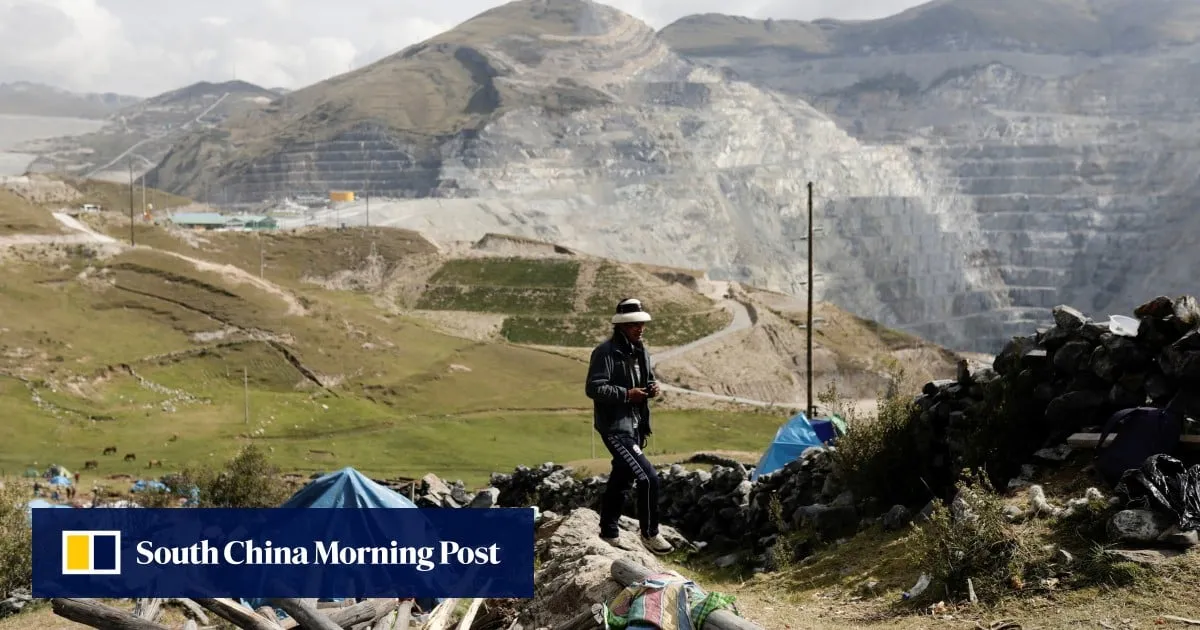
Peru wants to move to the next phase of its economic relationship with China to reduce the risks from trade ties dominated by the export of raw minerals, according to the country’s ambassador, Carlos Vasquez.He told Tsinghua University’s World Peace Forum in Beijing on Friday that Peru was now seeking investment in the country’s infrastructure as it sought to diversify its economy.He said a handful of products – including copper, iron and fishmeal – accounted for more than 90 per cent of Peru’s exports to China.Vasquez said even though the country was currently benefiting from high prices for raw materials “we don’t determine the price, the price is determined by some foreign markets”.Supported by strong global demand for minerals such as copper, iron and zinc, Peru’s economy grew by about 3 per cent last year and is projected to grow by 3.6 per cent this year.Vasquez said these commodities had an increasing strategic importance as China expanded its industrial base and accelerated its energy transition, but the situation was “not sustainable in the long term”.
SRCSouth China Morning Post
LANGEN
LEANCenter-Right
WORDS175
ENT12
MON · 2026-07-06 · 12:54 GMTBRIEF NSR-2026-0706-90492
NSR-2026-0706-90492News Report·EN·Diplomatic
Why Peru wants to shift its relationship with China beyond raw mineral supplies
Peru's Ambassador to China, Carlos Vasquez, stated at Beijing's World Peace Forum that Peru aims to evolve its economic relationship with China beyond its current reliance on raw mineral exports. He explained that a small number of products, including copper, iron, and fishmeal, constitute over 90% of Peru's exports to China, making the country vulnerable to fluctuating global market prices.
Cao JiaxuanSouth China Morning PostFiled 2026-07-06 · 12:54 GMTLean · Center-RightRead · 1 min
South China Morning PostFIG 01
Reading time
1min
Word count
175words
Sources cited
1cited
Entities identified
12entities
Quality score
100%
§ 01
Briefing Summary
AI-generatedNEWSAR · AI
Peru's Ambassador to China, Carlos Vasquez, stated at Beijing's World Peace Forum that Peru aims to evolve its economic relationship with China beyond its current reliance on raw mineral exports. He explained that a small number of products, including copper, iron, and fishmeal, constitute over 90% of Peru's exports to China, making the country vulnerable to fluctuating global market prices. To mitigate these risks and diversify its economy, Peru is now seeking Chinese investment in its infrastructure. While acknowledging the current economic benefits from high commodity prices, Vasquez emphasized that this situation is not sustainable long-term, despite the growing strategic importance of these minerals for China's industrial expansion and energy transition.
Confidence 0.90Sources 1Claims 5Entities 12
§ 02
Article analysis
Model · rule-basedFraming
Diplomatic
Economic Impact
Tone
Measured
AI-assessed
CalmNeutralAlarmist
Factuality
0.80 / 1.00
Factual
LowHigh
Sources cited
1
Limited
FewMany
§ 03
Key claims
5 extracted01
The current reliance on commodity exports is not sustainable in the long term.
quoteCarlos Vasquez
Confidence
1.00
02
Over 90% of Peru's exports to China consist of a few products like copper, iron, and fishmeal.
statisticCarlos Vasquez
Confidence
1.00
03
Peru is seeking investment in infrastructure to diversify its economy.
quoteCarlos Vasquez
Confidence
1.00
04
Peru seeks to shift its economic relationship with China beyond raw mineral supplies to reduce risks.
quoteCarlos Vasquez
Confidence
1.00
05
Peru's economy grew by about 3% last year and is projected to grow by 3.6% this year, supported by global demand for minerals.
statistic
Confidence
0.90
§ 04
Full report
1 min read · 175 words§ 05
Entities
12 identifiedKey playerOppositionContextPositiveNeutralNegative
Organizations1
§ 06
Keywords & salience
9 termsraw mineral supplies
1.00
economic relationship
1.00
diversify economy
0.90
infrastructure investment
0.80
export of raw minerals
0.70
trade ties
0.60
foreign markets
0.50
global demand
0.50
energy transition
0.40
§ 07
Topic connections
Interactive graph Network visualization showing 46 related topics
View Full Graph Person Organization Location Event|Click node to navigate|Edge numbers = shared articles