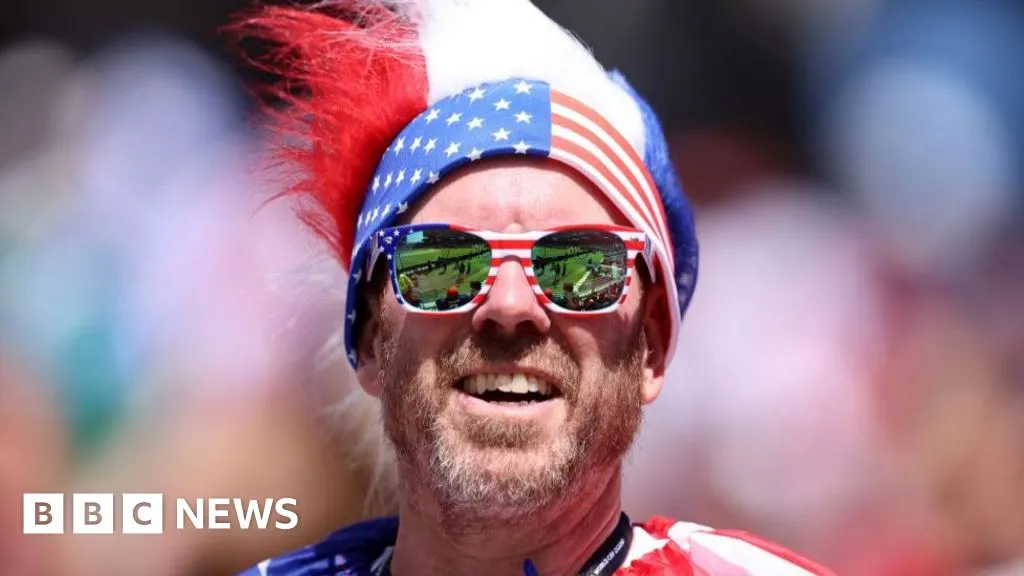
In many countries, football is not just a national sport but an obsession nurtured over decades.That can't be said about World Cup co-hosts USA where American sports have a longer history and dominate the media coverage, the sponsorship deals and the national conversation.Soccer, as it's known in the US, has made big strides in the country since it last hosted the men's tournament in 1994. But it's still some way behind women's football, which is a global powerhouse and higher up the US sporting pecking order.As the men's team prepare to face Belgium on Monday evening for a place in the last eight, could they capitalise on this rare national spotlight to elevate the game to new heights of popularity - and muscle in on baseball, American football, basketball and ice hockey?Americans are flocking to World Cup matches in every corner of the country, and celebrities and ardent football fans have been donning stars and stripes for the US Men's National Team (USMNT).Pop-up shops are teeming with football merchandise and viewing parties are spread across parks, shopping centres and even museums. The sight of USA fans in colourful jerseys is commonplace throughout the host cities, and just about every restaurant with a TV has patrons transfixed on the latest drama.Die-hard fans, many clad in American flags and US squad regalia, told the BBC they were convinced that whether the team won or lost, this World Cup could be a tipping point for the country.While standing in queue for a burrito just before the USA v Turkey match in downtown LA, documentary filmmaker Erik Olsen, who has watched many World Cups, said this tournament had been a unifying experience."To have all these different people come together to cheer on the US team, and maybe even their own team - if you're from Mexico or Argentina or someplace else - we need that kind of global spirit right now," he said.Getty ImagesInterest in football in the US is on the rise, but still faces stiff competition from the other professional sports - such as American football and basketballSteve Salcedo, a lifelong football fan who has been cheering during the tournament for both the US and Mexico teams, said his son and his friends had embraced the sport, more than he and his friends did at their age. And he was confident that football fever would outlast the tournament."The hype is definitely here for the World Cup, it'll be here until the World Cup ends," he forecasted. "Of course it's going to die down, but in general I think soccer is here to stay."Keenah Pacheco, 16, came to the fan zone with her mom and friend, and said she used to cheer for Mexico but now backed the US team. The excitement prompted her to consider picking up the game herself."The last time I played soccer was when I was eight years old. Watching the World Cup has really made me want to play again, so it's really bringing out this passion back," she said.This 2026 World Cup is touting record-breaking TV ratings, historic ticket demand and packed fan events across the host nations. An average US audience of 18 million tuned in for the USMNT's opener against Paraguay across Fox's platforms, and another seven million viewers watched on Spanish-language Telemundo, the broadcasters said.While tournament co-host Mexico has historically adopted the sport more deeply than Americans, the US role as co-host - plus the fact the lion's share of games have taken place US soil - has helped Americans come around to the sport more than ever before.US President Donald Trump, who hasn't yet attended any matches, has called the attendance records "a great tribute to the United States" and Fifa President Gianni Infantino has dubbed it the "most successful event in history".This tournament features more matches than ever before, and North American stadiums have enormous capacities to accommodate even more fans, naturally upping the consumption of this World Cup.Fifa announced last month that fan attendance had exceeded 3.6 million in the first two weeks of play, surpassing the record of 3.58 million set in 1994 - when the US last hosted the tournament. Many of the attendees have been American fans - not just those with family links to other teams, but also people simply adopting another nation.Getty ImagesA fan zone in SeattleBut while attendances soar and TV ratings for matches show increased interest on par with the NBA Finals and the World Series of baseball, it's not yet clear how long it will last. For some analysts, it remains to be seen whether or not this will be a breakthrough moment."It's gone from around the fringes to being mainstream in the sense that there is a strong minority group of people that love it - that's the biggest difference," said Jeff Schneider, executive director of the Center for Sports, Entertainment, Media & Technology Law at the University of Southern California (USC).Schneider argued that football - which is regarded as a "foreign import" by many Americans - is never going to be in the zeitgeist like American football or basketball. Those sports have longer-established history in the states and came of age at a time when media was not as pervasive "and when people spent their leisure time doing things, not passively consuming things".But he conceded that there was a firmly established foothold of loyal fans who both watch and play the sport - and that number has been increasing.That's mostly down to youth sports."Soccer has picked up where [American] football as a youth sport has declined," said Steve Bank, an expert in sports law at the University of California Los Angeles School of Law. "In [American] football, people worry about concussions, and that kind of thing has made it more problematic over the years."If the national team progress further, then the chances of the sport making strides in the US will increase. Belgium stand in the way on Monday evening and the scrutiny on the team's performance has only increased in the wake of the controversial rescinding of striker Folarin Balogun's red card, after a phone call between Trump and Infantino.The seeds for growth were sown 30 years ago when a professional league called Major League Soccer (MLS) was launched as part of the deal to which the US signed up when hosting the 1994 World Cup. The MLS now has 30 teams across the US and Canada and features the world's biggest star, Lionel Messi.But the biggest audience draws are the English Premier League and Spain's La Liga, which have contributed to a sharp rise in spending on football media rights, according to research by Ampere Analysis.This growth has made the US the biggest foreign market for the four largest European leagues.A recent Ampere survey of of sports fans found that football has narrowly unseated baseball as the number three sport in the US, with 10% of Americans saying it's their favourite.Challenges lie ahead though, particularly around levels of investment.The idea of transplanting the European game and the European league system to the US was unrealistic, said Bank, the expert in sports law.Other analysts identify structural barriers that prevent some Americans from connecting with football. American sports deliver definitive, immediate results with higher scores (basketball games routinely go into triple digits)."You have to be okay with not winning [in football], and Americans are not okay with not winning," said Schneider, the law professor at USC with a specialism in sport, entertainment and media."One of the main reasons why Americans have never adopted soccer is because it's impossible to dominate," he added. "You can't win year after year after year after year, like the Patriots or the Yankees. They're bandwagon hoppers, they love to get on the bandwagon for a good team, and that's not soccer."But still, a variety of factors are helping platform the sport into the mainstream in the US. These include the rise of streaming and TV programming which have made the the matches more accessible, as well as a variety of football-related entertainment programmes, such as Ted Lasso and Welcome to Wrexham - both of which humorously translated the sport for American audiences.Immigration to the US from football-crazed countries has also helped, along with the ubiquity of Fifa video games, said Bank.Longtime US fans remain optimistic about the domestic future of the sport. Olsen, who continued waiting in the lengthy line for a burrito at the fan zone in downtown LA, said this year's tournament just felt different."There's something about the fact this team is young and hungry and doing well that makes me feel there could be kind of a sea change about soccer in the US."Getty Images
SRCBBC News - World
LANGEN
LEANCenter
WORDS1 442
ENT12
MON · 2026-07-06 · 11:19 GMTBRIEF NSR-2026-0706-90512
NSR-2026-0706-90512Analysis·EN·Human Interest
Is this a breakthrough moment for soccer in the US?
The US Men's National Team's performance in the World Cup, particularly their match against Belgium, is being viewed as a potential turning point for soccer's popularity in the United States. While American football, basketball, and baseball have historically dominated the US sports landscape, this World Cup has seen unprecedented fan engagement, with record-breaking TV ratings and attendance figures.
3 hours agoShareSaveAdd as preferred on GoogleNardine SaadLos AngelesBBC News - WorldFiled 2026-07-06 · 11:19 GMTLean · CenterRead · 6 min
BBC News - WorldFIG 01
Reading time
6min
Word count
1 442words
Sources cited
3cited
Entities identified
12entities
Quality score
100%
§ 01
Briefing Summary
AI-generatedNEWSAR · AI
The US Men's National Team's performance in the World Cup, particularly their match against Belgium, is being viewed as a potential turning point for soccer's popularity in the United States. While American football, basketball, and baseball have historically dominated the US sports landscape, this World Cup has seen unprecedented fan engagement, with record-breaking TV ratings and attendance figures. Americans are flocking to viewing parties and merchandise sales are booming, indicating a growing interest in the sport. Experts and fans alike believe this tournament could elevate soccer's status, potentially making it more mainstream, though its long-term impact remains to be seen. The US co-hosting the tournament has significantly contributed to this increased national spotlight.
Confidence 0.90Sources 3Claims 5Entities 12
§ 02
Article analysis
Model · rule-basedFraming
Human Interest
Economic Impact
Tone
Measured
AI-assessed
CalmNeutralAlarmist
Factuality
0.40 / 1.00
Mixed
LowHigh
Sources cited
3
Well sourced
FewMany
§ 03
Key claims
5 extracted01
Watching the World Cup has made a 16-year-old want to play soccer again.
quoteKeenah Pacheco
Confidence
0.80
02
Soccer has made significant strides in the US since it last hosted the men's tournament in 1994.
factual
Confidence
0.80
03
The hype for the World Cup is here and will likely die down, but soccer is generally here to stay in the US.
predictionSteve Salcedo
Confidence
0.70
04
Americans are flocking to World Cup matches, and celebrities and fans are supporting the USMNT.
factual
Confidence
0.70
05
This World Cup could be a tipping point for soccer's popularity in the US, even if the team wins or loses.
quoteDie-hard fans
Confidence
0.60
§ 04
Full report
6 min read · 1 442 words§ 05
Entities
12 identifiedKey playerOppositionContextPositiveNeutralNegative
Locations4
§ 06
Keywords & salience
8 termssoccer in us
1.00
world cup
0.90
usmnt
0.80
sports popularity
0.70
american sports
0.60
national conversation
0.50
unifying experience
0.40
football fever
0.40
§ 07
Topic connections
Interactive graph Network visualization showing 51 related topics
View Full Graph Person Organization Location Event|Click node to navigate|Edge numbers = shared articles