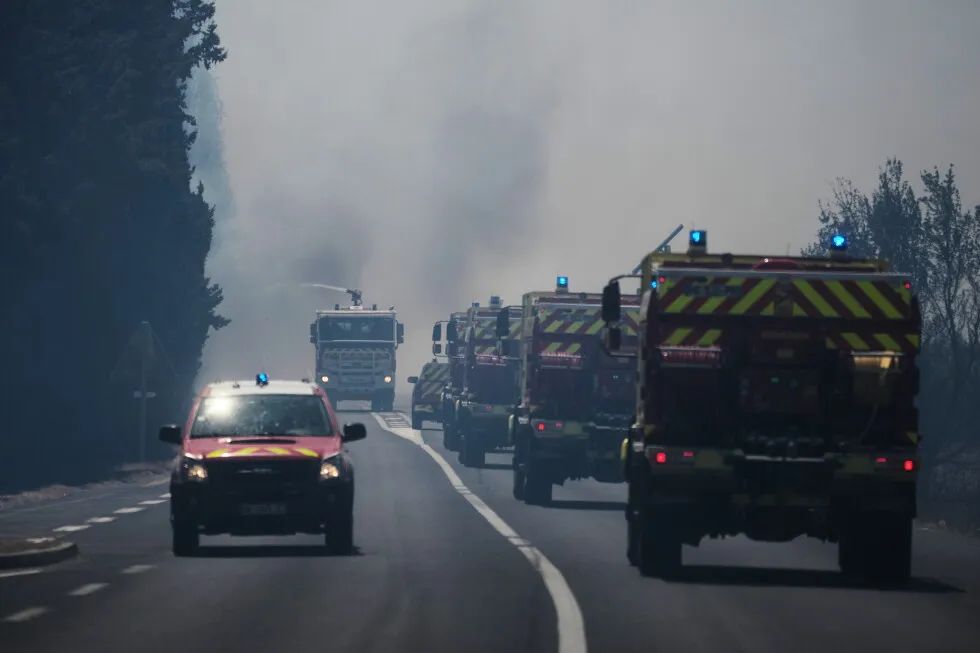
wildfire bars fans from France" class="entity-link entity-event" data-entity-id="12008" data-entity-type="event">Tour de France segment as parts of Europe sizzle again under extreme heat 1 of 3 | Firefighters work on a wildfire in Ille-sur-Têt, southern France, Monday, July 6, 2026. (AP Photo/Thibault Camus) 2 of 3 | Locals try to extinguish a wildfire on the outskirts of the northern city of Thessaloniki, Greece, Saturday, July 4, 2026. (AP Photo/Giannis Papanikos) 3 of 3 | A water bomber flies over a wildfire in Ille-sur-Têt, southern France, Monday, July 6, 2026. (AP Photo/Thibault Camus) By SUMAN NAISHADHAM Updated 4:25 PM MESZ, July 6, 2026 Leer en español Add AP News on Google Add AP News as your preferred source to see more of our stories on Google. Share Share Facebook Copy Link copied Print Email X LinkedIn Bluesky Flipboard Pinterest Reddit MADRID (AP) — A large wildfire in the south of France prompted France" class="entity-link entity-event" data-entity-id="12008" data-entity-type="event">Tour de France organizers to ban fans on Monday from attending the finale of the third stage of the cycling showpiece race. After a couple of days in Spain, the race entered France with a stage to the Pyrenees town of Les Angles, about 60 kilometers (37 miles) from a fire that has burned almost 1,821 hectares (4,500 acres) of land. France" class="entity-link entity-event" data-entity-id="12008" data-entity-type="event">Tour de France organizers said the large wildfire currently in the Pyrénées-Orientales required a large mobilization of wildfire-fighting resources, internal security forces, and other government agencies. “The top priority remains the protection of people, property, and natural areas, as well as bringing the fire under control,” authorities said. As a result, organizers decided that once the peloton reaches France for the last 40 kilometers (25 miles), the publicity caravan — a 10-kilometer (6-mile) procession of sponsor vehicles that precedes the race — would not be able to operate. Only riders and vehicles essential to the race would be allowed on the route, and spectators were asked not to gather on the roadside or at the finish area. New York resident sues ICE on free speech grounds over critical email sent to its former head 3 MIN READ Microsoft cuts 4,800 jobs, including many at Xbox in a ‘reset’ of its gaming division 1 MIN READ Prayers and celebrations for the Dalai Lama’s 91st birthday, in photos 1 MIN READ Stage 3 started from the Spanish town of Granollers, where temperatures reached around 35 degrees Celsius (95 Fahrenheit), race organizers said, quoting the Spanish Meteorological Agency. Nearly 700 firefighters were battling the blaze, which led authorities on Sunday night to order the evacuation of more than two dozen villages. Europe is the world’s fastest-warming continent, with temperatures increasing twice as fast as the global average since the 1980s, according to the European Union’s Copernicus Climate Change Service. Globally, 2025 was the third-hottest year on record, bringing severe heatwaves across Europe. In Greece, 96 wildfires had broken out over the past 48 hours, the country’s government spokesman Pavlos Marinakis said Monday. The vast majority were quickly brought under control before they could spread, he said. Scientists warn that climate change is exacerbating the frequency and intensity of heat and dryness, especially in southeastern Europe, making the region more vulnerable to health impacts and wildfires. The most significant fire broke out Sunday afternoon in the Mandra area west of the capital, Athens. Authorities deployed 29 aircraft and more than 200 firefighters in a race to tame the blaze before nightfall, when firefighting planes can no longer operate. By Monday, the fire had abated, although it had not been fully extinguished. Several parts of the country were listed as being at a high or very high risk of wildfires on Monday due to strong winds. One wildfire that broke out in the southern island of Crete triggered evacuation orders for a village near the town of Ierapetra. The blaze, which was burning through mainly agricultural land, was being fanned by strong winds, the fire department said. In the Iberian Peninsula, another surge in heat spread across Spain and Portugal, where hundreds of firefighters were also working to contain wildfires. Spain’s weather agency AEMET warned that a heatwave that began Sunday would endure at least until Thursday, bringing elevated daytime and nighttime temperatures. Across much of Spain, including the capital Madrid, daytime highs were expected to range between 37 C and 42 C (99 F and 108 F) on Monday and Tuesday. Overnight conditions were also forecast to be uncomfortably hot, with temperatures easily exceeding 20 C (68 F) — which scientists refer to as ‘tropical nights’. This means people might not be recovering properly from daytime heat in the overnight hours. In Portugal, inland locations saw temperatures soar Monday, while coastal Lisbon also baked under temperatures reaching 33 C (91 F). Temperatures were expected to drop later in the week. Associated Press writers John Leicester in Paris and Elena Becatoros in Athens contributed to this report SUMAN NAISHADHAM Naishadham is an Associated Press reporter covering Spain and Portugal. She is based in Madrid. twitter mailto
SRCAssociated Press (AP)
LANGEN
LEANCenter
WORDS827
ENT12
MON · 2026-07-06 · 14:53 GMTBRIEF NSR-2026-0706-90544
NSR-2026-0706-90544News Report·EN·Environmental
Wildfire bars fans from Tour de France segment as parts of Europe sizzle again under extreme heat
A large wildfire in southern France has forced Tour de France organizers to ban fans from the finale of the third stage. The blaze, which has burned nearly 4,500 acres, required significant resources, leading organizers to cancel the publicity caravan and restrict access for spectators along the final 25 miles of the route.
Associated Press (AP)Filed 2026-07-06 · 14:53 GMTLean · CenterRead · 4 min
Associated Press (AP)FIG 01
Reading time
4min
Word count
827words
Sources cited
3cited
Entities identified
12entities
Quality score
100%
§ 01
Briefing Summary
AI-generatedNEWSAR · AI
A large wildfire in southern France has forced Tour de France organizers to ban fans from the finale of the third stage. The blaze, which has burned nearly 4,500 acres, required significant resources, leading organizers to cancel the publicity caravan and restrict access for spectators along the final 25 miles of the route. This event occurs as parts of Europe, including Spain and Portugal, are experiencing extreme heatwaves, with temperatures in Spain expected to reach up to 108 F. Greece has also seen a surge in wildfires, with 96 outbreaks in the past 48 hours. Scientists attribute the increasing frequency and intensity of heat and wildfires to climate change.
Confidence 0.90Sources 3Claims 5Entities 12
§ 02
Article analysis
Model · rule-basedFraming
Environmental
Human Interest
Tone
Measured
AI-assessed
CalmNeutralAlarmist
Factuality
0.80 / 1.00
Factual
LowHigh
Sources cited
3
Well sourced
FewMany
§ 03
Key claims
5 extracted01
In Greece, 96 wildfires had broken out over the past 48 hours.
statisticPavlos Marinakis, Greece’s government spokesman
Confidence
1.00
02
Globally, 2025 was the third-hottest year on record, bringing severe heatwaves across Europe.
factual
Confidence
1.00
03
Europe is the world’s fastest-warming continent, with temperatures increasing twice as fast as the global average since the 1980s.
statisticEuropean Union’s Copernicus Climate Change Service
Confidence
1.00
04
The wildfire in Pyrénées-Orientales has burned almost 1,821 hectares (4,500 acres) of land.
statistic
Confidence
1.00
05
A large wildfire in southern France prompted Tour de France organizers to ban fans from attending the finale of the third stage.
factualTour de France organizers
Confidence
1.00
§ 04
Full report
4 min read · 827 words§ 05
Entities
12 identifiedKey playerOppositionContextPositiveNeutralNegative
Organizations1
Locations9
§ 06
Keywords & salience
8 termswildfire
1.00
tour de france
0.90
extreme heat
0.80
france
0.70
firefighters
0.60
evacuation
0.50
pyrenees
0.40
cycling
0.40
§ 07
Topic connections
Interactive graph No topic relationship data available yet. This graph will appear once topic relationships have been computed.