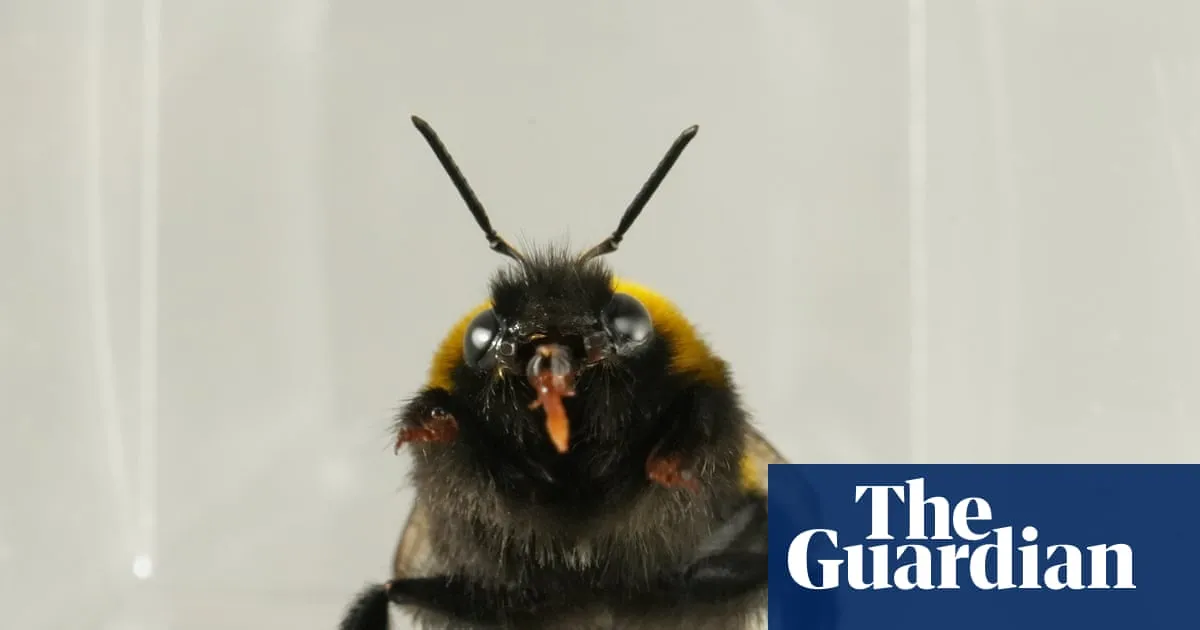
When bumblebees taste something good, they reach out their glossa – or insect tongue – for a while afterwards, almost as if they are licking their lips. And when they don’t like something, the insects will shake their heads and wipe their mouths.Scientists who captured the miniature facial expressions on slow-motion video say the behaviour is consistent with “liking” and “disliking” responses observed in mammals. Their results have been published in the journal Proceedings of the National Academy of Sciences.In the study, a collaboration between Macquarie University and the Southern Medical University in China, researchers presented bumblebees with droplets of different solutions – 60% sugar, 20% sugar, plain water, 5% salt, or quinine (at a concentration of 1 millimolar) – and recorded their reactions.Professor Andrew Barron, who researches insect behaviour at Macquarie University and who co-authored the paper, said under normal conditions the bees displayed something called “post-consumption glossa” after tasting the sweet solution: they kept on licking even after they’d finished drinking.In contrast, they showed clear distaste for salt or quinine solutions.“facial expressions are an important window into the internal states of animals,” he said. “What we found is that bees show responses with their mouthparts to solutions that indicate their subjective like or dislike of those solutions. It tells us there is an inner life to the insect.”Slow-motion footage of bumblebees shows how they react when they 'like' or 'dislike' things – videoWithout language, evidence for pleasure or pain is challenging to establish in other animals. So scientists study behavioural markers, like facial expressions, to gauge positive and negative experiences.Previous studies have shown that mammals, such as primates and rats, display clear signs of “liking” such as licking and sticking out their tongues, and “disliking”.“If a rat gets a salty taste it doesn’t like, it wipes its mouth parts, wipes its whiskers, wipes its tongue,” Barron said. “And we see something similar in a bee.”But while similar findings in mammals were readily accepted, in insects like bees, the concept of an inner life remained “highly controversial”, he said.To make sure they were not just observing a chemical reflex, the scientists tested responses with 18 colonies under a range of circumstances, including when the bees were heat-stressed, already full, or given doses of different drugs.skip past newsletter promotionafter newsletter promotionIn insects like bees, the concept of an inner life remains ‘highly controversial’, Prof Andrew Barron says. Photograph: The Bee Lab at Southern Medical UniversityThe bees’ reactions depended on context. For example, heat exposure changed their response to water or salty solutions from neutral or averse reactions to positive.It is as if someone had offered you an electrolyte drink, Barron said. “You’d probably go ‘blegh’ most of the time. Unless you’ve just been out on a really, really hot day, and done an enormous run, in which case an electrolyte drink is exactly what your body needs and it tastes fantastic.”Associate Prof Thomas White, an entomologist from the University of Sydney who was not involved in the paper, said research into insect behaviour and sentience was “a fast moving field”.What made this study fascinating was its focus on the “positive side of life”, he said, as the vast majority of research investigated negative feelings, like pain or fear.“The picture is increasingly pushing towards a view that insects, or many insects, have some simple capacity to feel the world, not just to assess it and detect it and process information, but to actually have a point of view,” White said.That was challenging for some people, he said. “It cuts against a lot of people’s intuition about where we might draw the line in the animal kingdom, as to what can feel pleasure and pain, and hence the kind of ethical and moral responsibilities we have towards those animals.”“There’s always been a tension between thinking of insects as animals, or some sort of mini robots,” Barron said. “This is another step towards showing there’s an inner life to being a bee.”
SRCThe Guardian - World News
LANGEN
LEANCenter-Left
WORDS659
ENT12
MON · 2026-07-06 · 19:00 GMTBRIEF NSR-2026-0706-90590
NSR-2026-0706-90590News Report·EN·Human Interest
Do bees have inner lives? Slow-motion video reveals bumblebee behaviour similar to ‘liking’ or ‘disliking’
A study published in *Proceedings of the National Academy of Sciences* by researchers from Macquarie University and Southern Medical University suggests bumblebees may have inner lives. Using slow-motion video, scientists observed bumblebees exhibiting behaviors similar to "liking" and "disliking" when presented with different solutions.
Petra StockThe Guardian - World NewsFiled 2026-07-06 · 19:00 GMTLean · Center-LeftRead · 3 min
The Guardian - World NewsFIG 01
Reading time
3min
Word count
659words
Sources cited
2cited
Entities identified
12entities
Quality score
100%
§ 01
Briefing Summary
AI-generatedNEWSAR · AI
A study published in *Proceedings of the National Academy of Sciences* by researchers from Macquarie University and Southern Medical University suggests bumblebees may have inner lives. Using slow-motion video, scientists observed bumblebees exhibiting behaviors similar to "liking" and "disliking" when presented with different solutions. Bees showed "post-consumption glossa," akin to licking lips, after tasting sweet solutions, and head shaking and mouth wiping in response to distasteful ones like salt or quinine. These reactions, which varied based on context such as heat stress, are comparable to mammalian responses and may indicate subjective experiences, challenging the view of insects as mere robots.
Confidence 0.90Sources 2Claims 5Entities 12
§ 02
Article analysis
Model · rule-basedFraming
Human Interest
Environmental
Tone
Mixed Tone
AI-assessed
CalmNeutralAlarmist
Factuality
0.80 / 1.00
Factual
LowHigh
Sources cited
2
Limited
FewMany
§ 03
Key claims
5 extracted01
Bees shake their heads and wipe their mouths after tasting unpleasant solutions like salt or quinine.
factualScientists
Confidence
0.90
02
Bees extend their glossa (tongue) after tasting sweet solutions, similar to 'licking lips'.
factualScientists
Confidence
0.90
03
Bumblebees exhibit behaviors resembling 'liking' or 'disliking' when tasting different solutions, observed via slow-motion video.
factualScientists
Confidence
0.90
04
These bee behaviors are consistent with 'liking' and 'disliking' responses observed in mammals.
factualProfessor Andrew Barron
Confidence
0.80
05
The findings suggest that bees have an 'inner life', though this concept remains controversial in insects.
quoteProfessor Andrew Barron
Confidence
0.70
§ 04
Full report
3 min read · 659 words§ 05
Entities
12 identifiedKey playerOppositionContextPositiveNeutralNegative
Organizations4
Locations1
§ 06
Keywords & salience
9 termsinsect inner life
1.00
bumblebee behavior
1.00
facial expressions
0.90
liking and disliking
0.90
slow-motion video
0.80
subjective experience
0.70
insect tongue
0.60
animal behavior
0.50
macquarie university
0.40
§ 07
Topic connections
Interactive graph No topic relationship data available yet. This graph will appear once topic relationships have been computed.