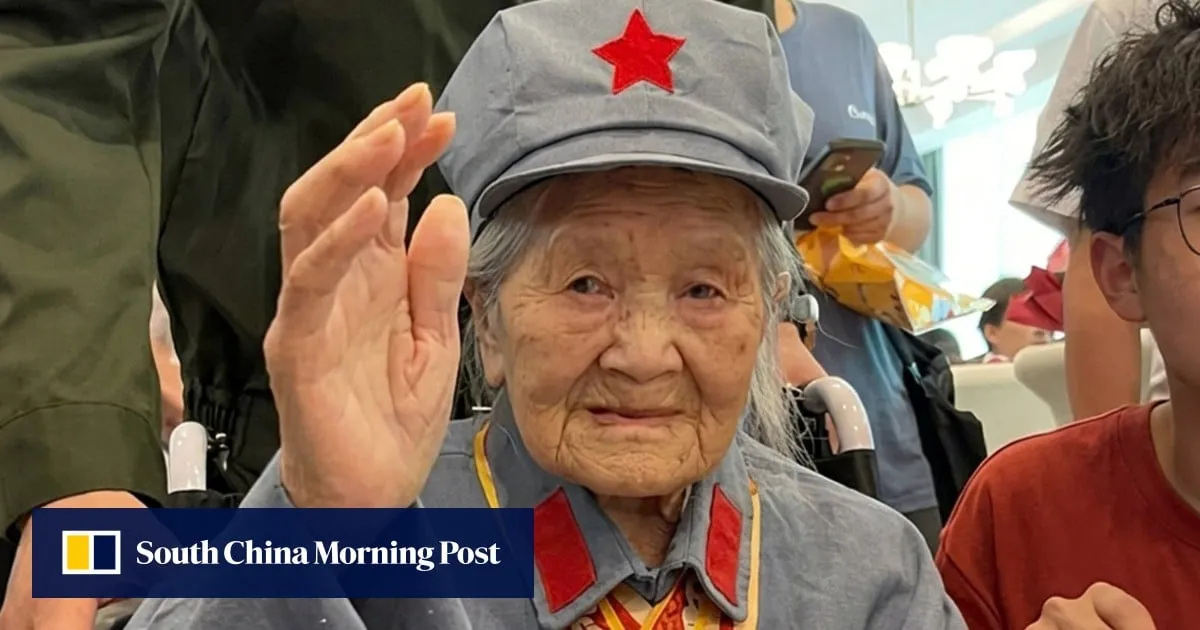
China’s last surviving female Red Army veteran has marked her 105th birthday, as her extraordinary wartime story stirred admiration across mainland social media.On June 27, Wang Quanying, from Sichuan province in southwestern China, sat in a wheelchair in military uniform, her chest adorned with medals, as relatives, volunteers and well-wishers gathered to celebrate the milestone.Although Wang never learned to read or write, local media said she could still sing Red Army songs from memory, had sharp eyesight and continued to do needlework.She has attributed her longevity to “a positive mindset, a largely vegetarian diet, compassion and a willingness to do good”.Red Army veteran Wang Quanying, adorned with medals, is surrounded by relatives, volunteers, and well-wishers on June 27 during her 105th birthday celebration. Photo: QQ.comAccording to the national state broadcaster CCTV, Wang was born into a poor rural family, was orphaned at the age of one and raised by her uncle.At five, she was sent to work for a local official’s family, herding cattle, grinding grain and doing other manual labour.In 1935, a Red Army unit stopped in her village. Wang later recalled that the soldiers did not mistreat the poor and even shared food with villagers.Inspired by their mission to help ordinary people, she joined the Red Army at 14, serving as a guide, cook, nurse and grain porter.A well-preserved official document verifying Wang’s historical enlistment and membership in her Red Army unit. Photo: QQ.comShe was also able to identify medicinal herbs and used folk remedies to treat wounded soldiers when medical supplies were scarce.The Red Army was a Communist-led force made up largely of peasants and workers.In October 1934, besieged by Kuomintang troops, it began a two-year strategic retreat from Ruijin in Jiangxi province that became known as the Long March.The campaign covered about 12,500km and more than 600 battles before the forces eventually regrouped in Gansu province in northwestern China.Further ReadingWang recalled that she was the only survivor among the 12 young Red Army soldiers who had set out with her.During a battle in 1936, she and several companions became separated from the main force. In an attempt to rejoin it, they crossed snowbound mountains, surviving on grass roots and melted snow. With no shoes, Wang lost a toe to frostbite.Wang points to her foot, where she lost a toe to severe frostbite while crossing snowbound mountains barefoot to rejoin the main Red Army force in 1936. Photo: QQ.comAfter more than a month of gruelling travel, she was stranded in Sichuan, where she concealed her identity, married a local villager and had five children. Only two daughters survived the hardship.After the founding of the People’s Republic of China in 1949, she changed her first name to Quanying, meaning “all heroes,” in tribute to fallen Red Army soldiers.Mainland reports said Wang’s lifelong regret was not being able to complete the Long March. Yet she has remained grateful, never boasting of her service, and has continued to honour the comrades who did not return.Wang now has a large family, including 10 university graduates across four generations. Her elder daughter retired from a government post, and her younger daughter was a doctor.Relatives and volunteers from across China attended her birthday banquet, where she also received two digitally restored portraits of her younger self.Wang’s extended family and volunteers from across China gather for a banquet to honour the veteran’s 105th birthday. Photo: QQ.com“Happy birthday to Grandma Wang,” one online observer wrote. “She endured unimaginable hardship and lived to see the country prosper on behalf of her fallen comrades.”“She is a woman who can hold up half the sky,” another netizen remarked.
SRCSouth China Morning Post
LANGEN
LEANCenter-Right
WORDS600
ENT9
TUE · 2026-07-07 · 06:58 GMTBRIEF NSR-2026-0707-90773
NSR-2026-0707-90773News Report·EN·Human Interest
China last female Red Army veteran who enlisted at 14 celebrates 105th birthday in uniform
Wang Quanying, China's last surviving female Red Army veteran, celebrated her 105th birthday on June 27 in Sichuan province. Enlisting at 14, she served as a guide, cook, nurse, and grain porter, even using folk remedies to treat wounded soldiers.
Zoey ZhangSouth China Morning PostFiled 2026-07-07 · 06:58 GMTLean · Center-RightRead · 3 min
South China Morning PostFIG 01
Reading time
3min
Word count
600words
Sources cited
1cited
Entities identified
9entities
Quality score
100%
§ 01
Briefing Summary
AI-generatedNEWSAR · AI
Wang Quanying, China's last surviving female Red Army veteran, celebrated her 105th birthday on June 27 in Sichuan province. Enlisting at 14, she served as a guide, cook, nurse, and grain porter, even using folk remedies to treat wounded soldiers. Wang endured extreme hardship during her service, including frostbite that cost her a toe, and was separated from the main Red Army force. After the Long March, she settled in Sichuan, married, and raised a family. Despite not completing the Long March, she remains grateful and her story has garnered admiration on social media.
Confidence 0.90Sources 1Claims 5Entities 9
§ 02
Article analysis
Model · rule-basedFraming
Human Interest
Conflict
Tone
Measured
AI-assessed
CalmNeutralAlarmist
Factuality
0.70 / 1.00
Factual
LowHigh
Sources cited
1
Limited
FewMany
§ 03
Key claims
5 extracted01
Wang Quanying attributes her longevity to 'a positive mindset, a largely vegetarian diet, compassion and a willingness to do good'.
quoteWang Quanying
Confidence
1.00
02
China's last surviving female Red Army veteran, Wang Quanying, celebrated her 105th birthday.
factual
Confidence
1.00
03
Wang Quanying's lifelong regret was not being able to complete the Long March.
factualMainland reports
Confidence
0.90
04
She lost a toe to frostbite in 1936 while attempting to rejoin the main Red Army force.
factualWang Quanying (recalled)
Confidence
0.90
05
Wang Quanying joined the Red Army at 14, serving as a guide, cook, nurse, and grain porter.
factualWang Quanying (recalled)
Confidence
0.90
§ 04
Full report
3 min read · 600 words§ 05
Entities
9 identifiedKey playerOppositionContextPositiveNeutralNegative
Organizations3
Locations4
§ 06
Keywords & salience
8 termsred army veteran
1.00
long march
0.90
wartime story
0.80
centenarian
0.70
chinese history
0.60
military uniform
0.50
rural family
0.40
medicinal herbs
0.40
§ 07
Topic connections
Interactive graph No topic relationship data available yet. This graph will appear once topic relationships have been computed.