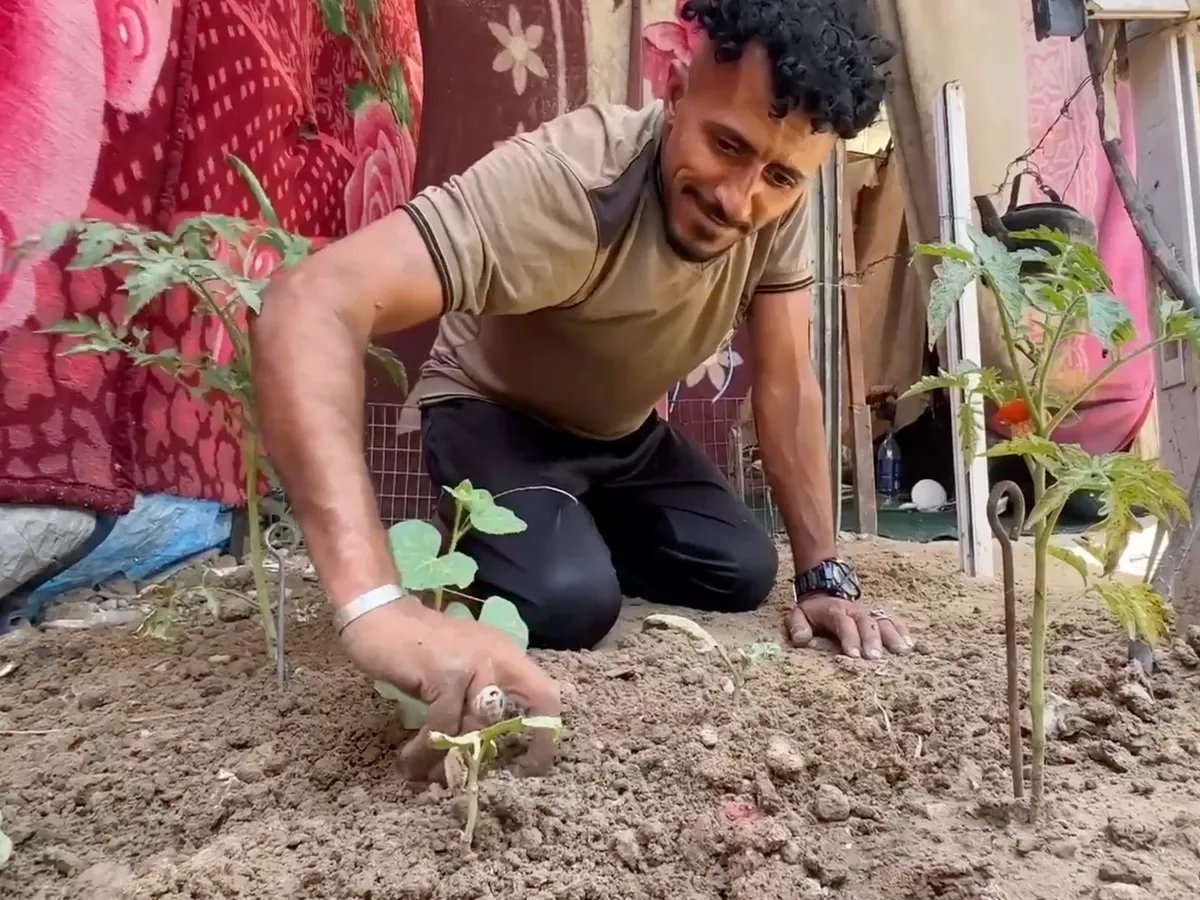
Israel has devastated 95 percent of Gaza’s farms, engineering starvation and aid dependency, experts warn.A displaced Palestinian man plants seedlings in a patch of dirt beside his tent in Gaza as severe food shortages and the destruction of farmland force families to grow their own food [Screengrab/Al Jazeera]Published On 7 Jul 2026Gaza City, Gaza – Looking at old photos on his mobile phone, farmer Abu Fares recalled how the Sheikh Ijlin neighbourhood of Gaza City was once renowned for its grapevines, fig trees and seasonal crops.The reality today, though, is very different. Extensive Israeli bulldozing in the neighbourhood and across much of Gaza since October 2023 has turned the once-thriving region into a barren wasteland, stripping it of the agricultural elements that supported thousands of families.That devastated landscape is a double humanitarian tragedy for Gaza’s displaced farmers: During Israel’s genocidal war, they have lost both their homes and their sole source of income as Israeli forces systematically destroy the territory’s farmlands. With a suffocating Israeli siege that prevents the entry of basic farming supplies, the destruction has become a primary driver of the starvation threatening more than two million Palestinians.Yet now, driven by soaring food prices and desperation, many displaced Palestinians are transforming small patches of dirt around the tents they are living in into miniature gardens. One displaced farmer described how she relies on this method to grow tomatoes, eggplants, peppers and molokhia greens to feed her family, which includes orphaned children.An erased landscapeDespite severe shortages of water, seeds and fertilisers, farmers like Abu Mohammed continue to work the soil, viewing agriculture not just as an income source but also as a form of resistance and a way to hold on to their land.According to the Ministry of Agriculture in Gaza, cultivated areas have fallen to less than 15 percent of their usual productive capacity due to the lack of inputs, the destruction of irrigation sources and attacks on farmers working in their fields.Accessing former farmlands has in effect become a death sentence for Palestinians. Israeli forces have designated large swaths of farmland as falling within their “Yellow Line“, or the territory they hold, making the land impossible to reach due to artillery fire.That has meant growing plants on small patches of land near tents, for many farmers, is the only option available.Engineered dependencyExperts warned that this devastation is not a byproduct of war but a deliberate strategy.Fadel El-Zubi, a food security expert and regional policy adviser at the United Nations Food and Agriculture Organization (FAO), stated that the destruction is not collateral damage but a direct targeting of Gaza’s entire food system. He noted that the systematic destruction of wells, irrigation networks, crop stores and perennial trees is designed to dry up the elements of survival, pushing the population into forced dependence on food aid and creating permanent food dependency.Before the latest Israeli war on Gaza, agriculture accounted for about 10 percent of Gaza’s economy and supported more than 560,000 people. Today, that system has collapsed. Beth Bechdol, the FAO’s deputy director general, has warned that the destruction of greenhouses and wells means local food production has ground to a halt, exacerbating the critical risk of famine across the enclave.Catastrophic dataThe scale of the agricultural ruin is unprecedented. Geospatial assessments from the FAO and the UN Satellite Centre from May 2025 revealed that less than 5 percent of Gaza’s cropland remained available for cultivation. By October, UNRWA, the UN agency for Palestinian refugees, confirmed that most farmland was either destroyed or inaccessible.Recent data from the Government Media Office in Gaza showed that Israel has destroyed more than 94 percent of the enclave’s 178,000 dunams (178sq km/69sq miles) of agricultural land. Consequently, annual agricultural production plummeted from 405,000 tonnes to 28,000 tonnes.Across the territory, up to 4 million fruit trees have been uprooted, including 1.6 million olive trees that will take decades to replace. Furthermore, up to 87 percent of agricultural wells and 85 percent of greenhouses have been severely damaged or destroyed. Direct losses in the agricultural and livestock sectors are currently estimated at $2.8bn.Rebuilding this shattered lifeline requires enormous investment. Last year, the FAO launched an urgent appeal for $75m to support farmers with seeds, animal feed, irrigation equipment and basic production inputs. However, El-Zubi noted that less than 10 percent of this amount has been funded and attributed the shortfall to shifting international donor priorities as global crises shift.Despite the lack of funding and deadly security risks, Gaza’s farmers continue their desperate attempts to revive whatever remains of their land, clinging to the hope of restoring a sector that was once the backbone of their survival.
SRCAl Jazeera
LANGEN
LEANCenter
WORDS770
ENT10
TUE · 2026-07-07 · 12:56 GMTBRIEF NSR-2026-0707-90880
NSR-2026-0707-90880News Report·EN·Human Interest
Displaced Gaza farmers turn to dirt near tents to grow crops
Displaced farmers in Gaza are cultivating small plots of land near their tents due to the widespread destruction of agricultural areas. Experts warn that Israel has devastated approximately 95 percent of Gaza's farms, leading to severe food shortages and aid dependency.
Al Jazeera StaffAl JazeeraFiled 2026-07-07 · 12:56 GMTLean · CenterRead · 4 min
Al JazeeraFIG 01
Reading time
4min
Word count
770words
Sources cited
2cited
Entities identified
10entities
Quality score
100%
§ 01
Briefing Summary
AI-generatedNEWSAR · AI
Displaced farmers in Gaza are cultivating small plots of land near their tents due to the widespread destruction of agricultural areas. Experts warn that Israel has devastated approximately 95 percent of Gaza's farms, leading to severe food shortages and aid dependency. This systematic destruction of farmland, including irrigation systems and perennial trees, is seen by experts as a deliberate strategy to undermine Gaza's food system and create permanent reliance on aid. Before the conflict, agriculture was a significant part of Gaza's economy, supporting over half a million people. Current data indicates a drastic drop in agricultural production and substantial losses in the sector, with rebuilding efforts facing significant funding shortfalls.
Confidence 0.90Sources 2Claims 5Entities 10
§ 02
Article analysis
Model · rule-basedFraming
Human Interest
Social Justice
Tone
Sensational
AI-assessed
CalmNeutralAlarmist
Factuality
0.60 / 1.00
Mixed
LowHigh
Sources cited
2
Limited
FewMany
§ 03
Key claims
5 extracted01
The destruction of Gaza's food system is a deliberate strategy, not collateral damage.
quoteFadel El-Zubi
Confidence
0.90
02
Cultivated areas in Gaza have fallen to less than 15 percent of their usual productive capacity.
statisticMinistry of Agriculture in Gaza
Confidence
0.90
03
The destruction of farmlands is a primary driver of the starvation threatening more than two million Palestinians.
factual
Confidence
0.80
04
Israel has devastated 95 percent of Gaza’s farms, engineering starvation and aid dependency, experts warn.
factualexperts
Confidence
0.80
05
Extensive Israeli bulldozing in Gaza since October 2023 has turned the region into a barren wasteland.
factual
Confidence
0.70
§ 04
Full report
4 min read · 770 words§ 05
Entities
10 identifiedKey playerOppositionContextPositiveNeutralNegative
Locations5
§ 06
Keywords & salience
9 termsagricultural destruction
1.00
gaza farmers
1.00
food shortages
0.90
displaced palestinians
0.90
farming resistance
0.80
siege
0.70
farmland
0.60
humanitarian tragedy
0.50
aid dependency
0.40
§ 07
Topic connections
Interactive graph Network visualization showing 51 related topics
View Full Graph Person Organization Location Event|Click node to navigate|Edge numbers = shared articles