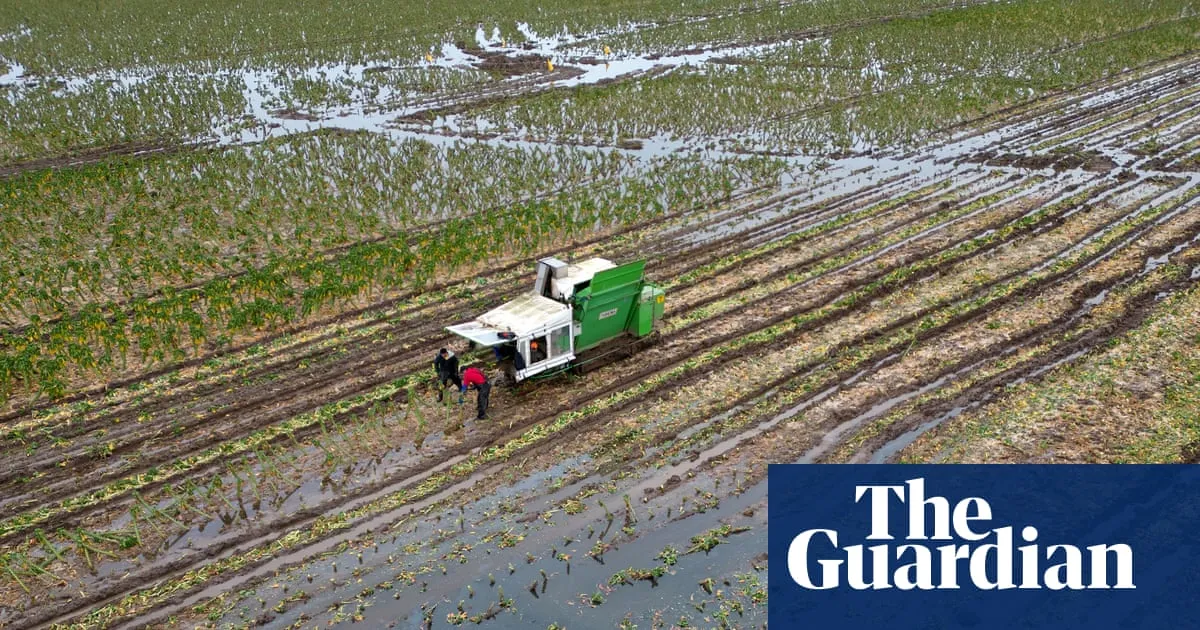
The global attack on nature is threatening the UK’s national security, government intelligence chiefs have warned, as the increasingly likely collapse of vitally important natural systems would bring mass migration, food shortages and price rises, and global disorder.Food supplies are particularly at risk since “without significant increases” the UK would be unable to compete with other nations for scarce resources, a report to ministers says.Some vital ecosystems could face collapse within five years, threatening the UK’s national security and prosperity, according to the 14-page report.Many of the impacts are already being felt in the form of crop failures, intensified natural disasters and infectious disease outbreaks. These will intensify, resulting in “geopolitical instability, economic insecurity, conflict, migration and increased inter-state competition for resources”.The hard-hitting report, which originally would have been published last autumn but for an intervention by Downing Street, is attributed only to the Department for Environment, Food and Rural Affairs, but the Guardian understands that the joint intelligence committee, which oversees spy agencies MI5 and MI6, was responsible.National security experts have stepped up their warnings that the climate crisis will bring existential dangers for which we are still unprepared. Tuesday’s report focuses on an even less considered threat, that of the collapse of biological systems, such as rainforests turning to savannah-like conditions under the impact of deforestation, climate breakdown and other stresses.Lt Gen Richard Nugee, a former senior military commander, said: “This assessment, a welcome and important acknowledgment of the very critical nature of the diversity of threats facing the UK, treats ecosystem collapse with the seriousness it deserves, as a threat to our national security. When risks are systemic, unavoidable and already unfolding, there is a duty to build national resilience and preparedness, which depend on understanding and honesty.”The report is unusual in applying military intelligence techniques to examine the biodiversity crisis unfolding across the world. “Critical ecosystems that support major food production areas and impact global climate, water and weather cycles are the most important for UK national security,” the report says.“Severe degradation or collapse of these would highly likely result in water insecurity, severely reduced crop yields, a global reduction in arable land, fisheries collapse, changes to global weather patterns, release of trapped carbon exacerbating climate change, novel zoonotic disease and loss of pharmaceutical resources.”The authors identify key hotspots that are under increasing threat as “particularly significant” for the UK, including the Amazon and Congo rainforests, boreal forests, the Himalayas and south-east Asia’s coral reefs and mangroves.Some of these, including coral reefs and boreal forests, are likely to start to collapse from 2030, while the others could take up to 2050, the report found. Some scientists have warned that the Amazon is already showing signs of shifting faster than expected.Ruth Chambers, a senior fellow at Green Alliance, a thinktank that pressed the government to release the report, said: “This should be essential reading for government. It should focus minds on meeting targets to reverse the decline of UK nature, where progress is lagging in most areas. But it should also make us think again about backing away from international efforts to preserve biodiversity, like our failure to contribute to a fund for the world’s rainforests at the last global climate summit.”Ministers are debating how much the UK should spend assisting poor countries to cope with the climate crisis and stem the decline of nature, when the current pledge of £11.6bn to be spent from 2021 to 2026 runs out. Insiders have suggested to the Guardian that the amount is likely to be cut substantially and that the ringfencing of some spending for nature projects could end.Zac Goldsmith, who was a climate and nature minister under Boris Johnson, warned against such moves. “The assessment shows that we cannot expect to be able to destroy key ecosystems like the great forest basins, peatlands, mangroves or coral reefs without serious implications for our safety and prosperity. But that is what we are doing,” he said. “The government has shifted its priority away from nature towards a very narrow focus on carbon and we must hope this report forces a reversal.”The report also says the UK must focus on its own food systems, which are highly reliant on imports, because without strong action “it is unlikely the UK would be able to maintain food security if ecosystem collapse drives geopolitical competition for food”.David Exwood, a deputy president of the National Farmers’ Union, said the government must provide financial support to help farmers invest in environmental improvements and food production. “With an increasingly volatile geopolitical and climactic situation, we cannot rely on imports to sustain us. Investing in our national food security has to be a priority, and that starts with investing in the land,” he said.A spokesperson for the Department for Environment, Food and Rural Affairs said: “Nature underpins our security, prosperity, and resilience and understanding the threats we face from biodiversity loss is crucial to meeting them head on. The findings of this report will inform the action we take to prepare for the future.”
SRCThe Guardian - World News
LANGEN
LEANCenter-Left
WORDS836
ENT5
TUE · 2026-01-20 · 19:03 GMTBRIEF NSR-2026-0120-9099
NSR-2026-0120-9099News Report·EN·National Security
Biodiversity collapse threatens UK security, intelligence chiefs warn
Government intelligence chiefs have warned that the UK's national security is threatened by the global biodiversity collapse. A report to ministers states that vital ecosystems could face collapse within five years, posing risks to food supplies and resources.
Fiona Harvey Environment editorThe Guardian - World NewsFiled 2026-01-20 · 19:03 GMTLean · Center-LeftRead · 4 min
The Guardian - World NewsFIG 01
Reading time
4min
Word count
836words
Sources cited
2cited
Entities identified
5entities
Quality score
75%
§ 01
Briefing Summary
AI-generatedNEWSAR · AI
Government intelligence chiefs have warned that the UK's national security is threatened by the global biodiversity collapse. A report to ministers states that vital ecosystems could face collapse within five years, posing risks to food supplies and resources. The UK would struggle to compete with other nations for scarce resources without significant increases in production. Crop failures, intensified natural disasters, and infectious disease outbreaks are already being felt, and these impacts will intensify, leading to geopolitical instability, economic insecurity, conflict, migration, and increased inter-state competition. The report attributes the threat to deforestation, climate breakdown, and other stresses on biological systems.
Confidence 0.90Sources 2Claims 5Entities 5
§ 02
Article analysis
Model · rule-basedFraming
National Security
Environmental
Tone
Mixed Tone
AI-assessed
CalmNeutralAlarmist
Factuality
0.70 / 1.00
Factual
LowHigh
Sources cited
2
Limited
FewMany
§ 03
Key claims
5 extracted01
Ecosystem collapse is a threat to our national security.
quoteLt Gen Richard Nugee
Confidence
1.00
02
Critical ecosystems that support major food production areas and impact global climate are the most important for UK national security.
factualreport
Confidence
0.90
03
The global attack on nature is threatening the UK’s national security.
factualgovernment intelligence chiefs
Confidence
0.90
04
Severe degradation or collapse of these would highly likely result in water insecurity, severely reduced crop yields, and a global reduction in arable land.
predictionreport
Confidence
0.80
05
Some vital ecosystems could face collapse within five years, threatening the UK’s national security and prosperity.
predictionreport to ministers
Confidence
0.80
§ 04
Full report
4 min read · 836 words§ 05
Entities
5 identifiedKey playerOppositionContextPositiveNeutralNegative
Organizations3