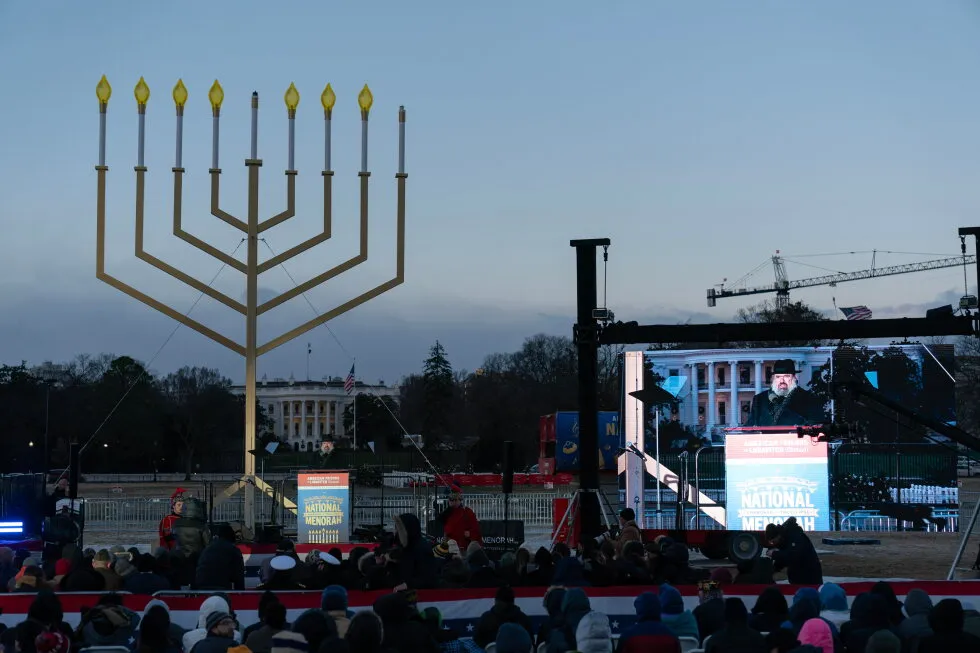
New AP-NORC poll reveals sharp divides among US Jews over Israel and Gaza 1 of 4 | Rabbi Levi Shemtov speaks to the crowd before he lights the Menorah during the annual National Menorah Lighting in celebration of Hanukkah, on the Ellipse near the White House in Washington, Dec. 14, 2025. (AP Photo/Jose Luis Magana, File) 2 of 4 | President Donald Trump gestures during a Hanukkah reception in the East Room of the White House, Dec. 16, 2025, in Washington, as Rabbi Levi Shemtov watches. (AP Photo/Alex Brandon, File) 3 of 4 | Exterior view of the Central Synagogue of New York, Feb. 28, 2026, in New York. (AP Photo/Kena Betancur, File) 4 of 4 | Rabbi Seth Adelson, of Congregation Beth Shalom, a Conservative synagogue located just blocks from Tree of Life in the Squirrel Hill neighborhood, sits for a portrait with Audrey Glickman, a Tree of Life member who survived the 2018 synagogue attack, Friday, Sept. 27, 2024, in Pittsburgh. (AP Photo/Jessie Wardarski, File) 1 of 4 | Rabbi Levi Shemtov speaks to the crowd before he lights the Menorah during the annual National Menorah Lighting in celebration of Hanukkah, on the Ellipse near the White House in Washington, Dec. 14, 2025. (AP Photo/Jose Luis Magana, File) 1 of 4 Rabbi Levi Shemtov speaks to the crowd before he lights the Menorah during the annual National Menorah Lighting in celebration of Hanukkah, on the Ellipse near the White House in Washington, Dec. 14, 2025. (AP Photo/Jose Luis Magana, File) Add AP News on Google Add AP News as your preferred source to see more of our stories on Google. Share 2 of 4 | President Donald Trump gestures during a Hanukkah reception in the East Room of the White House, Dec. 16, 2025, in Washington, as Rabbi Levi Shemtov watches. (AP Photo/Alex Brandon, File) 2 of 4 President Donald Trump gestures during a Hanukkah reception in the East Room of the White House, Dec. 16, 2025, in Washington, as Rabbi Levi Shemtov watches. (AP Photo/Alex Brandon, File) Add AP News on Google Add AP News as your preferred source to see more of our stories on Google. Share 3 of 4 | Exterior view of the Central Synagogue of New York, Feb. 28, 2026, in New York. (AP Photo/Kena Betancur, File) 3 of 4 Exterior view of the Central Synagogue of New York, Feb. 28, 2026, in New York. (AP Photo/Kena Betancur, File) Add AP News on Google Add AP News as your preferred source to see more of our stories on Google. Share 4 of 4 | Rabbi Seth Adelson, of Congregation Beth Shalom, a Conservative synagogue located just blocks from Tree of Life in the Squirrel Hill neighborhood, sits for a portrait with Audrey Glickman, a Tree of Life member who survived the 2018 synagogue attack, Friday, Sept. 27, 2024, in Pittsburgh. (AP Photo/Jessie Wardarski, File) 4 of 4 Rabbi Seth Adelson, of Congregation Beth Shalom, a Conservative synagogue located just blocks from Tree of Life in the Squirrel Hill neighborhood, sits for a portrait with Audrey Glickman, a Tree of Life member who survived the 2018 synagogue attack, Friday, Sept. 27, 2024, in Pittsburgh. (AP Photo/Jessie Wardarski, File) Add AP News on Google Add AP News as your preferred source to see more of our stories on Google. Share Updated [hour]:[minute] [AMPM] [timezone], [monthFull] [day], [year] As Israel’s actions continue to divide America’s Jewish communities nearly three years into the latest war in Gaza, a new AP-NORC poll reveals that some of the biggest gaps are between religious and secular Jews.The survey from The Associated Press-NORC Center for Public Affairs Research makes clear that for many U.S. Jews, support for Israel remains a bedrock of their religious identity, its existence a guarantee of Jewish self-determination and safety. Yet others — particularly those who identify as Jews through ethnic, cultural or family ties, rather than religion — feel less connected to Israel and judge its actions in the ongoing conflict more harshly.About 7 in 10 Jewish adults overall identify as Jewish when asked about their religious affiliation, according to the sweeping survey that touched on everything from views on Israel to antisemitism concerns and strains on interpersonal relations. The rest, about 3 in 10 Jewish adults, say they are atheists, agnostics, or have no particular religious affiliation, but still identify as Jewish in other ways. Israel has been at the center of the turmoil in the Middle East since the Oct. 7, 2023, Hamas-led attack that killed some 1,200 people. More than 73,000 Palestinians have died in Gaza since Israel retaliated, according to the Hamas-run Gaza Health Ministry, which doesn’t distinguish between civilian and militant deaths. Israel’s ongoing offensives have become a wedge issue for Jewish and non-Jewish Americans, leading to protests, raising antisemitism fears and questions about America’s close ties to Israel.How we did thisThe Associated Press-NORC Center for Public Affairs Research surveyed 3,040 U.S. adults from June 11-17, 2026 from NORC’s probability-based AmeriSpeak Panel, which is designed to be representative of the U.S. population. The survey included 1,022 Jewish adults, which allows for more reliable estimates of this group’s opinions. Survey weighting ensures their views aren’t overrepresented in the findings by adjusting the results so each group reflects its actual share of the population.Respondents were categorized as Jewish if they said their religion was Jewish, or if they identified as religiously unaffiliated but said they considered themselves Jewish because of their ethnic, cultural, or family background. Among Jews with a religious affiliation, views on Israel’s recent military actions are far from uniform or uncritical. Only about half say Israel’s ongoing military operations in Gaza are justified. About one-quarter believe Israel has committed genocide against Palestinians in Gaza, an accusation that’s been leveled by some human rights organizations and vehemently denied by Israel and the U.S. government. But they are more supportive of Israel’s actions than secular American Jews. About 4 in 10 religiously unaffiliated Jews say Israel has committed genocide against Palestinians, and only about 2 in 10 see Israel’s current operations in Gaza as justified. The vast majority, 74%, say they are “not too” or “not at all” emotionally attached to Israel, a sharp contrast from other Jewish adults. Anna Constant, 56, of Seattle identifies as culturally Jewish and says she doesn’t feel closely connected to Israel.“I kind of think of myself as an American version of a Jew. I do have a homeland,” she said, referring to the United States. At the same time, “my heart is broken for everything everyone is navigating over there. ... We have bad governments happening not just in Israel but in the United States. I’m trying to hold on to the reality that the people are not the governments.” Conflicting views about Israel’s military actionsJews who regularly attend religious services are more likely than those who never attend to feel a connection to Israel and see its military actions in Gaza as justified, the survey found.About 3 in 10 Jewish adults never attend religious services, although that rises to about two-thirds among religiously unaffiliated Jews. About half of Jewish adults attend a few times a year or less often. About 2 in 10 attend at least once a month, including about 1 in 10 who attend weekly.According to the survey, Jewish adults mostly identify as Democrats; about 3 in 10 identify as Republicans. Religiously unaffiliated Jews are slightly more likely than Jewish adults overall to identify as Democrats, and less likely to call themselves Republicans.Jacqueline Rothstein, 35, splits time between a New York City suburb on Long Island and the city’s heavily Jewish borough of Brooklyn. She is Modern Orthodox, attending worship services about once a month.A political independent, she views Republican President Donald Trump favorably and has an unfavorable view of New York City Mayor Zohran Mamdani, a Muslim Democrat who supports Palestinian rights. Rothstein says her Jewish identity and supporting Israel are “extremely important” to her. She’s keenly aware of divisions within the Jewish community, and cites family history as one key reason for the differing views of Israel. Two of her grandparents were Sephardic Jews expelled from Egypt in the 1960s; the other two were Holocaust survivors, she said.“There are plenty of American Jews whose grandparents didn’t have that trauma,” Rothstein said. “If you have no connection to Israel, if your grandparents were safe in America, ... then you don’t know the struggle.”Jewish adults who identify as religiously Jewish are much likelier than nonreligious Jews to identify as Zionists. About 3 in 10 religiously Jewish adults say “Zionist” describes them “extremely” or “very” well, compared to 6% of religiously unaffiliated Jews.Just under half of secular Jews, 45%, say “Zionist” describes them ”not very well” or “not well at all.” Many still see Israel as central to their Jewish identitySupporting Israel is still fundamental to many Jewish adults’ identity, but its importance compared to other aspects of being Jewish varies.About half of religiously affiliated Jewish adults say supporting Israel is “extremely” or “very” important to their Jewish identity, compared to about 1 in 10 religiously unaffiliated Jewish adults.Rabbi Seth Adelson noted that Israel was founded primarily by secular Jews, but suggested that today in the U.S., stronger connections to Israel are felt by religiously observant Jews. He is the rabbi of Congregation Beth Shalom in Pittsburgh, a Conservative synagogue with close ties to the three congregations targeted in the 2018 massacre at the nearby Tree of Life synagogue in which 11 worshippers were killed in the nation’s deadliest antisemitic attack.“In recent years, perhaps due to the complexity of that region, due to the challenges faced by modern states, religious Jews have been more likely to hold on to our ancient stories, and Jews of no religion have been less likely to hold on to those stories,” Adelson said.Some of the divide is generational. Younger Jews — regardless of their Jewish affiliation — are less likely to see Israel as important to their Jewish identity. But there are commonalities, too. Majorities of younger and older Jewish adults, for instance, say that remembering the Holocaust is important to their Jewish identity.Bonnie Brody, 78, grew up in a community with several Holocaust survivors in Queens, New York. While she doesn’t always agree with its government’s choices, the Florida resident sees Israel as a vital haven for Jews.“I heard the stories of the concentration camps and how even (the U.S.) turned back a ship full of Jews,” she said, referring to the ocean liner St. Louis that departed Germany in 1939 with hundreds of Jewish refugees aboard, and was prevented from landing in the U.S. “Many of them had nowhere to go.”Painful conflicts with family over Israel are commonThe survey finds that rifts are springing up within families and communities over Israel, even among religiously unaffiliated Jews.Most Jewish adults, 55%, say they’ve felt offended by another person’s comments about Israel since the Oct. 7 attack, while about 4 in 10 say they’ve disagreed with family members about something related to Israel.About 3 in 10 say they’ve stopped talking to someone because of something they said about Israel.Shainah Horowitz, 45, a staunch Democrat from Portland, Oregon, says the Jewish community in that solidly liberal city is riddled with divisions. On one hand, she said, there is friction between politically right-leaning Orthodox Jews and Jews with more left-leaning views, including those in her Conservative synagogue which takes pride in being LGBTQ+-inclusive. Meanwhile, she said, secular anti-Zionist Jews in Portland can be stridently critical of Jews who — like Horowitz herself — identify as Zionists and support the concept of Israel as a Jewish state.“I cannot have conversations with certain friends — non-Jews and some very secular Jews who buy into the anti-Israel slant,” she said.___Associated Press religion coverage receives support through the AP’s collaboration with The Conversation US, with funding from Lilly Endowment Inc. The AP is solely responsible for this content.___The AP-NORC poll of 3,040 adults was conducted June 11-17 using a sample drawn from NORC’s probability-based AmeriSpeak Panel, which is designed to be representative of the U.S. population. The poll included interviews with 1,022 Jewish adults. The margin of sampling error for adults overall is plus or minus 2.8 percentage points and the margin of sampling error for Jewish adults is plus or minus 5.0 percentage points. Crary has headed AP’s 11-person Religion team since 2020. Among previous AP jobs, he was a foreign correspondent for 14 years, and has used that experience to bolster AP’s worldwide religion coverage. Thomson-DeVeaux is the AP’s editor for polling and surveys.
SRCAssociated Press (AP)
LANGEN
LEANCenter
WORDS2 091
ENT12
WED · 2026-07-08 · 09:23 GMTBRIEF NSR-2026-0708-91144
NSR-2026-0708-91144News Report·EN·Social Justice
New AP-NORC poll reveals sharp divides among US Jews over Israel and Gaza
A new AP-NORC poll reveals significant divisions among U.S. Jewish communities regarding Israel and the Gaza conflict, with the sharpest divides occurring between religious and secular Jews.
By
DAVID CRARY, AMELIA THOMSON-DEVEAUX and PETER SMITHAssociated Press (AP)Filed 2026-07-08 · 09:23 GMTLean · CenterRead · 9 min
Associated Press (AP)FIG 01
Reading time
9min
Word count
2 091words
Sources cited
0cited
Entities identified
12entities
Quality score
100%
§ 01
Briefing Summary
AI-generatedNEWSAR · AI
A new AP-NORC poll reveals significant divisions among U.S. Jewish communities regarding Israel and the Gaza conflict, with the sharpest divides occurring between religious and secular Jews. For many religiously affiliated Jews, support for Israel is deeply tied to their identity and safety, while those identifying as Jewish through cultural or ethnic ties feel less connected and are more critical of Israel's actions. The survey found that religiously unaffiliated Jews are more likely to believe Israel has committed genocide and less likely to see its current operations as justified. These differing views have led to rifts within families and communities. The poll was conducted from June 11-17, 2026, among 1,022 Jewish adults.
Confidence 0.90Claims 4Entities 12
§ 02
Article analysis
Model · rule-basedFraming
Social Justice
Conflict
Tone
Measured
AI-assessed
CalmNeutralAlarmist
Factuality
0.80 / 1.00
Factual
LowHigh
Sources cited
0
No named sources
FewMany
§ 03
Key claims
4 extracted01
The poll surveyed 1,000 adults nationwide, including 537 Jewish adults.
statisticAP-NORC poll
Confidence
1.00
02
Divisions are apparent across different age groups and religious affiliations within the U.S. Jewish community.
statisticAP-NORC poll
Confidence
1.00
03
The poll indicates differing views on U.S. support for Israel and the handling of the conflict.
statisticAP-NORC poll
Confidence
1.00
04
A new AP-NORC poll shows significant divisions among U.S. Jews regarding the Israel-Gaza conflict.
statisticAP-NORC poll
Confidence
1.00
§ 04
Full report
9 min read · 2 091 words§ 05
Entities
12 identifiedKey playerOppositionContextPositiveNeutralNegative
People3
Organizations4
Locations4
Events1
§ 06
Keywords & salience
7 termsisrael
1.00
gaza
1.00
us jews
1.00
ap-norc poll
0.90
divides
0.80
hanukkah
0.50
synagogue
0.40
§ 07
Topic connections
Interactive graph Network visualization showing 51 related topics
View Full Graph Person Organization Location Event|Click node to navigate|Edge numbers = shared articles