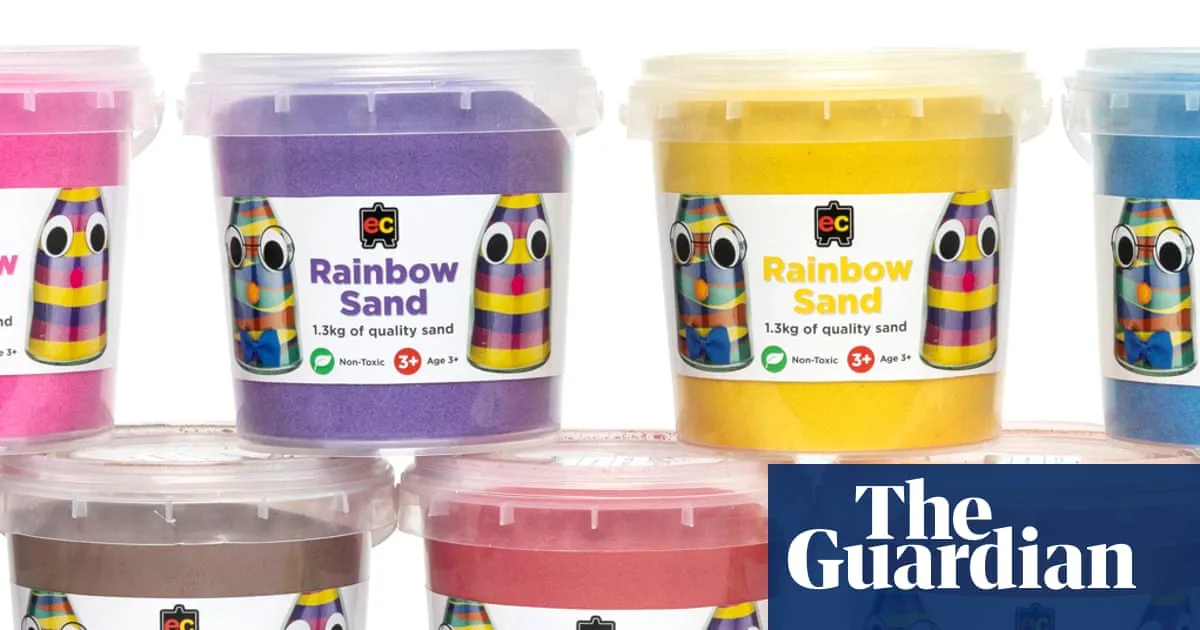
Educational Colours sand products are among those recalled over concerns that they may contain asbestos. Photograph: ACCC View image in fullscreen Educational Colours sand products are among those recalled over concerns that they may contain asbestos. Photograph: ACCC Contaminated children’s play sand sold in Australia can release toxic airborne asbestos, research finds Exclusive New study contradicts statements that play products removed from shelves because of asbestos concerns were ‘low risk’ Get our breaking news email, free app or daily news podcast Colourful children’s play sand that was sold in Australia while contaminated with asbestos can release hazardous airborne fibres of the toxic mineral, researchers have discovered. The Australian Competition and Consumer Commission (ACCC) and the lead researcher of the Auckland University of Technology (AUT) study, which found 90% of craft sand samples released asbestos into the air when played with, confirmed the products had been sold in Australia. At least 22 children’s sand products, many of which were sold at leading Australian retailers, were recalled between November 2025 and May this year due to concerns they could contain asbestos. Some of those products were also sold in New Zealand, prompting jointly funded research into whether the contaminated products contained asbestos which could become airborne and potentially more easily inhaled by children. Led by Associate Prof Terri-Ann Berry, the AUT study tested 15 products sold by three different companies: 11 were dusty “craft” sands and four were “moulding sand” containing an additive to make them sticky and clumpy. Berry said they simulated the way children might play with the sand by using “plastic spoons, toy cars, little scoops and all sorts”. Nine of the craft sands produced airborne asbestos fibres regardless of the intensity with which they were “played”, Berry said. Only one did not release any fibres, and another was an uncontaminated control sample. None of the moulding sands released airborne particles, Berry said. While the study is yet to be peer reviewed, Berry described the results as concerning. She and her colleagues had hoped to prove correct the initial public messaging that the recalled products were low-risk because the asbestos “couldn’t get from the sand into the air”. “Our idea was, well, wouldn’t it be great if we can test and there are no fibres in the air and everyone takes a sigh of relief,” she said. “Obviously, [the findings] were not what we wanted.” Berry said she didn’t want parents to panic, and that health authorities in New Zealand and Australia would decide on the next steps. Last week, Berry presented the findings to about 50 people from the relevant Australian bodies, including the asbestos and Silica Safety and Eradication Agency (Assea). Assea and health officials had been provided with a list of the affected products, Berry said, but she would not disclose them publicly. Officeworks and Kmart, two of the biggest retailers who recalled sand products, said they had asked AUT for a copy of the findings. When their products were recalled, Officeworks said there was “no identifiable safety hazard”. At the time, Kmart said “traces of asbestos” had been detected in a sand castle building set in New Zealand, which was also sold in Australia, but the fibres were unlikely to be released unless it was mechanically crushed. Both companies on Wednesday said safety was their priority, and they had “processes in place” to ensure products were tested to government regulatory requirements. They said they would work out whether to take any further action as the AUT study “moves through the standard stages of peer review and evaluation”. The ACCC said it was “working with suppliers of recalled products on the wording of their recalls” where necessary, after alerting retailers to the AUT findings. Retailers “should consider this new information as part of their risk assessment, and take further action, including recall action, as appropriate to address the risk to consumers”, an ACCC spokesperson said. Explore more on these topics Consumer affairs Health asbestos news Share Reuse this content
SRCThe Guardian - World News
LANGEN
LEANCenter-Left
WORDS663
ENT8
WED · 2026-07-08 · 15:00 GMTBRIEF NSR-2026-0708-91262
NSR-2026-0708-91262News Report·EN·Public Health
Contaminated children’s play sand sold in Australia can release toxic airborne asbestos, research finds
New research from Auckland University of Technology (AUT) indicates that contaminated children's play sand sold in Australia can release toxic airborne asbestos fibers. This finding contradicts previous statements that recalled products were low-risk.
Catie McLeod Consumer affairs reporterThe Guardian - World NewsFiled 2026-07-08 · 15:00 GMTLean · Center-LeftRead · 3 min
The Guardian - World NewsFIG 01
Reading time
3min
Word count
663words
Sources cited
2cited
Entities identified
8entities
Quality score
100%
§ 01
Briefing Summary
AI-generatedNEWSAR · AI
New research from Auckland University of Technology (AUT) indicates that contaminated children's play sand sold in Australia can release toxic airborne asbestos fibers. This finding contradicts previous statements that recalled products were low-risk. The study, which tested 15 products, found that 90% of craft sand samples released asbestos into the air when played with, even with light handling. At least 22 children's sand products were recalled in Australia between November 2025 and May this year due to asbestos concerns. Retailers like Officeworks and Kmart, who previously stated their recalled products posed no identifiable safety hazard, are now reviewing the AUT study's findings. The Australian Competition and Consumer Commission (ACCC) has alerted retailers to the research and advised them to consider it for further risk assessment and potential action.
Confidence 0.90Sources 2Claims 5Entities 8
§ 02
Article analysis
Model · rule-basedFraming
Public Health
Human Interest
Tone
Mixed Tone
AI-assessed
CalmNeutralAlarmist
Factuality
0.80 / 1.00
Factual
LowHigh
Sources cited
2
Limited
FewMany
§ 03
Key claims
5 extracted01
The study aimed to contradict initial public messaging that recalled products were low-risk.
quoteAssociate Prof Terri-Ann Berry
Confidence
1.00
02
None of the moulding sands tested released airborne particles.
factualAssociate Prof Terri-Ann Berry
Confidence
0.90
03
At least 22 children's sand products were recalled in Australia between Nov 2025 and May this year due to asbestos concerns.
statisticAustralian Competition and Consumer Commission (ACCC)
Confidence
0.90
04
90% of craft sand samples released asbestos into the air when played with in a study.
statisticAuckland University of Technology (AUT) study
Confidence
0.90
05
Contaminated children's play sand sold in Australia can release toxic airborne asbestos.
factualresearchers
Confidence
0.90
§ 04
Full report
3 min read · 663 words§ 05
Entities
8 identifiedKey playerOppositionContextPositiveNeutralNegative
Organizations3
Topics1
§ 06
Keywords & salience
9 termscontaminated play sand
1.00
airborne asbestos
1.00
children's products
0.90
toxic mineral
0.80
research findings
0.70
health risk
0.60
product recall
0.50
accc
0.40
auckland university of technology
0.40
§ 07
Topic connections
Interactive graph Network visualization showing 3 related topics
View Full Graph Person Organization Location Event|Click node to navigate|Edge numbers = shared articles