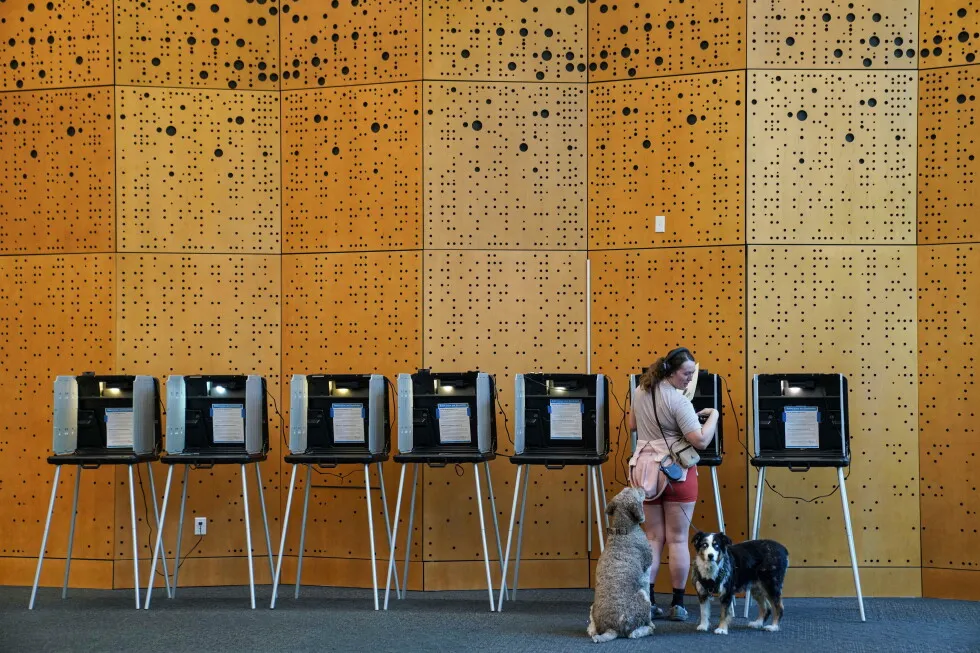
The Trump administration is ramping up pressure on states to change election practices 1 of 3 | Danielle Grisolano brings her dogs Lincoln and Pepper with her to vote in the Democratic primaries at Denver Public Library, Tuesday, June 30, 2026, in Denver. (AP Photo/Rebecca Slezak) 2 of 3 | Stickers sit on a table inside a polling place, Nov. 5, 2024, in Atlanta. (AP Photo/Brynn Anderson, File) 3 of 3 | “I voted” stickers sit near a ballot box during the Democratic primaries at Denver Public Library Tuesday, June 30, 2026, in Denver. (AP Photo/Rebecca Slezak) By GEOFF MULVIHILL and MARC LEVY Updated 7:46 PM MESZ, July 8, 2026 Add AP News on Google Add AP News as your preferred source to see more of our stories on Google. Share Share Facebook Copy Link copied Print Email X LinkedIn Bluesky Flipboard Pinterest Reddit President Donald Trump’s administration is threatening to withhold some federal funding from states that don’t make changes to voting practices and is warning state election officials that they face arrest if they don’t remove noncitizens from voter rolls. Letters to states and grant application details are the latest in a line of actions by Trump’s administration to shape details of running elections that have long been the job of states. Courts have largely rejected the administration’s previous efforts, which reflect untrue claims about widespread voting fraud and come less than four months ahead of crucial midterm elections where Democrats seek to take control of one or both chambers of Congress and check Trump’s power. “The overall point is that Trump is trying to use whatever levers of power and persuasive power that he might have to try to interfere with how states and localities are going to conduct the 2026 election,” said Rick Hasen, a UCLA law professor and the director of the Safeguarding Democracy Project. “Some of this is aimed at changing how the rules are conducted. Some of it appears to be aimed at undermining voter confidence in the integrity of the election process.” Justice Department warns election officials of prosecution In letters sent Tuesday, to election officials for all 50 states and the District of Columbia — often secretaries of state — the Department of Justice’s Civil Rights Division said they and other election administrators could face criminal charges if they knowingly allow nonvoters to vote or remain on voting rolls. Trump’s fixation on voting has had mixed results. He still has ways to affect November’s elections 1 MIN READ Ohio adds new photo ID requirement for mail voting for 2027 election 2 MIN READ Trump administration loses appeal over access to personal information of Michigan voters 2 MIN READ It also called on the states to tell the federal government within five days how they intend to comply with the law. Derek Muller, a law professor at the University of Notre Dame who specializes in election law, said it’s not clear the 50-state letter means anything except to restate some parts of the law, with a request to follow up, “which I’m sure many states will ignore.” The letter also warns that anyone who knowingly and willfully gives false information in registering to vote or voting would faces criminal prosecution. Antiterrorism grants include election requirements A Federal Emergency Management Agency antiterrorism grant announcement in June includes a list of election-related requirements, saying that 20% of grants for states and urban areas would be withheld until they comply. The program includes more than $1 billion for states and local and tribal governments for a variety of programs aimed at preventing terror at crowded places, online, with border security — and around elections. FEMA expects to award 56 grants. “Recipients can ensure that their efforts contribute to a secure, transparent, and resilient electoral process, thereby reinforcing public trust and the integrity of democratic institutions,” the grant announcement says, noting that securing election infrastructure is a national security priority. The list of items for states includes verifying the citizenship of all registered voters and election workers. Places that use electronic voting systems that use bar codes or QR codes to count votes would have to submit plans to switch to hand-marked paper ballots. Every jurisdiction would have to show it audits results. UCLA’s Hasen said it could be difficult even for states that want to comply. It’s too close to the midterm election to make some of the changes, he said, and some would require state legislatures to pass new laws. The White House on Wednesday referred questions to FEMA, which did not immediately respond to an interview request. Some states are pushing back, while others are defending the latest actions. Oregon’s secretary of state, Democrat Tobias Read, accused the Justice Department of “knocking on our door again with more threats and no evidence to back up their fever dreams about non-existent voter fraud.” Oregon elections are secure, accurate, and fair, he said, adding that he isn’t “intimidated by political threats or manufactured controversy.” The Michigan secretary of state’s office, headed by Democrat Jocelyn Benson, said it has discussed its work repeatedly with the Justice Department and in public statements, congressional hearings and court testimony – information that it said “is either in the DOJ’s possession or easy reach.” “We will be happy to provide it again to help address any confusion,” the office said in a statement. In a statement, Ohio Republican Secretary of State Frank LaRose defended the Justice Department’s missive to states, saying it’s reminding them of their legal obligation regarding election integrity. A lot of states aren’t taking it seriously, he said without giving examples or citing evidence. He said Ohio has worked with the federal government to ensure that its voter rolls are accurate and that only U.S. citizens vote. Georgia’s secretary of state’s office says the state has already taken many of the actions required in the FEMA grant, including a citizenship audit of voter rolls. Several of Trump’s election actions have faced resistance Trump has repeatedly and wrongly asserted that fraud cost him reelection in 2020, and his administration has put forth a series of policies and actions aimed at how elections are run. In recent days, courts have rejected the Justice Department’s effort to collect the names and contact information for every election worker in Georgia in the 2020 election and others trying to force New Hampshire and Pennsylvania to turn over detailed information about registered voters. With those rulings, the federal government has lost similar cases more than 10 times around its requests for details from 30 states and the District of Columbia. Last week, a group of Democratic governors asked the U.S. Postal Service to withdraw its proposed rule seeking to implement an order from Trump to create a list of eligible voters — and potentially limit who can receive a ballot in the mail. A court previously put the order on hold, saying it was unconstitutional. Also last week, the Supreme Court rebuked Trump and ruled that states can count mailed ballots that arrive after Election Day. Associated Press reporters Gabriela Aoun Angueira, Bill Barrow, Kate Brumback and Josh Kelety contributed to this article. GEOFF MULVIHILL Mulvihill covers topics on the agendas of state governments across the country. He has focused on abortion, gender issues and opioid litigation. twitter mailto MARC LEVY Levy covers politics and state government for The Associated Press. He is based in Pennsylvania. twitter
SRCAssociated Press (AP)
LANGEN
LEANCenter
WORDS1 234
ENT12
WED · 2026-07-08 · 17:53 GMTBRIEF NSR-2026-0708-91284
NSR-2026-0708-91284News Report·EN·Political Strategy
The Trump administration is ramping up pressure on states to change election practices
The Trump administration is increasing pressure on states to alter their election practices, threatening to withhold federal funding from those that do not comply and warning election officials of potential arrest if noncitizens are not removed from voter rolls. These actions, including letters from the Department of Justice and new requirements in FEMA antiterrorism grants, aim to influence state-run election procedures.
Associated Press (AP)Filed 2026-07-08 · 17:53 GMTLean · CenterRead · 5 min
Associated Press (AP)FIG 01
Reading time
5min
Word count
1 234words
Sources cited
2cited
Entities identified
12entities
Quality score
100%
§ 01
Briefing Summary
AI-generatedNEWSAR · AI
The Trump administration is increasing pressure on states to alter their election practices, threatening to withhold federal funding from those that do not comply and warning election officials of potential arrest if noncitizens are not removed from voter rolls. These actions, including letters from the Department of Justice and new requirements in FEMA antiterrorism grants, aim to influence state-run election procedures. Previous efforts by the administration, based on unsubstantiated claims of widespread fraud, have largely been rejected by courts. States are responding differently, with some Democratic officials criticizing the actions as politically motivated and others, like Ohio and Georgia, defending them as necessary for election integrity. These developments occur shortly before crucial midterm elections.
Confidence 0.90Sources 2Claims 5Entities 12
§ 02
Article analysis
Model · rule-basedFraming
Political Strategy
Legal & Judicial
Tone
Measured
AI-assessed
CalmNeutralAlarmist
Factuality
0.70 / 1.00
Factual
LowHigh
Sources cited
2
Limited
FewMany
§ 03
Key claims
5 extracted01
Some of this is aimed at changing how rules are conducted, some at undermining voter confidence.
quoteRick Hasen
Confidence
1.00
02
Trump is trying to use levers of power to interfere with how states conduct the 2026 election.
quoteRick Hasen
Confidence
1.00
03
The administration is warning state election officials they face arrest if they don't remove noncitizens from voter rolls.
factual
Confidence
0.90
04
The Trump administration is threatening to withhold federal funding from states that don't change voting practices.
factual
Confidence
0.90
05
Courts have largely rejected the administration’s previous efforts regarding election practices.
factual
Confidence
0.80
§ 04
Full report
5 min read · 1 234 words§ 05
Entities
12 identifiedKey playerOppositionContextPositiveNeutralNegative
Organizations5
§ 06
Keywords & salience
10 termselection practices
1.00
trump administration
0.90
voting fraud
0.80
voter rolls
0.70
federal funding
0.60
election officials
0.60
midterm elections
0.50
criminal charges
0.50
safeguarding democracy project
0.40
election integrity
0.40
§ 07
Topic connections
Interactive graph Network visualization showing 51 related topics
View Full Graph Person Organization Location Event|Click node to navigate|Edge numbers = shared articles