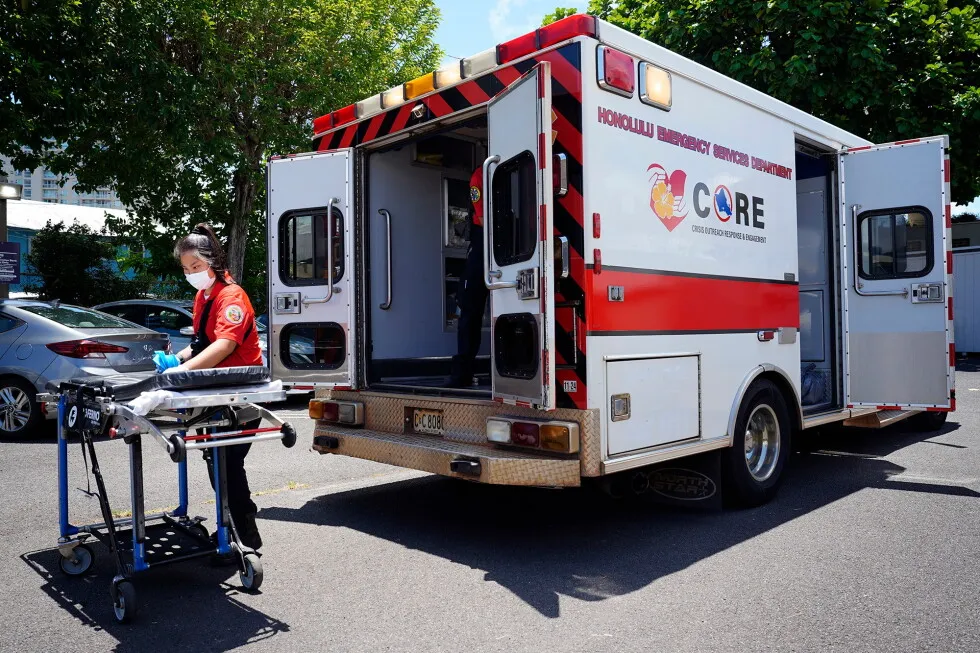
Honolulu-core-team" class="entity-link entity-organization" data-entity-id="161543" data-entity-type="organization">Honolulu C.O.R.E. team EMT Taylor Kodani cleans a gurney after transporting a homeless patient from Kaimuki Community Park, Aug. 19, 2024, in Honolulu. (Kevin Fujii/Civil Beat via AP) By Jeremy Hay/Honolulu Civil Beat Updated 10:21 PM MESZ, July 8, 2026 Add AP News on Google Add AP News as your preferred source to see more of our stories on Google. Share Share Facebook Copy Link copied Print Email X LinkedIn Bluesky Flipboard Pinterest Reddit An audit of a Honolulu homeless assistance initiative that came under fire for being ineffective has been halted because the program keeps changing direction and can’t produce reliable data about its efforts. That development leaves the future direction of the Crisis, Outreach, Response and Engagement program in flux. Known as CORE, the program launched in 2021 to pair social workers with EMTs on 911 calls for help with homeless people in mental health crises. The City Council last September voted to audit the $2.7 million program, citing concerns it had drifted from its original purpose to steer people off the streets and into shelters and services. Acting City Auditor Troy Shimasaki suspended the audit 10 months later, saying CORE’s focus had shifted too frequently and its data systems were too “fragmented.” “We found that the program’s mission, service model, and governance had not been clearly defined over time,” Shimasaki wrote in a June 30 report to the City Council. Taken together the problems that prevented the audit “are absolutely concerning,” Shimasaki told Civil Beat, adding that he couldn’t recall the last time an audit had been similarly suspended. The auditing team told CORE leadership in the city’s Emergency Services Department that they needed to have “key performance measures so you can hold yourself accountable and demonstrate whatever success or challenges this program may have going forward,” Shimasaki said. “It clearly isn’t available now and it is very difficult for any agency to offer its value to the taxpayers if you don’t do that.” Trump administration blocks federal homelessness funds in Los Angeles 1 MIN READ 51 Ranching Could Soon Come To An End On Moloka‘i. Paniolo Blame TB Testing 3 MIN READ Honolulu Spent $450K On Plans For Flood-Prone Stream. Then It Did Nothing 3 MIN READ Emergency Services Director Jim Ireland vigorously defended the program, saying it has made changes to its data systems, partly in response to the auditor’s criticisms, and developed new approaches to better meet its goals. It is succeeding in its chief litmus test, he said: getting more people off the streets more quickly. “Part of this journey is we found things that needed to change,” Ireland told Civil Beat. “It’s evolving to meet the needs of the community… we’re doing what we think is right for this community.” CORE directed 125 people into temporary shelter or behavioral treatment facilities in 2024, the program previously reported. Ireland said last year that number rose nearly fourfold, to 480. Councilmember Val Okimoto, who with Councilmember Andria Tupola introduced the resolution calling for the audit, told Civil Beat that Ireland needed to be held accountable for the program’s current woes. “Director Ireland should work with the mayor and the new managing director (Krishna Jayaram) to identify the best path forward,” Okimoto said. She added: “CORE leadership should definitely take a break, identify best practices and pursue a path that best utilizes taxpayer resources to get individuals safely off the street and into stable housing.” Ireland, however, did not seem inclined to take that cue. He said the program will continue on its present track, relying heavily on a 2025 state law that makes it easier to get troubled homeless people psychiatrically evaluated and involuntarily committed to treatment if they are deemed an imminent danger to themselves or others. “We have the stars aligned now, and now with Act 219, to really make a difference,” he said, referring to the new law. CORE was originally designed as a program that paired social workers with EMTs to do outreach to people who are homeless, lifting them out of the cycle of repeated 911 emergency calls and emergency room visits and connecting them with treatment and housing resources. But as Shimasaki described it in his report to the council, the program then went from running an Iwilei respite center for the very ill, back to an outreach model and more recently to focusing on using Act 219, an approach it has been piloting but intends to fully implement this summer. The program no longer employs social workers, although its 29-person field staff includes community health workers. Those workers are trained and certified to provide outreach services but do not have advanced clinical training. Jenny Neal, a social worker and former CORE field supervisor, said Shimasaki’s findings did not surprise her. “All of that stuff were issues when I was there,” said Neal, who resigned in 2024 and now works as a contract EMT. For example, she said a CORE team she led contributed to a database used by social services providers around Oʻahu that collects and tracks anonymized daily data about individuals who use homeless housing and support services. But she said other CORE teams she had trained to do the same did not use the database. And as CORE changed direction and shed social workers, she said it lost its way, becoming a program where EMTs provide triage medical care rather than working with people to get them into services and housing. “They’re hit it and quit it. They’re life and death, and I get it, I’ve been on the ambulance,” Neal said. “But I’ve also been on calls on the ambulance where I’m like, ‘Man, if I had one hour to sit with this person. I could keep them from being a high-utilizer 911 caller,’ and that’s what CORE is supposed to be doing.” Supporters of the program, though, said that while it has been finding its way, CORE is now better poised to get people off the streets and into care, largely because Act 219 has given it a new tool. “CORE is the key to making that happen,” said Scott Miscovich, a physician who runs two Honolulu facilities where people either found ill on the streets or being discharged from medical care are sent to live. It would be a mistake to return to the original CORE model, Miscovich said. “It was relationship building, which wasn’t wrong. That’s how you have to start if you don’t have the law behind you,” he said. Opponents of using Act 219 on a widespread basis, however, said the auditor’s decision is an opportunity to steer CORE back to its roots. “While disappointing, the (auditor’s) report does open a door for us to have hopefully some really meaningful conversations with the city and county on how to proceed,” said Josh Frost, policy advocate at the American Civil Liberties Union of Hawaiʻi. “We believe that it needs to be revamped and refocused in a very specific way,” he said of CORE. “It’s not law enforcement. It’s not sending homeless folks to the ER or forced treatment. It’s medical workers and social workers going out into the community and talking to these folks and learning what their needs are and then trying to fulfill those needs.” For Tupola, the suspension of the audit is also a moment for CORE to evaluate where it can be most useful and target its efforts there. For the Westside lawmaker, that would be her Waiʻanae Coast district, which includes the largest homeless population on Oʻahu, according to the latest official count. Tupola said her office already coordinates efforts to connect Westside homeless residents with social workers, support services and housing. CORE should join in those efforts, she said. “I think their best bet is to try to see if they can nestle themselves into something that’s more related to a specific outcome for a small geographic area,” she said. “It’s plug and play.” Regardless, Tupola added, “Hopefully they stick to a better direction. Then we can actually measure progress or even measure impact based on one direction instead of like four.” That direction is now established, said Ireland, and it won’t include social work because that type of case management is already being done by other nonprofit social service providers that work with people who are homeless. CORE still does some outreach, helping connect people to temporary shelter or treatment when they accept the help, Ireland said. But its teams – which include nurses or physicians, police officers, EMTs and a paramedic supervisor — now focus on using Act 219 to get people off the street who would otherwise not agree to accept shelter and services. “Literally nobody else can do that,” Ireland said. This story was originally published by Honolulu Civil Beat and distributed through a partnership with The Associated Press.
SRCAssociated Press (AP)
LANGEN
LEANCenter
WORDS1 469
ENT12
WED · 2026-07-08 · 20:53 GMTBRIEF NSR-2026-0708-91356
NSR-2026-0708-91356News Report·EN·Economic Impact
Honolulu Homeless Services Program Too Disorganized To Assess, Auditor Says
An audit of Honolulu's Crisis, Outreach, Response, and Engagement (CORE) program, established in 2021 to assist homeless individuals in mental health crises, has been suspended. City Auditor Troy Shimasaki halted the audit after ten months, citing CORE's frequent shifts in mission, service model, and governance, as well as fragmented data systems that prevent reliable assessment of its effectiveness.
Associated Press (AP)Filed 2026-07-08 · 20:53 GMTLean · CenterRead · 6 min
Associated Press (AP)FIG 01
Reading time
6min
Word count
1 469words
Sources cited
2cited
Entities identified
12entities
Quality score
100%
§ 01
Briefing Summary
AI-generatedNEWSAR · AI
An audit of Honolulu's Crisis, Outreach, Response, and Engagement (CORE) program, established in 2021 to assist homeless individuals in mental health crises, has been suspended. City Auditor Troy Shimasaki halted the audit after ten months, citing CORE's frequent shifts in mission, service model, and governance, as well as fragmented data systems that prevent reliable assessment of its effectiveness. The program, which originally paired social workers with EMTs, has evolved to focus on utilizing a new state law for involuntary commitment to treatment. Emergency Services Director Jim Ireland defended the program's evolution, stating it is adapting to community needs and has increased the number of people placed in shelter or treatment. However, some city officials and former employees express concern over the program's lack of clear direction and accountability, while supporters believe its current approach, particularly with the new law, is more effective.
Confidence 0.90Sources 2Claims 5Entities 12
§ 02
Article analysis
Model · rule-basedFraming
Economic Impact
Public Health
Tone
Measured
AI-assessed
CalmNeutralAlarmist
Factuality
0.70 / 1.00
Factual
LowHigh
Sources cited
2
Limited
FewMany
§ 03
Key claims
5 extracted01
The CORE program, launched in 2021, pairs social workers with EMTs for 911 calls involving homeless individuals in mental health crises.
factual
Confidence
1.00
02
The auditing team told CORE leadership they needed key performance measures to demonstrate success or challenges.
quoteActing City Auditor Troy Shimasaki
Confidence
0.90
03
The City Council voted to audit the $2.7 million program due to concerns it had drifted from its original purpose.
factual
Confidence
0.90
04
An audit of Honolulu's homeless assistance initiative was halted due to the program's disorganization and inability to produce reliable data.
factualActing City Auditor Troy Shimasaki
Confidence
0.90
05
CORE directed 125 people into temporary shelter or behavioral treatment facilities in 2024, a number that rose to 480 last year according to the program's reporting.
statisticCORE program reporting / Jim Ireland
Confidence
0.80
§ 04
Full report
6 min read · 1 469 words§ 05
Entities
12 identifiedKey playerOppositionContextPositiveNeutralNegative
People5
Organizations5
§ 06
Keywords & salience
10 termshomelessness
1.00
audit
0.90
disorganization
0.80
honolulu
0.70
core program
0.70
data systems
0.60
accountability
0.50
emt
0.40
social workers
0.40
mental health crises
0.40
§ 07
Topic connections
Interactive graph No topic relationship data available yet. This graph will appear once topic relationships have been computed.