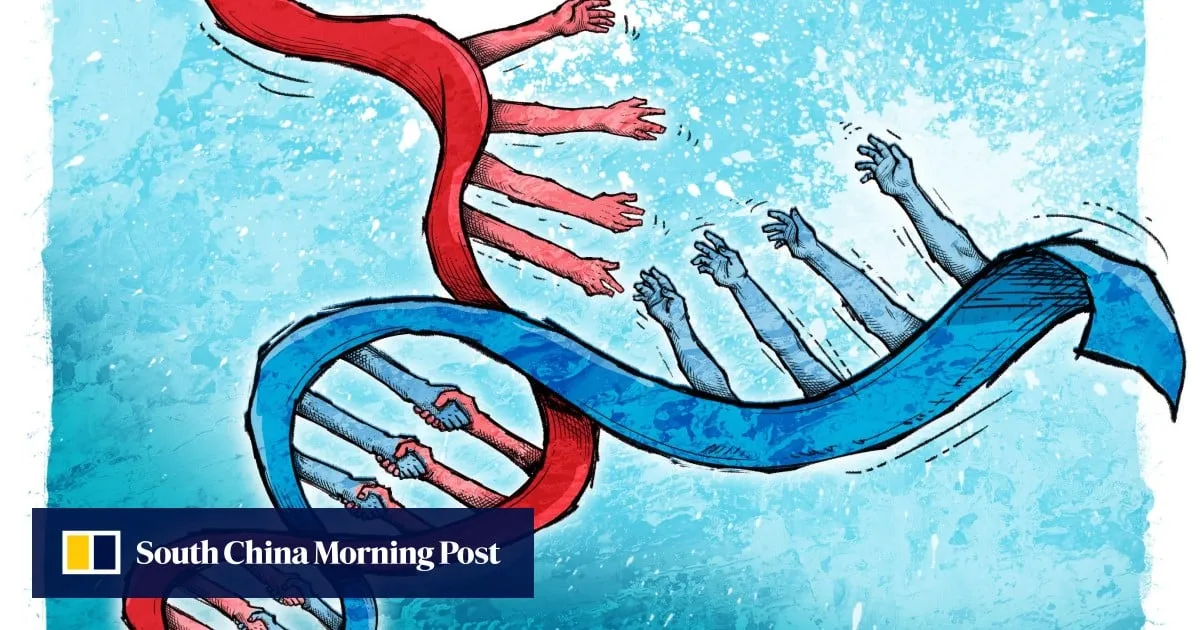
As the United States marks the 250th anniversary of its founding, it confronts a new world order dominated by its relationship with China. In this wide-ranging series, we examine the pressure points and possibilities in those ties, from hard tech to soft power. Here, Dannie Peng looks at what is at stake amid the countries’ historic low in scientific collaboration.In late May, Zhang Ning, founder of TopEdit, a Maryland-based company that provides editing services for academic publications, learned of a troubling development.The US Congress was discussing a proposal to ban American research institutions from collaborating with certain Chinese entities using federal research funds.
SRCSouth China Morning Post
LANGEN
LEANCenter-Right
WORDS103
ENT10
WED · 2026-07-08 · 22:00 GMTBRIEF NSR-2026-0709-91405
NSR-2026-0709-91405Analysis·EN·Technology
US-China scientific decoupling: the hidden costs of geopolitical rivalry
The United States is facing a new global order shaped by its relationship with China, with scientific collaboration between the two nations at a historic low. In late May, a proposal was discussed in the US Congress that would prohibit American research institutions from partnering with specific Chinese entities when using federal research funds.
Dannie PengSouth China Morning PostFiled 2026-07-08 · 22:00 GMTLean · Center-RightRead · 1 min
South China Morning PostFIG 01
Reading time
1min
Word count
103words
Sources cited
1cited
Entities identified
10entities
Quality score
100%
§ 01
Briefing Summary
AI-generatedNEWSAR · AI
The United States is facing a new global order shaped by its relationship with China, with scientific collaboration between the two nations at a historic low. In late May, a proposal was discussed in the US Congress that would prohibit American research institutions from partnering with specific Chinese entities when using federal research funds. This development was noted by Zhang Ning, founder of TopEdit, a company that edits academic publications. The article suggests this trend is part of broader geopolitical rivalry impacting ties between the US and China, with implications for areas ranging from hard technology to soft power.
Confidence 0.85Sources 1Claims 4Entities 10
§ 02
Article analysis
Model · rule-basedFraming
Technology
Diplomatic
Tone
Measured
AI-assessed
CalmNeutralAlarmist
Factuality
0.60 / 1.00
Mixed
LowHigh
Sources cited
1
Limited
FewMany
§ 03
Key claims
4 extracted01
The US is marking the 250th anniversary of its founding.
factualarticle
Confidence
1.00
02
Zhang Ning is the founder of TopEdit, a company providing editing services for academic publications.
factualarticle
Confidence
1.00
03
The US Congress was discussing a proposal to ban American research institutions from collaborating with certain Chinese entities using federal research funds.
factualarticle
Confidence
0.90
04
The US and China are experiencing a historic low in scientific collaboration.
factualarticle
Confidence
0.80
§ 04
Full report
1 min read · 103 words§ 05
Entities
10 identifiedKey playerOppositionContextPositiveNeutralNegative
Organizations2
§ 06
Keywords & salience
9 termsscientific decoupling
1.00
us-china relations
0.90
geopolitical rivalry
0.80
scientific collaboration
0.70
research institutions
0.60
federal research funds
0.50
academic publications
0.40
hard tech
0.40
soft power
0.40
§ 07
Topic connections
Interactive graph Network visualization showing 51 related topics
View Full Graph Person Organization Location Event|Click node to navigate|Edge numbers = shared articles