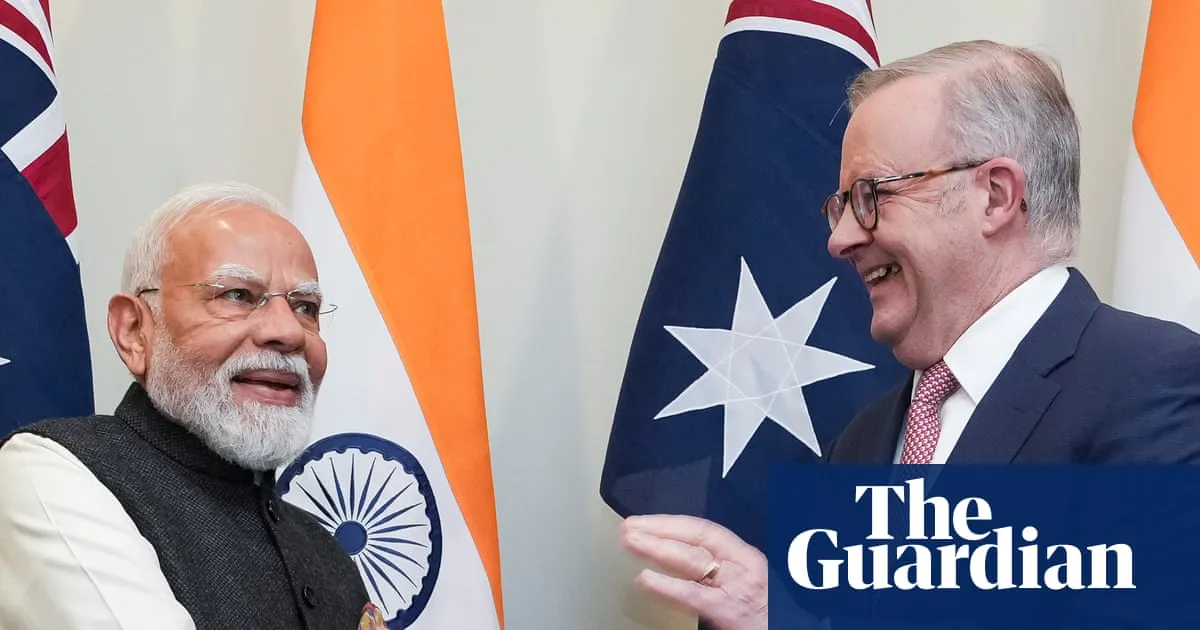
Australian prime minister Anthony Albanese walks with Indian prime minister Narendra Modi during Modi’s three-day visit. Photograph: Jesse Thompson/Getty Images View image in fullscreen Australian prime minister Anthony Albanese walks with Indian prime minister Narendra Modi during Modi’s three-day visit. Photograph: Jesse Thompson/Getty Images Modi and Albanese to ink major uranium deal as Indian leader’s visit expected to draw 30,000-strong crowd Ahead of Modi’s Marvel Stadium event, Anthony Albanese credits Indian PM’s ‘leadership and personal engagement with Australia’ for strength of bilateral relationship Follow our Australia news live blog for latest updates Get our breaking news email, free app or daily news podcast Anthony Albanese has announced a major uranium deal with India that could end decades of delays to regular shipments of the fuel. The prime minister said the agreement would enable uranium exports to flow to India for “peaceful purposes,” with Modi hailing it as vital to help expand his country’s nuclear energy sector. Australia struck a deal with India to sell uranium to the country in 2014 but regular shipments have not occurred due to concerns it could be used for weapons. Speaking at Government House in Melbourne alongside Modi, the prime minister said Australia’s relationship with India had “never been stronger.” “We share a focus on deepening and diversifying the relationship between our countries so we can continue to grow from strength to strength,” he said. Albanese said the uranium arrangement would provide an additional market for Australia’s resource sector. He also pointed to a joint declaration on defence and security co-operation to deepen our practical partnership as signs of the deepening ties between the two countries. “We undertake to consult on defence related developments in the Indo Pacific that affect our shared interests,” he told reporters. Modi pointed to the importance of the bilateral relationship for the Indo-Pacific region, saying the countries would work to “bring peace, stability, freedom of navigation and a rules-based order in the entire region.” The Indian prime minister is in the country for three days and will later on Thursday address more than 20,000 members of the Indian-Australian community in what is expected to be a loud rally at Melbourne’s Marvel Stadium. Speaking at a business event in the city alongside Modi earlier on Thursday, Albanese said for all the “broad affection between our peoples” the relationship between the countries was “underdone, under-explored and under-examined”. “In the last decade or so, that has certainly changed for the better,” the prime minister said. “Prime minister Modi, your leadership and your personal engagement with Australia has been absolutely central to this change. “And so has the drive and determination of the business leaders in this room.” While few national leaders can lay claim to drawing a crowd of tens of thousands during an international diplomatic visit, Modi is an exception. The Indian diaspora throughout Australia are making their way to Melbourne in large numbers for a glimpse of the leader of the world’s most populous nation. Modi was one of three types of people who were “very popular” in his homeland, Canberra India Council chair Deepak-Raj Gupta said. “Politicians, Bollywood stars and cricket players,’’ he said. “It doesn’t really matter who you are if you fall into one of those.” Gupta has travelled to Melbourne with his wife and a contingent of friends to attend as many Modi-related events as possible. But Modi is also one of the world’s most polarising political leaders. Human rights groups such as Amnesty International have condemned him for declines in India’s living standards, including targeting of journalists and academics through anti-terror legislation. Marginal religious groups including Muslims and Christians have also been targeted. Nevertheless, Modi was able to unite the Indian diaspora in a way no one else could, Australian Multicultural Action Network president Ravi Krishnamurthy said. “We look for connection [between Australia and India]. There is pride in adding to Australia’s multicultural community,” he said. Krishnamurthy said he hoped there would be more conversations about two-way trade and tertiary education deals. “Businesses here are starting to invest in India,” he said. The Australian Federal Police formally warned a young person who had made a death threat towards Modi ahead of his arrival in Australia. A far-right influencer also gatecrashed the Melbourne hotel where the Indian prime minister is staying, before being thrown out by police. He posted a video of his late-night tirade where he yelled “fuck Modi” in the hotel’s lobby. Explore more on these topics Australian foreign policy Victoria Narendra Modi Anthony Albanese India news Share Reuse this content
SRCThe Guardian - World News
LANGEN
LEANCenter-Left
WORDS756
ENT11
THU · 2026-07-09 · 04:58 GMTBRIEF NSR-2026-0709-91474
NSR-2026-0709-91474News Report·EN·Economic Impact
Modi and Albanese to ink major uranium deal as Indian leader’s visit expected to draw 30,000-strong crowd
Australian Prime Minister Anthony Albanese announced a major uranium deal with India during Indian Prime Minister Narendra Modi's three-day visit. This agreement aims to end over a decade of delays in regular uranium shipments for India's nuclear energy sector, with exports intended for peaceful purposes.
Australian Associated PressThe Guardian - World NewsFiled 2026-07-09 · 04:58 GMTLean · Center-LeftRead · 4 min
The Guardian - World NewsFIG 01
Reading time
4min
Word count
756words
Sources cited
2cited
Entities identified
11entities
Quality score
100%
§ 01
Briefing Summary
AI-generatedNEWSAR · AI
Australian Prime Minister Anthony Albanese announced a major uranium deal with India during Indian Prime Minister Narendra Modi's three-day visit. This agreement aims to end over a decade of delays in regular uranium shipments for India's nuclear energy sector, with exports intended for peaceful purposes. Both leaders highlighted the strengthening bilateral relationship, emphasizing cooperation in defense and security within the Indo-Pacific region. Modi's visit also includes addressing a large Indian diaspora gathering in Melbourne, with an expected crowd of 30,000. The deal is seen as beneficial for Australia's resource sector and further diversifies the growing ties between the two nations.
Confidence 0.90Sources 2Claims 5Entities 11
§ 02
Article analysis
Model · rule-basedFraming
Economic Impact
Diplomatic
Tone
Measured
AI-assessed
CalmNeutralAlarmist
Factuality
0.70 / 1.00
Factual
LowHigh
Sources cited
2
Limited
FewMany
§ 03
Key claims
5 extracted01
Narendra Modi's leadership and personal engagement with Australia have been central to the strengthening of the bilateral relationship.
quoteAnthony Albanese
Confidence
1.00
02
Australia's relationship with India has 'never been stronger,' according to Prime Minister Albanese.
quoteAnthony Albanese
Confidence
1.00
03
The uranium deal is intended to enable uranium exports to India for peaceful purposes, supporting its nuclear energy sector.
factualAnthony Albanese and Narendra Modi
Confidence
1.00
04
Australia and India have agreed to a major uranium deal, potentially ending decades of delays to regular shipments.
factualAnthony Albanese
Confidence
1.00
05
Narendra Modi is expected to address over 20,000 members of the Indian-Australian community at Marvel Stadium.
statisticArticle
Confidence
0.90
§ 04
Full report
4 min read · 756 words§ 05
Entities
11 identifiedKey playerOppositionContextPositiveNeutralNegative
Locations6
§ 06
Keywords & salience
10 termsuranium deal
1.00
bilateral relationship
0.90
narendra modi
0.80
anthony albanese
0.80
nuclear energy
0.70
defence and security
0.60
australia-india
0.50
indo-pacific region
0.50
peaceful purposes
0.40
rules-based order
0.40
§ 07
Topic connections
Interactive graph No topic relationship data available yet. This graph will appear once topic relationships have been computed.