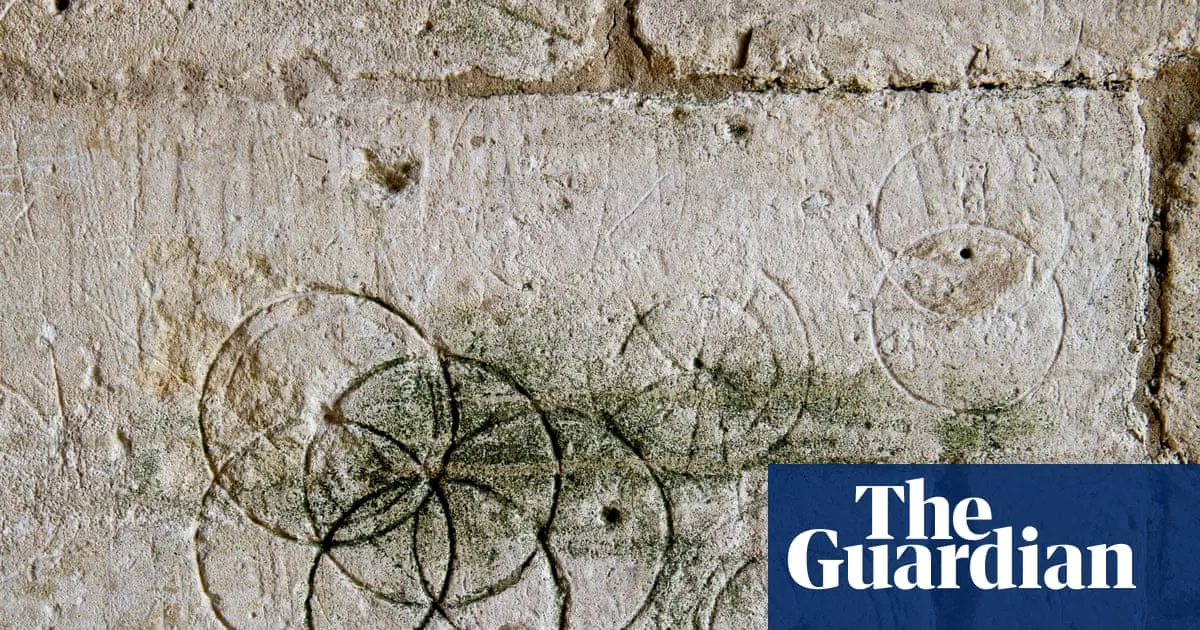
Over the years, English Heritage and Historic England have claimed to have identified large numbers of “witches’ marks” or “Ritual protection symbols” on the walls of historic buildings, including medieval churches and houses.Now a leading architectural historian has said there is “absolutely no evidence” that these marks have anything to do with witches or any “mystical meanings”.Daisy wheels, or Hexafoils, are among symbols that are no more than the marks of stonemasons who worked on those buildings, according to Jennifer Alexander, a professor of architectural history at Warwick University and author of a new study.She told The Guardian: “Do you remember at school when you were first given a pair of compasses and you made a daisy wheel? It’s that. There are hundreds of such marks and they tend to be [of] varying degrees of skill. It’s much more the sort of thing you’d use to train apprentices with, giving them skills in using tools on intractable surfaces like stone.”She said such marks were “practical geometry” being taught and tried out. “The Daisy wheels are practices for drawing on stone and learning how to use compasses with straight edges to do geometry.”Ridiculing their identification as “witches’ marks”, Alexander said: “Anything on a stone building that looks like a design gets picked up as these damn things now. There’s absolutely no evidence they were ever used like that.”In 2024, English Heritage, the charity that looks after historic sites, announced that research at Gainsborough Old Hall in Lincolnshire had revealed “a staggering array of carved ritual protection, or Apotropaic marks – sometimes called ‘witches’ marks’ – the most identified at any of our 400 sites”.It added at the time: “Simple circles that seem to be missing the internal six-petal design of a daisy wheel or a hexafoil are among the marks found … These were believed to trap demons. Others include overlapping Vs or Marian marks, which are believed by some to call on the Virgin Mary for protection, and a pentangle, which – despite modern connotations – was originally used to protect against evil.”In 2016, Historic England, the public body that advises government and helps to protect the historic environment, asked the public to hunt for witches’ marks that “date back to times when belief in witchcraft and the supernatural was widespread”.Its website states that witches’ marks, Ritual protection symbols or Apotropaic marks have been found in many historic places, while acknowledging that the significance of Hexafoils is disputed.“For example, the world of Wicca, which is a contemporary Pagan religious movement, sees them as sun motifs,” it states. “Another school of thought suggests they are purely secular and could be geometric exercises for apprentices … However, their interpretation as a ritual protection mark is the most widely accepted theory at present.”Such symbols have been identified on the stonework of some of the grandest barns, including a 14th-century one at Bradford-on-Avon in Wiltshire.Alexander said: “There’s no evidence that these are witches’ marks. What they’re telling us is that when that barn wasn’t needed for farm produce, it was either a schoolroom or a mason’s training shop.“There are a huge number of designs on the walls there and they vary enormously in skill. If you’re drawing a circle with a pair of compasses, you get three-quarters the way round and it’s very difficult to make a nice clean line because your wrist is upside down. When you’re doing it on paper, it’s bad enough. When you’re doing it on stone, it’s even harder. So people have to be trained.”She added: “There are things to ward off the evil eye, but they are a more generic thing … These are parts of the mechanisms by which buildings are constructed … Marks that look like a capital W or an M are mason ciphers. They can help you put things together in the right order if you’re building something. Or they can identify whose work it was.”Alexander’s book, Stonemasons’ Marks, has been published by Routledge ahead of this week’s International Medieval Congress in Leeds. She explores how marks were used and what they reveal about buildings and the people who built them.Historic England said: “We welcome new research that adds to our understanding of these marks. The more we learn about them, the richer our picture of the people who made and used these places becomes.”English Heritage said: “We welcome debates such as this, which encourage fresh perspectives on the past, and look forward to seeing where future research leads.”
SRCThe Guardian - World News
LANGEN
LEANCenter-Left
WORDS745
ENT12
THU · 2026-07-09 · 05:00 GMTBRIEF NSR-2026-0709-91477
NSR-2026-0709-91477News Report·EN·Human Interest
No evidence for ‘witches’ marks’ claims at old English buildings, historian says
Architectural historian Jennifer Alexander argues there is no evidence that symbols found on historic English buildings, such as daisy wheels, are "witches' marks" or ritual protection symbols. Alexander, author of a new study, contends these marks are actually the working marks of stonemasons, used for practical geometry and training apprentices.
Dalya AlbergeThe Guardian - World NewsFiled 2026-07-09 · 05:00 GMTLean · Center-LeftRead · 3 min
The Guardian - World NewsFIG 01
Reading time
3min
Word count
745words
Sources cited
3cited
Entities identified
12entities
Quality score
100%
§ 01
Briefing Summary
AI-generatedNEWSAR · AI
Architectural historian Jennifer Alexander argues there is no evidence that symbols found on historic English buildings, such as daisy wheels, are "witches' marks" or ritual protection symbols. Alexander, author of a new study, contends these marks are actually the working marks of stonemasons, used for practical geometry and training apprentices. This challenges previous interpretations by English Heritage and Historic England, who have identified numerous such symbols as apotropaic marks intended to ward off evil. Alexander suggests these marks were part of the construction process, with some potentially serving as mason ciphers for assembly or identification. Both English Heritage and Historic England have stated they welcome new research and debate on the topic.
Confidence 0.90Sources 3Claims 5Entities 12
§ 02
Article analysis
Model · rule-basedFraming
Human Interest
Tone
Measured
AI-assessed
CalmNeutralAlarmist
Factuality
0.70 / 1.00
Factual
LowHigh
Sources cited
3
Well sourced
FewMany
§ 03
Key claims
5 extracted01
There is no evidence that 'witches' marks' on historic buildings are related to witches or mystical meanings.
factualJennifer Alexander
Confidence
0.95
02
Historic England asked the public to hunt for 'witches' marks' in 2016, dating back to times of widespread belief in witchcraft.
quoteHistoric England
Confidence
0.90
03
English Heritage identified a 'staggering array of carved ritual protection' marks at Gainsborough Old Hall in 2024.
quoteEnglish Heritage
Confidence
0.90
04
Daisy wheels and hexafoils are marks of stonemasons training apprentices in using tools on stone.
factualJennifer Alexander
Confidence
0.90
05
The interpretation of these symbols as ritual protection marks is the most widely accepted theory at present.
factualHistoric England
Confidence
0.70
§ 04
Full report
3 min read · 745 words§ 05
Entities
12 identifiedKey playerOppositionContextPositiveNeutralNegative
Organizations4
§ 06
Keywords & salience
10 termswitches' marks
1.00
ritual protection symbols
0.90
architectural historian
0.80
daisy wheels
0.70
historic buildings
0.70
practical geometry
0.60
stonemasons
0.60
historic england
0.50
english heritage
0.50
apotropaic marks
0.40
§ 07
Topic connections
Interactive graph No topic relationship data available yet. This graph will appear once topic relationships have been computed.