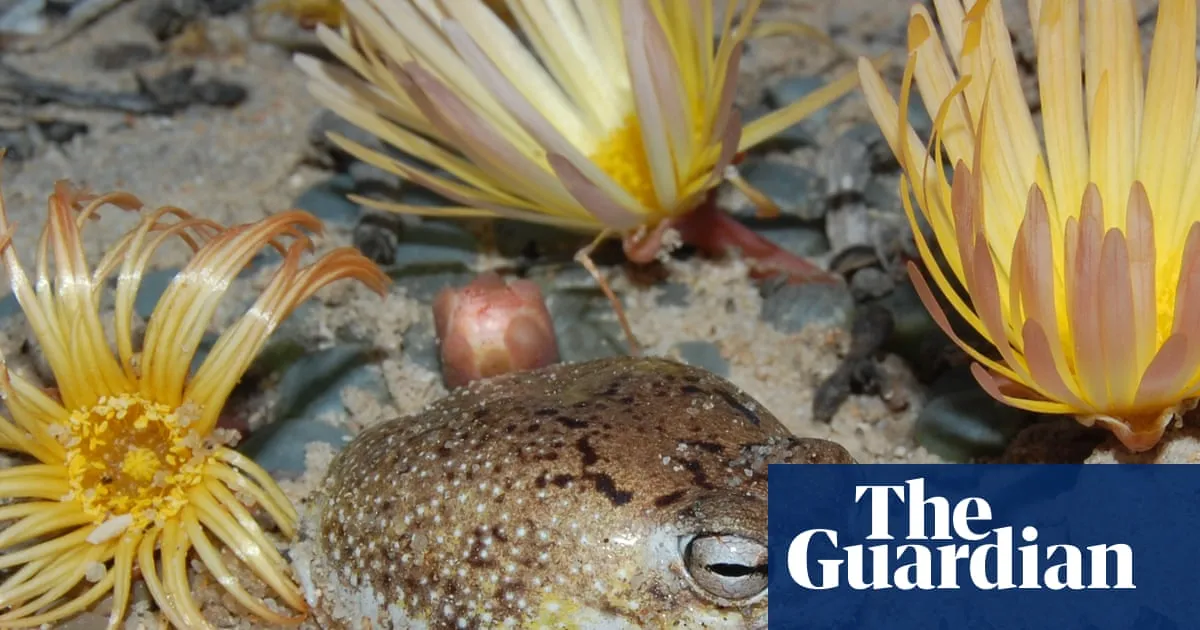
Life has colonised every corner of the planet by evolving ingenious survival strategies but these are increasingly being overwhelmed by destructive human activities, this year’s red list of endangered species has revealed.Many snails, limpets and clams have adapted to life at crushing depths in the oceans on hydrothermal vents where water temperatures can reach 450C (842F). But an assessment for the red list found that two-thirds of the hundreds of mollusc species found only on deep sea vents were at risk of extinction because of deep-sea mining.Mining for diamonds has put another extraordinary creature at risk of disappearing – the desert rain frog. Most frogs rely on water for survival but the bulbous desert rain frog has evolved to need almost none. It hides from the southern African sun by burying itself deep in the sand, coming out only at night to hunt insects.However, dwindling species can be saved, the International Union for Conservation of Nature (IUCN), which produces the red list, said. The new list shows the numbat, a stripy, termite-eating marsupial from Australia, has come back from the brink thanks to protection from feral cats and foxes.At least five more self-sustaining numbat populations have been established owing to conservation work. Photograph: phototrip/Alamy“Life on Earth has adapted to survive in the most hostile and unusual habitats [but] as pressures on biodiversity mount across the planet, even the creatures with the most ingenious survival strategies are under threat,” said Dr Grethel Aguilar, the IUCN director general. “But there is a clear path out of the biodiversity crisis: nature conservation works. By protecting the astounding range of biodiversity on this planet, we can preserve a welcoming environment for humans and wildlife alike.”An IUCN update in April declared emperor penguins officially in danger of extinction owing to the mass drowning of chicks as sea ice is melted by the climate crisis.More than 200 species of mollusc are known to live only on hydrothermal vents, where water heated by volcanic rocks jets out from the seabed. Many have been discovered only in the last decade but already face extinction.The exploration and extraction of deep-sea minerals throws up sediments that smother the animals. One snail, Lirapex felix, is classed as critically endangered because of mining activity in the Indian Ocean.However, more than 30 vent species are not in danger, as they live in marine protected areas where mining is not allowed. These include an ornately shelled snail, Provanna exquisita, that lives only in the Mariana Arc of Fire national wildlife refuge in the Pacific Ocean.skip past newsletter promotionafter newsletter promotionThe Provanna exquisita snail is not in danger as it lives in a marine protected area. Photograph: Chong Chen“This global assessment reveals that [vent] molluscs are one of the most highly threatened of all animal groups,” said Prof Julia Sigwart at Senckenberg Nature Research, the IUCN red list partner that coordinated the assessment. “It provides important information as the International Seabed Authority meets in Jamaica this month.” The IUCN voted for a moratorium on deep-sea mining in 2021.The desert rain frog is classed as vulnerable owing to diamond mining and energy infrastructure expansion into its range along the west coast of South Africa and Namibia. There is further pressure on the frog because of rising demand from the exotic pet trade following a viral video of the species squeaking its distress call.The good news on the numbat comes after decades of conservation work, which has helped numbers rebound from a low of just 300 in the late 1970s to between 2,000 and 3,000 today. The numbat has moved from endangered to near threatened on the red list.The impact of feral cats and red foxes has been reduced by baiting and predator-proof fencing, as well as captive breeding at Perth zoo and translocations from healthy groups. As a result, at least five more self-sustaining populations have been established. However, the species occupies only 0.04% of its original range across southern Australia, meaning continuing conservation work is essential, experts said.Another five Australian marsupials have been confirmed as extinct on the red list, with no sightings for at least 60 years. The crest-tailed, southern, northern and little mulgaras were rat-sized carnivores, while the little bettong was a rabbit-sized jumping marsupial. They are likely to have fallen prey to feral cats and foxes. More than 40 modern mammal extinctions have been recorded in Australia.“The [numbat] assessment shows that long-term conservation effort works; without it, invasive cats and foxes will continue to drive Australia’s small marsupials and native rodents to extinction,” said Prof John Woinarski, co-chair of the IUCN species survival commission group on Australasian marsupials and monotremes.“Continued management is vital not only to maintain the numbat’s unique evolutionary line as the last surviving member of the Myrmecobiidae family, but also to support its role in maintaining a healthy ecosystem, as digging for the termites it eats increases rain penetration into the soil, helping protect woodlands,” he said.The IUCN red list includes 175,909 species of which 49,505 are threatened with extinction, although many species have yet to be formally assessed.
SRCThe Guardian - World News
LANGEN
LEANCenter-Left
WORDS840
ENT12
THU · 2026-07-09 · 12:20 GMTBRIEF NSR-2026-0709-91602
NSR-2026-0709-91602News Report·EN·Environmental
Species’ ingenious survival strategies no match for human destruction, red list reveals
The latest IUCN Red List reveals that even species with remarkable survival strategies are threatened by human activities. Deep-sea molluscs living on hydrothermal vents face extinction due to deep-sea mining, with two-thirds of species at risk.
Damian Carrington Environment editorThe Guardian - World NewsFiled 2026-07-09 · 12:20 GMTLean · Center-LeftRead · 4 min
The Guardian - World NewsFIG 01
Reading time
4min
Word count
840words
Sources cited
3cited
Entities identified
12entities
Quality score
100%
§ 01
Briefing Summary
AI-generatedNEWSAR · AI
The latest IUCN Red List reveals that even species with remarkable survival strategies are threatened by human activities. Deep-sea molluscs living on hydrothermal vents face extinction due to deep-sea mining, with two-thirds of species at risk. The desert rain frog, adapted to arid conditions, is vulnerable due to diamond mining and habitat expansion. Conversely, conservation efforts have helped the Australian numbat rebound from the brink of extinction, moving from endangered to near threatened. However, five Australian marsupials have been declared extinct, likely due to invasive predators. The IUCN emphasizes that nature conservation is effective in addressing the biodiversity crisis.
Confidence 0.90Sources 3Claims 5Entities 12
§ 02
Article analysis
Model · rule-basedFraming
Environmental
Human Interest
Tone
Mixed Tone
AI-assessed
CalmNeutralAlarmist
Factuality
0.80 / 1.00
Factual
LowHigh
Sources cited
3
Well sourced
FewMany
§ 03
Key claims
5 extracted01
Nature conservation works and is a clear path out of the biodiversity crisis.
quoteDr Grethel Aguilar (IUCN director general)
Confidence
1.00
02
Emperor penguins are officially in danger of extinction due to climate crisis melting sea ice.
factualIUCN (April declaration)
Confidence
1.00
03
The numbat has come back from the brink of extinction thanks to protection from feral cats and foxes.
factualIUCN
Confidence
1.00
04
Two-thirds of mollusc species found only on deep-sea vents are at risk of extinction due to deep-sea mining.
statisticIUCN Red List assessment
Confidence
1.00
05
Mining for diamonds has put the desert rain frog at risk of disappearing.
factualArticle
Confidence
0.90
§ 04
Full report
4 min read · 840 words§ 05
Entities
12 identifiedKey playerOppositionContextPositiveNeutralNegative
§ 06
Keywords & salience
10 termsendangered species
1.00
biodiversity crisis
0.90
human destruction
0.80
deep-sea mining
0.70
survival strategies
0.60
nature conservation
0.60
iucn red list
0.50
climate crisis
0.50
hydrothermal vents
0.40
extinction risk
0.40
§ 07
Topic connections
Interactive graph No topic relationship data available yet. This graph will appear once topic relationships have been computed.