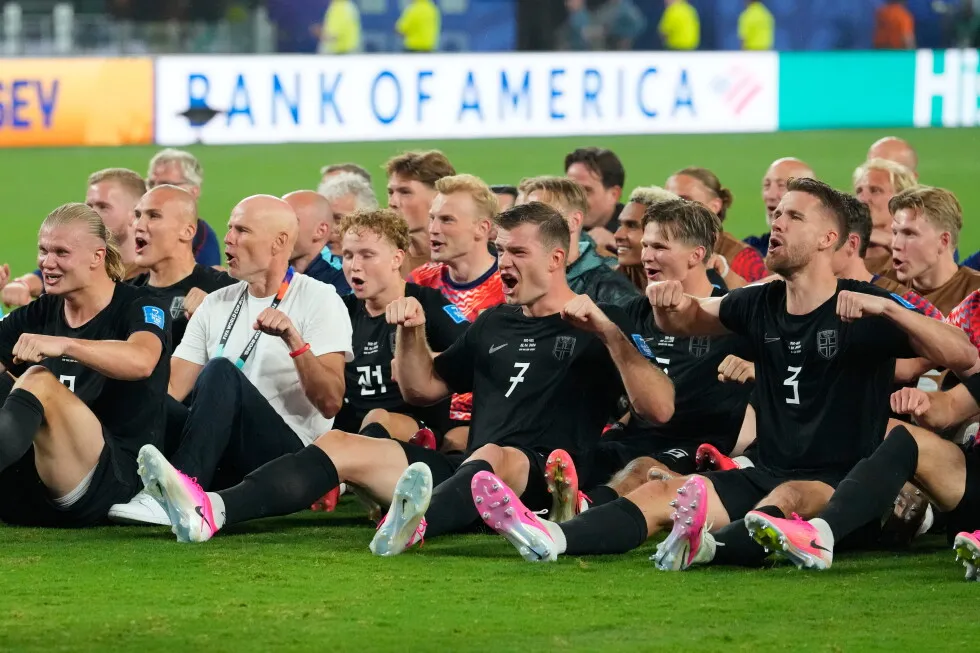
Norwegian players Erling Haaland, left, Alexander Soerloth (7), Kristoffer Ajer (3) and teammates celebrate after defeating Senegal in a World Cup Group I soccer match in East Rutherford, N.J., near New York, Monday, June 22, 2026. (AP Photo/Yuki Iwamura) Updated [hour]:[minute] [AMPM] [timezone], [monthFull] [day], [year] As Norway excels in its first World Cup appearance since 1998, false claims about what the team is eating are also grabbing attention online.The allegations focus on the quality of American food — more specifically, that the Norwegians distrust it so much that they brought food from home to avoid eating it. Norway’s team is based in Greensboro, North Carolina, for the duration of the 2026 tournament, which is being co-hosted by the U.S., Canada and Mexico.It’s true that the team shipped certain products from Norway for the World Cup, but the reason has nothing to do with concerns about quality. Norway fans perform a rowing ritual prior to the World Cup Group I soccer match between Senegal and Norway in East Rutherford, N.J., near New York, Monday, June 22, 2026. (AP Photo/Yuki Iwamura) Norway fans perform a rowing ritual prior to the World Cup Group I soccer match between Senegal and Norway in East Rutherford, N.J., near New York, Monday, June 22, 2026. (AP Photo/Yuki Iwamura) Add AP News on Google Add AP News as your preferred source to see more of our stories on Google. Share Here’s a closer look at the facts.CLAIM: The Norwegian men’s national soccer team brought its own food to the 2026 World Cup because it doesn’t trust the quality of food in the U.S.THE FACTS: This is false. The team brought some products from Norway to maintain consistency in players’ diets and provide a taste of home, according to its head chef Aron Espeland. Other ingredients have been sourced locally. Nutrition experts say that such a practice is common among elite athletes who play internationally.“When athletes are competing at the highest level, consistency is important,” Espeland said. “The players are used to certain products and flavors, and familiar foods can contribute both to nutrition and overall well-being during a demanding competition.” He continued: “Overall, the experience of cooking for the team in the U.S. has been excellent. We have had access to high-quality local ingredients, and our approach has been to combine those with a selection of Norwegian products that help create continuity and a sense of home for the players during the tournament.” 1 MIN READ 2 MIN READ 4 MIN READ Many of the claims spreading online say the team brought in 1,000 kilograms (2,200 pounds) of food from Norway for the World Cup. Espeland confirmed that the amount is actually about 580 kilograms (1,276 pounds). That consists of 300 kilograms (660 pounds) of Norwegian salmon and trout, 100 kilograms (220 pounds) of halibut, 80 kilograms (176 pounds) of Norwegian brown cheese, and 100 kilograms (220 pounds) of Jarlsberg cheese. The team, whose support staff includes three chefs, did not bring oranges from Norway, despite social media posts claiming otherwise. Espeland said that players are served freshly squeezed orange juice every morning, made from oranges sourced locally in the U.S. Plenty of other teams travel with their own chef and have taken their own food to past World Cups. For example, Argentina and Uruguay each brought thousands of pounds of meat to Qatar in 2022. The U.S. squad traveled to Brazil in 2014 with oatmeal, Cheerios, peanut butter and A1 Steak Sauce. Such practices are not unusual for elite athletes who compete in different countries, according to experts. The reasons include maintaining routine and consistency, reducing risk of adverse reactions, providing cultural familiarity and accommodating personal preferences. Norway’s players pose before the World Cup Group I soccer match between Iraq and Norway in Foxborough, Mass., near Boston, Tuesday, June 16, 2026. (AP Photo/Charles Krupa) Norway’s players pose before the World Cup Group I soccer match between Iraq and Norway in Foxborough, Mass., near Boston, Tuesday, June 16, 2026. (AP Photo/Charles Krupa) Add AP News on Google Add AP News as your preferred source to see more of our stories on Google. Share “Interpreting this practice as a lack of trust in the host nation’s food system misunderstands the purpose of high-performance nutrition,” said Rafaela G. Feresin, an associate professor of nutrition at Georgia State University. “The goal is not to evaluate local food quality; it is to eliminate unnecessary variability during competition. Bringing a chef and familiar ingredients to a major tournament is standard, performance-driven logistics.”Amy Goodson, a sports dietitian who has worked with professional teams including the Dallas Cowboys and the Texas Rangers, explained that bringing food to international competitions is more about “control, consistency, and performance” rather than distrust. “Nutrition is a performance variable at the World Cup level,” she said. “These athletes train, travel, and compete with elite intensity, often multiple times in a short window, while managing weather and time zone changes. What they eat directly impacts energy availability, hydration status, recovery, immune function, and even decision-making on the field. When margins are razor thin, fueling consistency becomes critical.” ___ Goldin debunks, analyzes and tracks misinformation for The Associated Press. She is based in New York.
SRCAssociated Press (AP)
LANGEN
LEANCenter
WORDS865
ENT12
FRI · 2026-07-10 · 03:53 GMTBRIEF NSR-2026-0710-91803
NSR-2026-0710-91803News Report·EN·Human Interest
FACT FOCUS: Norway brought its own food to the World Cup. But not because it distrusts US products
False claims circulating online suggest the Norwegian men's national soccer team brought food from home to the 2026 World Cup due to distrust of U.S. products.
By
MELISSA GOLDINAssociated Press (AP)Filed 2026-07-10 · 03:53 GMTLean · CenterRead · 4 min
Associated Press (AP)FIG 01
Reading time
4min
Word count
865words
Sources cited
2cited
Entities identified
12entities
Quality score
100%
§ 01
Briefing Summary
AI-generatedNEWSAR · AI
False claims circulating online suggest the Norwegian men's national soccer team brought food from home to the 2026 World Cup due to distrust of U.S. products. However, the team's head chef, Aron Espeland, confirmed they did ship approximately 580 kilograms of specific Norwegian products, including salmon, trout, halibut, and cheeses. This practice is common among elite athletes and is done to ensure dietary consistency, provide a sense of home, and maintain performance, not due to concerns about local food quality. Experts emphasize that bringing familiar ingredients and a chef is standard performance logistics for international competitions, focusing on control and consistency rather than distrust of the host nation's food.
Confidence 0.90Sources 2Claims 5Entities 12
§ 02
Article analysis
Model · rule-basedFraming
Human Interest
Public Health
Tone
Measured
AI-assessed
CalmNeutralAlarmist
Factuality
0.90 / 1.00
Factual
LowHigh
Sources cited
2
Limited
FewMany
§ 03
Key claims
5 extracted01
The experience of cooking for the team in the U.S. has been excellent, with access to high-quality local ingredients.
quoteAron Espeland (head chef)
Confidence
1.00
02
Consistency in products and flavors is important for elite athletes to maintain nutrition and well-being during demanding competitions.
quoteAron Espeland (head chef)
Confidence
1.00
03
The team brought approximately 580 kilograms (1,276 pounds) of food from Norway, including salmon, trout, halibut, and Norwegian brown cheese.
statisticAron Espeland (head chef)
Confidence
1.00
04
The Norwegian team brought some products from Norway to maintain dietary consistency and provide a taste of home, not due to quality concerns.
factualAron Espeland (head chef)
Confidence
1.00
05
False claims about the Norwegian team bringing food to the World Cup due to distrust of US products are circulating online.
factual
Confidence
1.00
§ 04
Full report
4 min read · 865 words§ 05
Entities
12 identifiedKey playerOppositionContextPositiveNeutralNegative
Locations8
§ 06
Keywords & salience
8 termsnorwegian national soccer team
1.00
world cup
1.00
athlete nutrition
0.90
food quality
0.80
diet consistency
0.70
elite athletes
0.60
international competition
0.50
taste of home
0.40
§ 07
Topic connections
Interactive graph No topic relationship data available yet. This graph will appear once topic relationships have been computed.