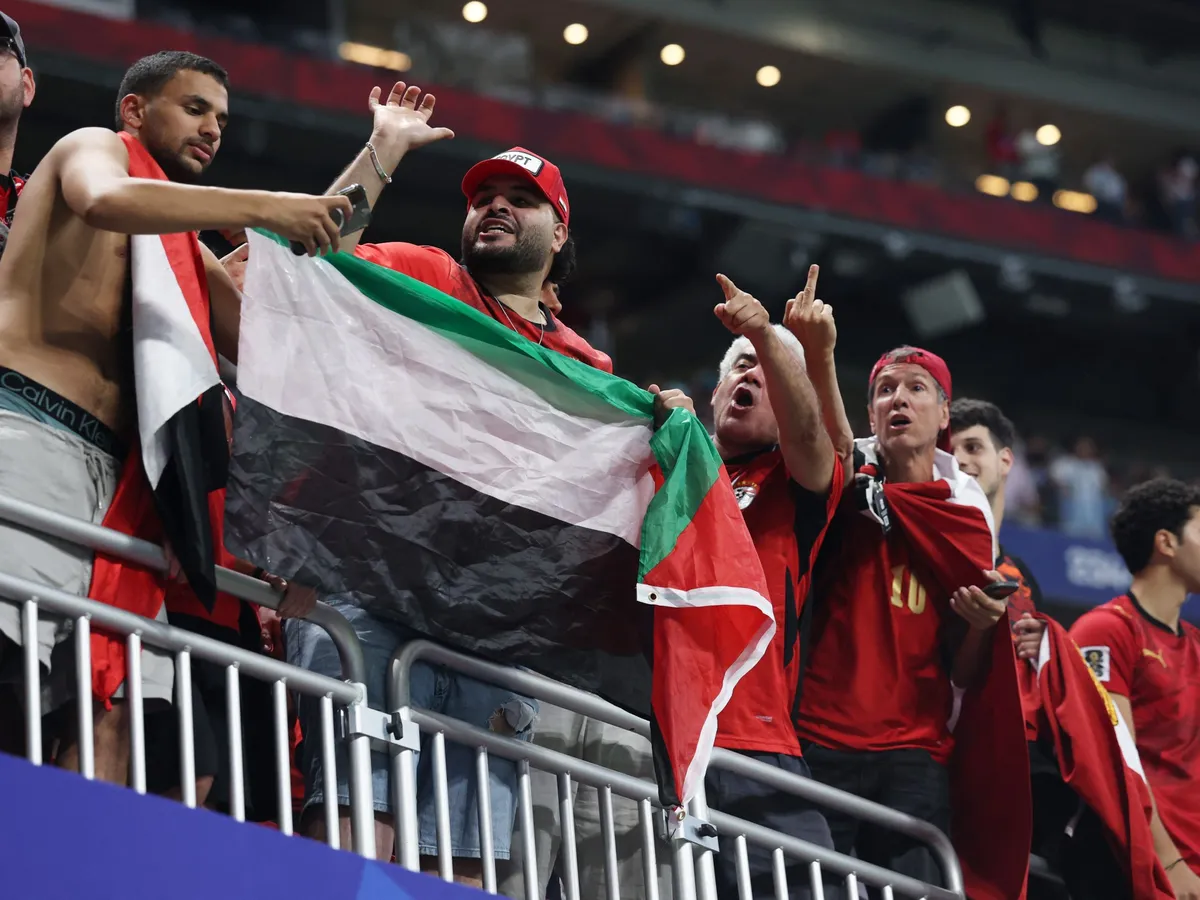
Contested calls and rival flags showed how Palestine now shapes debates over power and fairness in sport.Professor in the Media Studies program at the Doha Institute for Graduate Studies.Published On 10 Jul 2026Egypt fans with a Palestinian flag in the stands after the round-of-16 match between Argentina and Egypt in Atlanta Stadium, Atlanta, Georgia, US, July 7, 2026 [Paul Childs/Reuters]Tuesday’s round-of-16 FIFA World Cup match between Egypt and Argentina in Atlanta was perhaps both the tournament’s most controversial game and its most politically consequential.After going up 1-0 against the defending champions, Egypt had a second goal controversially disallowed and its request for video review of an Argentina goal denied.Fans and experts complained that video review (VAR) was employed unevenly and that Egypt’s 3-2 defeat was unjust.Egyptian manager Hossam Hassan said the game was “not fair”, and suggested that FIFA had wanted Argentina and its global superstar, Lionel Messi, to advance in the tournament.The Egyptian Football Association filed a formal complaint on Wednesday.Lost in the game’s controversial ending is perhaps a much bigger story — the way in which the Egypt-Argentina game has turned into the latest marker of the Palestinian struggle.Increasingly, positions on Israel and Palestine are seen as a gauge of political and moral integrity, while the Palestinian cause has emerged as a visible political dividing line within sport.Nowhere in recent sport memory has this been clearer than the Egypt-Argentina match.In the lead-up to the game, Hassan used his platform to highlight the Palestinian plight.After the Egyptian team’s first-ever World Cup knockout game victory on July 3, Hassan waved the Palestinian flag on the pitch and then dedicated the win to Palestine during his post-game news conference.He then used a Monday pre-game news conference to deliver a passionate address about Palestinian suffering.As part of his remarks, Hassan said that anyone who doesn’t feel compassion for Palestinians “is not a human being”.The politics surrounding Israel and Palestine also spilled into the fan experience.During the match, Palestinians in Gaza waved Egyptian flags and cheered on the Egyptian squad.Meanwhile, Egyptian and Argentinian supporters inside the stadium traded flag jabs, with Argentinian supporters raising an Israeli flag and Egyptian fans holding up a Palestinian one.The political entanglementsThe appearance of an Israeli flag among Argentinian supporters was noteworthy and symbolically significant, particularly given Argentinians’ public opinion and politics.Polling data shows that the Argentinian public as a whole has grown highly critical of Israel, but the government remains ardently pro-Israel.Argentinian President Javier Milei’s relationship with US President Donald Trump – who has taken credit for bringing the World Cup to North America – is also important.Milei and Trump are reportedly very close, with the American leader calling Milei his “favourite president” and the Argentinian head of state offering open, explicit support for his American counterpart.Importantly, both leaders are highly supportive of Israel.Milei recently proclaimed that he is “proud to be the most Zionist president in the world”, while Trump has repeatedly described himself as Israel’s “best friend”.Trump is also close to FIFA president Gianni Infantino.In 2025, Infantino lobbied for Trump to be awarded the Nobel Peace Prize.Later that year, Infantino created a new honour, the FIFA Peace Prize, and promptly awarded it to Trump.The closeness of their relationship has been on display during the World Cup.Trump and Infantino teamed up earlier this week to reverse a red card given to American striker Folarin Balogun, who had been initially suspended from the USA team’s round-of-16 match against Belgium.Trump publicly said that he called Infantino and asked him to reverse the suspension.The incident does not establish interference in Egypt vs Argentina, but it reinforces the perception that access and political influence can affect FIFA decision-making.Infantino has also been accused of offering to whitewash Israeli crimes against Palestinians, while FIFA has faced criticism for refusing to sanction Israel after moving quickly to suspend Russia following its invasion of Ukraine.The Palestine lensThe Egypt-Argentina match took place against this larger political backdrop.Without the political drama – and without the spectre of Palestine – the controversy surrounding the match may have remained largely confined to football. Fans might have merely debated the refereeing decisions and VAR protocols.But this match took place at a particular historical moment: a genocide case against Israel at the International Court of Justice, unprecedented global condemnation of Israel, and widespread international support for the Palestinian cause, including within sport.For millions of football fans, especially in the Arab and Muslim worlds, Gaza has become a paradigmatic example of a global order in which power shapes not only outcomes, but also the rules by which outcomes are judged legitimate.Israel has killed tens of thousands of Palestinians and destroyed much of Gaza, all with the support of the world’s most powerful country, which shields Israel from accountability and actively seeks to undermine the rules-based order.It was through this political, Palestine-driven lens that the Egypt-Argentina match was interpreted.The disallowed Egyptian goal, non-calls on apparent Argentinian fouls, and the referee’s refusal to use VAR after an apparent foul on Egypt’s Mohamed Salah in the box were interpreted as reproducing a familiar pattern: the more powerful side receiving the benefit of the doubt, while supposedly neutral institutions appear to apply their rules unevenly.This does not necessarily mean that FIFA secretly conspired to ensure an Argentinian victory. But power and bias do not always require a premeditated, intentional plan, and the widespread reaction to the match cannot be separated from a broader crisis of trust in institutions that claim neutrality while operating in deeply unequal environments.For millions of football fans who support the Palestinian cause, the sting of the Egypt-Argentina match isn’t likely to fade quickly.But neither will the image of Hassan waving the Palestinian flag or using the world’s biggest sporting stage to speak about Palestinian suffering.The views expressed in this article are the author’s own and do not necessarily reflect Al Jazeera’s editorial policy.
SRCAl Jazeera
LANGEN
LEANCenter
WORDS972
ENT11
FRI · 2026-07-10 · 10:27 GMTBRIEF NSR-2026-0710-91919
NSR-2026-0710-91919Analysis·EN·Political Strategy
How an Egypt-Argentina World Cup game became a referendum on Palestine
A FIFA World Cup match between Egypt and Argentina on July 7, 2026, became a focal point for debates on power and fairness in sport, largely due to the Palestinian struggle. Controversial refereeing decisions, including a disallowed Egyptian goal and denied VAR review, led to accusations of an unfair outcome and suggestions that FIFA favored Argentina and Lionel Messi.
Mohamad ElmasryAl JazeeraFiled 2026-07-10 · 10:27 GMTLean · CenterRead · 4 min
Al JazeeraFIG 01
Reading time
4min
Word count
972words
Sources cited
2cited
Entities identified
11entities
Quality score
100%
§ 01
Briefing Summary
AI-generatedNEWSAR · AI
A FIFA World Cup match between Egypt and Argentina on July 7, 2026, became a focal point for debates on power and fairness in sport, largely due to the Palestinian struggle. Controversial refereeing decisions, including a disallowed Egyptian goal and denied VAR review, led to accusations of an unfair outcome and suggestions that FIFA favored Argentina and Lionel Messi. Egyptian manager Hossam Hassan used his platform to highlight Palestinian suffering, dedicating a win to Palestine and stating that a lack of compassion for Palestinians is inhuman. The match also saw fans displaying Palestinian and Israeli flags, reflecting broader political divisions. The article suggests that political influence, particularly concerning US President Donald Trump's relationship with FIFA president Gianni Infantino and Argentina's government, may impact FIFA's decision-making.
Confidence 0.90Sources 2Claims 5Entities 11
§ 02
Article analysis
Model · rule-basedFraming
Political Strategy
Social Justice
Tone
Mixed Tone
AI-assessed
CalmNeutralAlarmist
Factuality
0.40 / 1.00
Mixed
LowHigh
Sources cited
2
Limited
FewMany
§ 03
Key claims
5 extracted01
Hassan stated that anyone who doesn’t feel compassion for Palestinians “is not a human being”.
quoteHossam Hassan
Confidence
1.00
02
Egyptian manager Hossam Hassan suggested that FIFA had wanted Argentina and Lionel Messi to advance in the tournament.
quoteHossam Hassan
Confidence
1.00
03
Hossam Hassan waved the Palestinian flag on the pitch and dedicated the win to Palestine.
factualHossam Hassan
Confidence
0.95
04
Egypt had a second goal controversially disallowed and its request for video review of an Argentina goal denied during the World Cup match.
factual
Confidence
0.90
05
Argentinian supporters raised an Israeli flag, and Egyptian fans held up a Palestinian one during the match.
factual
Confidence
0.85
§ 04
Full report
4 min read · 972 words§ 05
Entities
11 identifiedKey playerOppositionContextPositiveNeutralNegative
Locations6
§ 06
Keywords & salience
10 termspalestine
1.00
world cup
0.90
egypt
0.80
argentina
0.80
sport
0.70
politics
0.70
var
0.60
political integrity
0.50
fairness
0.40
controversial game
0.40
§ 07
Topic connections
Interactive graph Network visualization showing 51 related topics
View Full Graph Person Organization Location Event|Click node to navigate|Edge numbers = shared articles