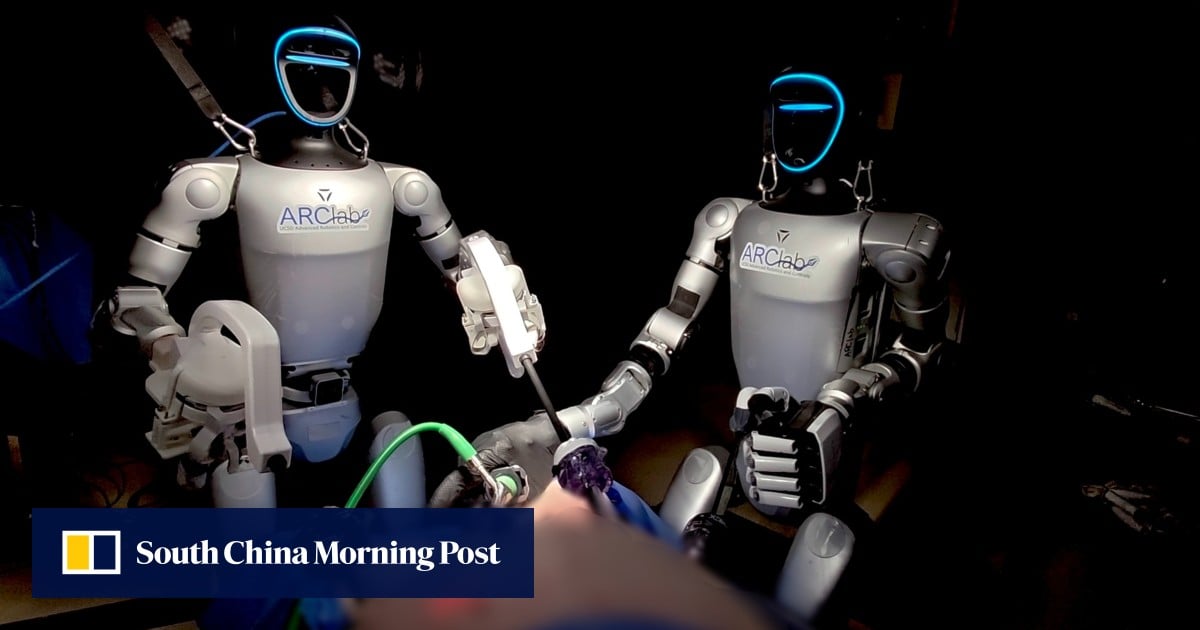
US scientists have carried out Keyhole Surgery with a Chinese-made robot taking the place of the lead surgeon.The general-purpose Humanoid Robot made by Robotics" class="entity-link entity-organization" data-entity-id="12531" data-entity-type="organization">Unitree Robotics was remotely controlled by two human surgeons as it successfully removed a pig’s gallbladder at the University of California San Diego (UCSD).Another robot also played a support role during the procedure, controlling the endoscope used to monitor the operation and retracting tissue.“Remotely operated and autonomous humanoid robots have real potential for expanding access to critical surgeries that patients might otherwise go without,” said Michael Yip, a professor in UCSD’s Department of Electrical and Computer Engineering and senior author of a paper on the surgery.A human-robot team successfully performed a Gallbladder Removal. Photo: Handout“This could help address healthcare crises not only in the US, but worldwide,” Yip told university newspaper UCSD Today.
SRCSouth China Morning Post
LANGEN
LEANCenter-Right
WORDS136
ENT10
FRI · 2026-07-10 · 13:00 GMTBRIEF NSR-2026-0710-91973
NSR-2026-0710-91973News Report·EN·Technology
US scientists use Chinese humanoid robot to carry out keyhole surgery and remove organs
US scientists at the University of California San Diego (UCSD) have successfully conducted keyhole surgery using a Chinese-made humanoid robot. The robot, manufactured by Unitree Robotics, was remotely controlled by two human surgeons to remove a pig's gallbladder.
Shi HuangSouth China Morning PostFiled 2026-07-10 · 13:00 GMTLean · Center-RightRead · 1 min
South China Morning PostFIG 01
Reading time
1min
Word count
136words
Sources cited
1cited
Entities identified
10entities
Quality score
100%
§ 01
Briefing Summary
AI-generatedNEWSAR · AI
US scientists at the University of California San Diego (UCSD) have successfully conducted keyhole surgery using a Chinese-made humanoid robot. The robot, manufactured by Unitree Robotics, was remotely controlled by two human surgeons to remove a pig's gallbladder. A second robot assisted by managing the endoscope and retracting tissue. This development, detailed in a UCSD paper, is seen as having significant potential to increase access to critical surgeries globally, addressing healthcare crises. Professor Michael Yip of UCSD highlighted the potential of remotely operated and autonomous humanoid robots in this regard.
Confidence 0.85Sources 1Claims 5Entities 10
§ 02
Article analysis
Model · rule-basedFraming
Technology
Public Health
Tone
Measured
AI-assessed
CalmNeutralAlarmist
Factuality
0.80 / 1.00
Factual
LowHigh
Sources cited
1
Limited
FewMany
§ 03
Key claims
5 extracted01
This technology could help address healthcare crises not only in the US, but worldwide.
quoteMichael Yip
Confidence
1.00
02
Remotely operated and autonomous humanoid robots have real potential for expanding access to critical surgeries.
quoteMichael Yip
Confidence
1.00
03
Another robot controlled the endoscope and retracted tissue during the surgery.
factual
Confidence
1.00
04
The robot was remotely controlled by two human surgeons during the procedure at the University of California San Diego (UCSD).
factual
Confidence
1.00
05
US scientists used a Chinese-made humanoid robot to perform keyhole surgery and remove a pig's gallbladder.
factual
Confidence
1.00
§ 04
Full report
1 min read · 136 words§ 05
Entities
10 identifiedKey playerOppositionContextPositiveNeutralNegative
People1
Organizations2
§ 06
Keywords & salience
9 termskeyhole surgery
1.00
humanoid robot
1.00
robotic surgery
0.90
remote operation
0.80
medical procedure
0.70
gallbladder removal
0.60
healthcare access
0.50
unitree robotics
0.40
university of california san diego
0.40
§ 07
Topic connections
Interactive graph Network visualization showing 2 related topics
View Full Graph Person Organization Location Event|Click node to navigate|Edge numbers = shared articles