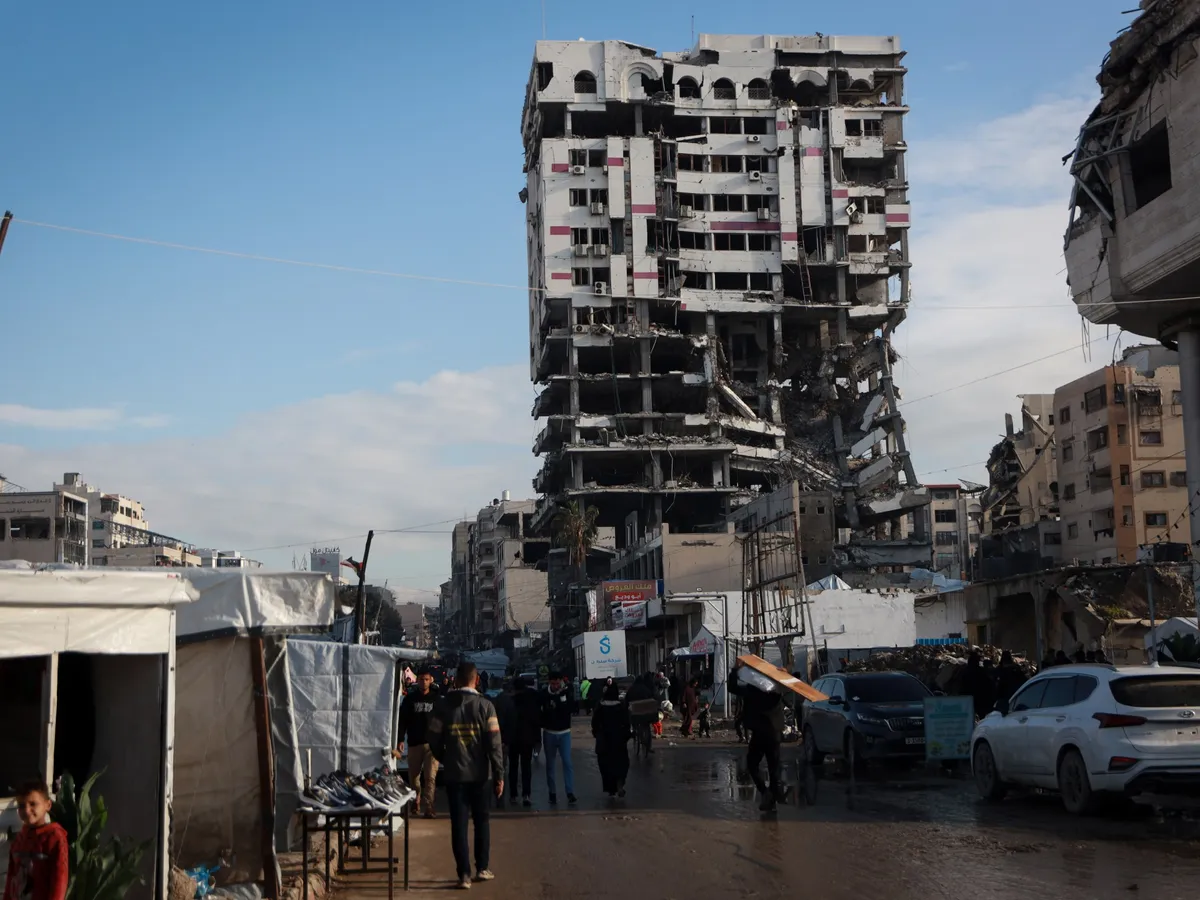
Hopes for a new Gaza administration clash with reality as Israeli control over crossings keeps aid flowing at a slow pace.Gaza has been largely destroyed by Israeli attacks, but little of the materials and equipment needed to rebuild the Palestinian territory has been allowed in [Abdelhakim Abu Riash/Al Jazeera]Published On 21 Jan 2026Gaza City – Khaled Abu Jarrar spends his days trying to find ways to get his wife treatment for her recently diagnosed liver cancer.The 58-year-old, originally from the town of Beit Hanoon in northern Gaza, but displaced with his family for the last year and a half in Gaza City, knows that his wife needs to travel abroad urgently.Recommended Stories list of 3 itemslist 1 of 3Israeli prisons are akin to ‘torture camps’, Israeli rights group findslist 2 of 3There is another war Israel is waging – one that is not making headlineslist 3 of 3Sanctions request against Netanyahu filed by UK lawyers, rights groupend of listIt is why he is so desperate for the Rafah crossing, previously the Gaza Strip’s main access point to the outside world, to open.Israel has kept it firmly shut for most of the past two years, as it conducted its genocidal war on Gaza, killing more than 70,000 Palestinians.Khaled is looking towards Gaza’s new administration – a group of Palestinian technocrats overseen by United States President Donald Trump’s so-called “board of peace” – to change things.The National Committee for Gaza Management (NGAC) met for the first time last week, in the Egyptian capital, Cairo. It will manage Gaza’s day-to-day affairs in place of the Palestinian group Hamas as part of the second phase of the Gaza ceasefire plan.The US announced that the second phase had begun last week.Khaled now wants to see tangible results from the NGAC and the second phase, starting with the opening of the Rafah crossing. But he is sceptical.“I hope it’s a committee with real powers, not just words on paper,” Khaled told Al Jazeera. “Otherwise, it will be a failed committee.”His pessimism is understandable. Israel has continued to attack Gaza, killing more than 400 Palestinians since the beginning of the ceasefire.It has also made clear its opposition to the NGAC, and makes little effort to allow for life in Gaza to improve. One of Israel’s most recent moves has been to order the shutdown of international humanitarian organisations providing vital medical care and food aid in Gaza.“On the ground, the shelling never stops,” Khaled said, as he followed news on the NGAC from inside a shelter set up in the former Legislative Council building in western Gaza City.“In the media, they talk about withdrawals and reconstruction, but on the ground, the bombing continues from the north and the south, and things seem even more complicated.”Khaled Abu Jarrar hopes the new committee set up to administer Gaza will have real powers and authority [Abdelhakim Abu Riash/Al Jazeera]Waiting for solutionsKhaled’s living arrangements in a government building are not unusual. Thousands of displaced people have found shelter in the structures from which Gaza was once administered, or buildings that have at least partially survived Israel’s targeting.This reality underlines the difficulty the NGAC and any administration will face when attempting to govern Gaza.And it makes any talk of new committees and administrations hinge on a series of simple questions for the displaced: Will the technocrats be able to overcome the restrictions imposed on Gaza by Israel? Will they be able to deliver tangible changes to the lives of Palestinians exhausted by displacement and loss?The committee is presented as a politically “neutral” framework, made up of non-factional figures with administrative and technical expertise. It will be led by Ali Shaath, a former Palestinian Authority (PA) deputy minister.But many Palestinians believe its success depends less on its composition and more on its ability to operate in an environment that Israel still dominates, and is unwilling to allow to rebuild.Palestinian political analyst Ahed Farwana referred to Israeli Prime Minister Benjamin Netanyahu’s recent comments, in which he described the second phase of the ceasefire as “symbolic”, as evidence that Israel has no intention of cooperating.“So far, things are unclear for the committee, because it depends on serious implementation of the second phase’s obligations,” Farwana told Al Jazeera.Many of the obligations on Israel in the first phase of the ceasefire, such as halting attacks, a full Israeli withdrawal from a specified area of Gaza, and the opening of the Rafah crossing, have not happened.Farwana believes that Netanyahu does not want to pay the political cost in Israel of allowing the ceasefire to progress and fully declaring an end to the war, particularly as he will face an election sometime this year.If anything, Farwana expects Israel to continue violating the ceasefire and expanding its buffer zone, while it cites excuses such as that one remaining Israeli body has not been handed over from Gaza. Hamas has said that it is unable to reach the body because of the amount of rubble left behind by Israeli attacks.“If there is real American pressure, there will be real change and implementation of the second phase,” Farwana said, arguing that the ceasefire’s partial success was largely tied to pushes made by the US administration. “[But] leaving the field to Netanyahu will not produce results.”Palestinians use what remains of the Gaza Legislative Council building in Gaza City for shelter [Abdelhakim Abu Riash/Al Jazeera]Israeli restrictionsIsraeli officials deny the existence of limits on the quantity of aid coming into Gaza. However, international organisations and local Palestinians point to delays in permit approvals, as well as prolonged inspection procedures that slow access and restrict the entry of goods Gaza desperately needs, including non-food items and heavy materials for infrastructure.The United Nations and aid agencies have repeatedly called for crossings to be opened and the facilitation of aid entry, stressing that the humanitarian situation in Gaza remains catastrophic and that a large share of agreed-upon aid has yet to enter since the implementation of the ceasefire.The continued closure of the Rafah crossing, in particular, has left Gaza almost entirely dependent on other entry points, such as Karem Abu Salem (Kerem Shalom), which is subject to complex inspection procedures and full Israeli security control.Against these obstacles, discussions about Gaza’s new administration become more complex, as any committee’s authority to manage services and reconstruction is directly linked to its ability to operate within restrictions on the movement of materials.Asmaa Manoun is waiting desperately for things to improve.The 45-year-old, originally from northern Gaza’s Jabalia refugee camp, is a mother of five, but one of her children was killed during the war.She now lives with her husband Mohammad – injured during the war – in the stairwell of a partially-destroyed building in Gaza City. A simple tarpaulin barely shelters them.Asmaa Manoun and her husband, Mohammad, live under in a stairwell and are desperate for the situation in Gaza to improve [Abdelhakim Abu Riash/Al Jazeera]Those conditions explain why Asmaa did not initially hear the news of the establishment of the NGAC, and talk of the beginning of the second phase of the ceasefire.“Most of the time, my phone isn’t charged, and the internet isn’t available,” she said. “Usually, we hear things from people around us in the camp, and discussions circulate among them.”Asmaa had initially left southern Gaza, where she had been living displaced, to Jabalia in an attempt to return home. But constant Israeli shelling and gunfire, including a bullet that she said killed a woman in the tent next to her, ended the experiment and made it clear that safety was still a far-off prospect.
SRCAl Jazeera
LANGEN
LEANCenter
WORDS1 256
ENT11
WED · 2026-01-21 · 06:11 GMTBRIEF NSR-2026-0121-9221
NSR-2026-0121-9221News Report·EN·Human Interest
Palestinians in Gaza confront reality behind ceasefire’s second phase
In January 2026, Palestinians in Gaza are facing the reality of the ceasefire's second phase, which involves a new administrative body, the National Committee for Gaza Management (NGAC), replacing Hamas to manage daily affairs. The NGAC met in Cairo to begin its work, overseen by a US "board of peace." However, hopes for improved conditions are tempered by continued Israeli control over crossings, severely restricting the flow of aid and reconstruction materials into the largely destroyed territory.
Maram HumaidAl JazeeraFiled 2026-01-21 · 06:11 GMTLean · CenterRead · 6 min
Al JazeeraFIG 01
Reading time
6min
Word count
1 256words
Sources cited
2cited
Entities identified
11entities
Quality score
100%
§ 01
Briefing Summary
AI-generatedNEWSAR · AI
In January 2026, Palestinians in Gaza are facing the reality of the ceasefire's second phase, which involves a new administrative body, the National Committee for Gaza Management (NGAC), replacing Hamas to manage daily affairs. The NGAC met in Cairo to begin its work, overseen by a US "board of peace." However, hopes for improved conditions are tempered by continued Israeli control over crossings, severely restricting the flow of aid and reconstruction materials into the largely destroyed territory. Despite the ceasefire, Israeli attacks persist, and international humanitarian organizations are being shut down. Gazans like Khaled Abu Jarrar, seeking medical treatment for his wife, remain skeptical about the NGAC's ability to bring meaningful change given Israel's opposition and ongoing restrictions.
Confidence 0.90Sources 2Claims 5Entities 11
§ 02
Article analysis
Model · rule-basedFraming
Human Interest
Political Strategy
Tone
Mixed Tone
AI-assessed
CalmNeutralAlarmist
Factuality
0.60 / 1.00
Mixed
LowHigh
Sources cited
2
Limited
FewMany
§ 03
Key claims
5 extracted01
I hope it’s a committee with real powers, not just words on paper. Otherwise, it will be a failed committee.
quoteKhaled Abu Jarrar
Confidence
1.00
02
The National Committee for Gaza Management (NGAC) met for the first time last week in Cairo.
factualAl Jazeera
Confidence
1.00
03
Israel has kept the Rafah crossing firmly shut for most of the past two years.
factualAl Jazeera
Confidence
0.90
04
Israel has continued to attack Gaza, killing more than 400 Palestinians since the beginning of the ceasefire.
factualAl Jazeera
Confidence
0.80
05
Israel conducted its genocidal war on Gaza, killing more than 70,000 Palestinians.
factualAl Jazeera
Confidence
0.70
§ 04
Full report
6 min read · 1 256 words§ 05
Entities
11 identifiedKey playerOppositionContextPositiveNeutralNegative
Organizations3
§ 06
Keywords & salience
10 termsgaza
1.00
ceasefire
0.80
rafah crossing
0.70
israeli control
0.70
palestinians
0.70
new administration
0.60
aid
0.60
national committee for gaza management
0.60
humanitarian organizations
0.50
rebuilding
0.50
§ 07
Topic connections
Interactive graph Network visualization showing 51 related topics
View Full Graph Person Organization Location Event|Click node to navigate|Edge numbers = shared articles