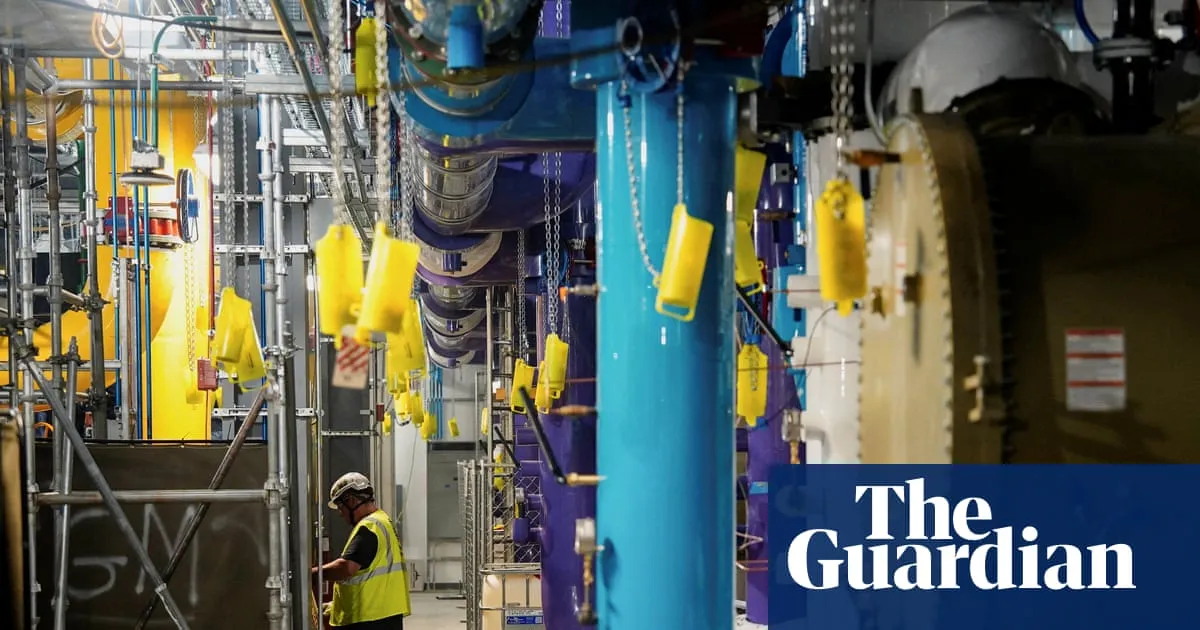
Microsoft, Amazon and Google’s collective Carbon Emissions have increased by nearly a fifth in the past year, driven largely by datacentre construction.In the financial year ending March 2026, the three tech companies emitted 119m mTCO₂e (metric tonnes of carbon dioxide equivalent), or about a third of those of France.The previous year, they emitted roughly 101m mTCO₂e, roughly equivalent to the 2024 emissions of Czechia.The US companies’ climate ambitions have been hit in recent years by a boom in demand for Cloud Services, such as storing data or running servers over the internet, related to training and operating chatbots and other AI products.Cecilia Rikap, an economics professor at University College London, said: “Claims by Microsoft, Amazon and Google about their clouds being ecologically friendly and sustainable are a marketing strategy. Governments should remember these expanding carbon footprints when the very same companies offer addressing the ecological crisis with AI solutions.“And, as migration to their clouds expands, and companies store data and train and use AI models and all sorts of digital technologies, these other companies are outsourcing their own digital/AI carbon footprint to cloud giants. Basically, shifting to the cloud helps other corporations obscure their environmental footprint.”Microsoft, Google and Amazon were contacted for comment.These increases were documented in the companies’ annual sustainability reports, which they have released over the past weeks. In its report released on Thursday, Microsoft said its Carbon Emissions had increased by 25% over the past year to 20m mTCO₂e, “driven primarily by the expansion of our datacentre infrastructure”.Google said its emissions had increased 18% over the past year, “driven by increases in supply chain activities that supported the rapid expansion of our business”. The search company says its AI systems have come up with solutions that have already helped to reduce emissions elsewhere by 41m tonnes of CO2 last year.Amazon reported a 16% increase in emissions overall, and a 20% increase in supply chain emissions, which included datacentre building and construction. In its report, it still framed this as “making progress” towards its goal of net zero emissions in 2040.skip past newsletter promotionafter newsletter promotionThe bulk of these emissions come from a big, global push to build the infrastructure for Artificial Intelligence. The world’s biggest tech companies are on track to spend $765bn (£570bn) this year, mostly on building AI datacentres – in locations from Norway to North Tyneside.It is a drastic reversal in a years-long push by big technology companies to cut their Carbon Emissions. Prior to this year, Microsoft’s emissions appeared to have flatlined, at 16m mTCO₂e, in 2023 and 2024. All three companies still say they aim to achieve net zero emissions: Google and Microsoft by 2030, Amazon by 2040.“The increases in total Carbon Emissions are strongly correlated with [the companies’] AI investment,” said Shaolei Ren, a professor of electrical engineering at University of California, Riverside. He noted that Microsoft’s sustainability report also suggested that there were fewer carbon credits available on global markets to offset its emissions. “While companies are actively investing in or purchasing carbon credits, the figure suggests a possible lack of credit supply in the carbon market to meet the technology companies’ needs … Everyone is talking about the lack of physical goods and infrastructure like power, but there may also be a lack of virtual goods – carbon credits.”Proposals for building datacentres across the global tech sector are becoming more numerous and ambitious as demand for AI tools, and investment by AI companies in the models that underpin them, increases. JLL, a US property consultancy, expects about 1,200 datacentres to be built globally between now and 2030, with demand overwhelmingly driven by AI.The datacentre boom is accompanied by vast projected power demands. The Uptime Institute, which rates and inspects datacentres, estimates that big datacentre projects announced last year would consume 1.3% of the world’s electricity usage, or a near-doubling of current datacentre demand. The majority of that new power demand will come from US projects, it said.
SRCThe Guardian - World News
LANGEN
LEANCenter-Left
WORDS658
ENT12
SAT · 2026-07-11 · 11:00 GMTBRIEF NSR-2026-0711-92229
NSR-2026-0711-92229News Report·EN·Environmental
Datacentres drive up big tech’s carbon emissions to a third of those of France
Microsoft, Amazon, and Google's combined carbon emissions rose nearly 20% in the past year, reaching 119 million metric tons of CO2 equivalent in the financial year ending March 2026. This increase is primarily attributed to the construction of datacenters to meet the surging demand for cloud services and AI products.
Aisha Down and Dan MilmoThe Guardian - World NewsFiled 2026-07-11 · 11:00 GMTLean · Center-LeftRead · 3 min
The Guardian - World NewsFIG 01
Reading time
3min
Word count
658words
Sources cited
1cited
Entities identified
12entities
Quality score
100%
§ 01
Briefing Summary
AI-generatedNEWSAR · AI
Microsoft, Amazon, and Google's combined carbon emissions rose nearly 20% in the past year, reaching 119 million metric tons of CO2 equivalent in the financial year ending March 2026. This increase is primarily attributed to the construction of datacenters to meet the surging demand for cloud services and AI products. Despite this rise, all three companies maintain their net-zero emission goals, with Microsoft and Google aiming for 2030 and Amazon for 2040. Experts suggest that the expansion of AI investment is strongly correlated with these increased emissions, and the growing demand for datacenters is projected to significantly increase global electricity consumption.
Confidence 0.90Sources 1Claims 5Entities 12
§ 02
Article analysis
Model · rule-basedFraming
Environmental
Technology
Tone
Mixed Tone
AI-assessed
CalmNeutralAlarmist
Factuality
0.70 / 1.00
Factual
LowHigh
Sources cited
1
Limited
FewMany
§ 03
Key claims
5 extracted01
Microsoft's carbon emissions increased by 25% over the past year to 20m mTCO2e.
statisticMicrosoft
Confidence
1.00
02
The world's biggest tech companies are on track to spend $765bn this year, mostly on building AI datacentres.
statistic
Confidence
1.00
03
Claims by tech companies about their clouds being ecologically friendly are a marketing strategy.
quoteCecilia Rikap
Confidence
1.00
04
Datacentre construction is the primary driver of the increased emissions for these tech companies.
factual
Confidence
1.00
05
Microsoft, Amazon, and Google's collective carbon emissions increased by nearly a fifth in the past year, reaching 119m mTCO2e.
statistic
Confidence
1.00
§ 04
Full report
3 min read · 658 words§ 05
Entities
12 identifiedKey playerOppositionContextPositiveNeutralNegative
People1
Organizations3
Locations4
§ 06
Keywords & salience
10 termsdatacentres
1.00
carbon emissions
1.00
artificial intelligence
0.90
cloud services
0.80
big tech
0.70
sustainability reports
0.60
amazon
0.50
google
0.50
microsoft
0.50
environmental footprint
0.40
§ 07
Topic connections
Interactive graph Network visualization showing 51 related topics
View Full Graph Person Organization Location Event|Click node to navigate|Edge numbers = shared articles