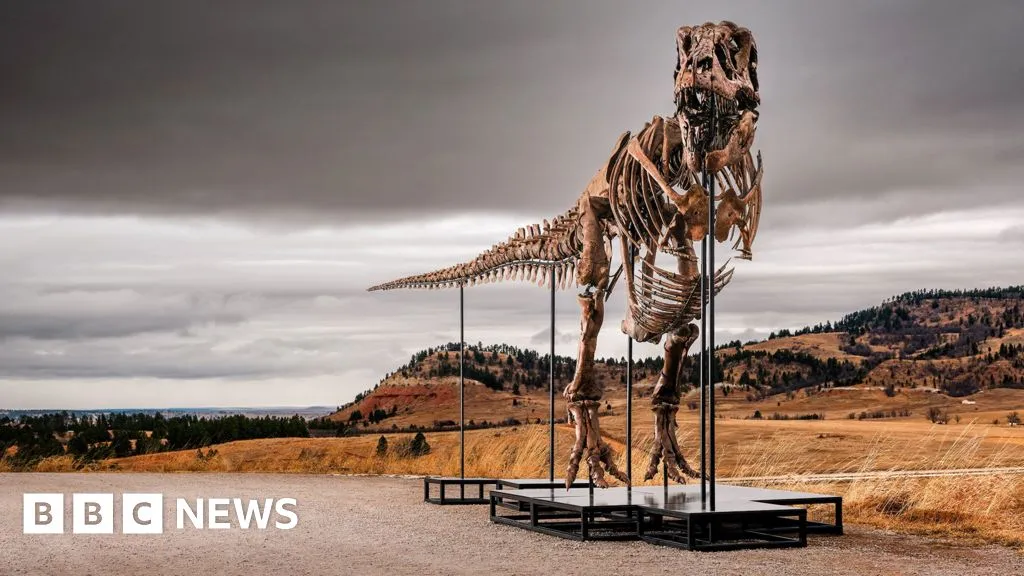
T. rex could become most expensive fossil ever - but it's a problem for scientistsMatthew ShermanIn 1997, Sotheby's hosted its first natural history auction selling fossils and other wonders of our prehistoric world.It was a niche event mostly attended by the world's museums looking for specimens to add to their collections.On the books that day was a Tyrannosaurus Rex called Sue - she was eventually sold for $8m (£6m) to the Field Museum in Chicago.Nearly 30 years later, on Tuesday, another T. rex will make an appearance at the annual auction - one of the most complete specimens of this kind ever found.And this time it is not just scientists who are dinosaur-hunting but also the super-rich.The new specimen, known as Gus, has already been valued at $30m but it could fetch more, possibly even becoming the most expensive dinosaur ever sold.It adds to a growing debate in the natural history world – should specimens of such scientific importance be reserved for museums and their scientists?Or - as auctioneers would argue - should fossil hunters be rewarded for their discovery of dinosaurs lost to science and saving them from a second extinction?Cassandra Hatton, global head of natural history at Sotheby's, knows very well the lengths some fossil scientists - palaeontologists - are willing to go to in the search for these creatures."People die on excavations," she says.And for many of these hunters, the ultimate prize is the Tyrannosaurus Rex.This dinosaur that lived millions of years ago hardly needs describing, having been immortalised in our culture by appearances in films like King Kong and Jurassic Park, and as the namesake of an English rock band.Sotheby'sGus the T. rex was discovered in Badlands country in South Dakota and named after the late owner of the land"The people that look for these fossils will spend months out in the field with tents and their food in their backpacks and they're camping out in the middle of nowhere with the rattlesnakes and the bugs and the mountain lions," she explains.This is South Dakota - Badlands country - where Gus was eventually discovered 67 million years after roaming our planet.But finding it is almost the easy part, explains Dr Fiann Smithwick, an independent palaeontologist who has been collecting and preserving fossils for the past 20 years."Suddenly when they're out of the ground, they're out of equilibrium, and that normally means they start to decay, fall apart."Thomas Heitkamp and the team that discovered Gus - named after the late Gary "Gus" Licking, a cattle rancher whose land it was found on - spent three years carefully excavating."But it's not the full year," Cassandra Hatton explains. "You can only dig during the field season. So you have to wait till the ground has thawed. And then you are furiously digging until the ground freezes again [in September]."In 2023, the dig was complete, but the team was only halfway through the recovery process. They then spent a further three years documenting and reconstructing the T. rex back in the lab.Fiann SmithwickDr Fiann Smithwick explained how coming across the fossils is the start of a careful and ardous process of excavationTuesday's auction will be a payday that has been a long time coming for the team, and could be the biggest yet.Gus has the highest pre-sale valuation at $30m. The record for a dinosaur auction is currently held by Apex, a Stegosaurus sold by Sotheby's in 2024 for $44.6m - but that was 11 times what it had originally been valued at going into the auction.If you are inclined to put a bid in this time, your starting offer cannot be lower than $19m.For some of the oldest and largest museums in the world dealing in fossils, even this is out of reach."We're already priced out of having access to many, many specimens," explains Prof Susannah Maidment, dinosaur researcher at London's Natural History Museum (NHM).The five most expensive dinosaurs sold at auction have all been since 2020, including Stan a T. rex sold for $31.8m in 2020 - the guide price had been $6-8m. And this, she says, is "really problematic"."There's no substitute for having the real fossil. If we're going to do any sort of study, the number one thing is we need to understand the anatomy. We need to know what's real," Prof Maidment explains.And she said palaeobiology - the study of past life on the planet - has never been more important."We are in what is probably a mass extinction right now, we're changing our environment very, very, very rapidly. The past is really the only kind of empirical data we have to tell us about what is going on right now and in the future," she says.That is just the impact on the scientists. Prof Maidment says that for the public, being able to see the real bones of a dinosaur in a museum "helps them engage with the natural world".She says that dinosaur specimens are no longer being seen for their scientific value "but like we might view art" as something to collect by wealthy individuals, which has driven the price up.'A huge bite mark on the skull'Matthew ShermanIt took three years to fully excavate the fossils, and a further three years to document and reconstructCassandra Hatton argues that the price of Gus is a reflection of how important a specimen he is."Gus is one of the largest and most complete T. rex ever found, 61% of the bones has been identified - in general you find half of the skeleton that's a major scientific find," she says.The condition of the bones also provides deep insight into the kind of life this creature would have had."There's a huge bite mark on the top of the skull, which could have been sustained during a battle. You've got broken bones - some of the ribs, you see huge lumps where they broke and they healed."Cassandra Hatton says she has reached out to museums all over the world for months to get them to take part in the auction. She wants "something that's scientifically important to get it into the public trust".But she said the price has to reflect the time, skill, expense and risks with recovering dinosaurs. "For a lot of excavators, some of these people are living hand to mouth. They're not wealthy people."They have to invest their own money. It's not billionaires digging them up."But it is billionaires buying them.Apex, the Stegosaurus, was auctioned to Kenneth Griffin, founder and CEO of the hedge fund Citadel. Griffin has since loaned Apex to the American Natural History Museum for four years.Museums have for a long time relied on wealthy individuals bequeathing, loaning or donating artefacts to build their science and art collections, explains Dr Smithwick, who recovers and sells fossils professionally.But unlike pieces of art, there is a big stumbling block to relying on the philanthropy of private estates when it comes to the study of fossils.The most respected scientific journals will not accept any study done on a specimen in a private collection. It is almost as if it does not exist to the scientific world.The argument is that scientists need to be able to revisit the fossil over many years - to agree and disagree, to check their findings as other specimens emerge."What happens [if] that person gets bored of them, dies, gets divorced. And there have been many cases where specimens have been in private collections, and there's been a scientific description of them and [that has] gone in the skip," says Prof Maidment from NHM."So it's actually just not science anymore."The second extinction of dinosaursSotheby'sThe team documented the recovery process and the fossils they found, including one of Gus's claws (left) and a metatarsal (right)Smithwick says the potential for losing specimens is also a risk with museums.One of the most prolific early collectors of fossils was Mary Anning. In 1829, she discovered the first Squaloraja fossil - known as the fish with the "curling iron eyes" - it was an ancient creature which bridged the gap between sharks and rays. Its body was donated to the Bristol Institute but over a century later it was destroyed in a WWII bombing raid.But they all agree - the fossil collector, the museum scientist, the auctioneer - that without the work and skill of these professional hunters, there would be no specimens to argue over and far fewer scientific discoveries."They're saving the dinosaurs from the second extinction," says Sotheby's Cassandra Hatton.And Smithwick knows too well the race against time to save fossils in his hunting ground on the Jurassic coast of England."I've found a rock with the perfect impression of what was a fish an hour before, and now it's gone. If you imagine a wave coming in, splitting that rock open, the next wave comes along, just wipes out the fish."The sea has broken it into 10,000 pieces, and that is it. It is lost forever."For fossils that are recovered in time, most will never make it to an auction house like Sotheby's.They are smaller, less culturally revered, but he argues they can hold much greater value - to museums and the public."There are countless other specimens that will be scientifically more important in the grand scheme of palaeontology," says Dr Smithwick. "And you have got people selling ammonites to kids on the beach and that is inspiring curiosity in the outside world."
SRCBBC News - World
LANGEN
LEANCenter
WORDS1 559
ENT10
SAT · 2026-07-11 · 23:58 GMTBRIEF NSR-2026-0712-92319
NSR-2026-0712-92319News Report·EN·Economic Impact
T. rex could become most expensive fossil ever - but it's a problem for scientists
A 67-million-year-old Tyrannosaurus rex fossil, named Gus, is set to be auctioned in New York with a pre-sale valuation of $30 million, potentially becoming the most expensive fossil ever sold. This sale highlights a growing debate among scientists and auction houses regarding the commercialization of scientifically significant fossils.
2 hours agoShareSaveAdd as preferred on GoogleEsme StallardSenior climate and science reporterBBC News - WorldFiled 2026-07-11 · 23:58 GMTLean · CenterRead · 7 min
BBC News - WorldFIG 01
Reading time
7min
Word count
1 559words
Sources cited
2cited
Entities identified
10entities
Quality score
100%
§ 01
Briefing Summary
AI-generatedNEWSAR · AI
A 67-million-year-old Tyrannosaurus rex fossil, named Gus, is set to be auctioned in New York with a pre-sale valuation of $30 million, potentially becoming the most expensive fossil ever sold. This sale highlights a growing debate among scientists and auction houses regarding the commercialization of scientifically significant fossils. While auctioneers argue that rewards incentivize discovery and preservation, paleontologists express concern that wealthy private collectors are pricing museums out of acquiring these specimens. This trend, with five of the most expensive dinosaur sales occurring since 2020, limits scientific study and public engagement with natural history, especially as understanding past life is crucial for current environmental challenges.
Confidence 0.90Sources 2Claims 5Entities 10
§ 02
Article analysis
Model · rule-basedFraming
Economic Impact
Human Interest
Tone
Mixed Tone
AI-assessed
CalmNeutralAlarmist
Factuality
0.70 / 1.00
Factual
LowHigh
Sources cited
2
Limited
FewMany
§ 03
Key claims
5 extracted01
In 1997, a T. rex fossil named Sue was sold for $8m to the Field Museum in Chicago.
factual
Confidence
1.00
02
The excavation and recovery process for Gus the T. rex took several years, with digging limited to specific seasons.
factualCassandra Hatton
Confidence
0.90
03
Fossils can begin to decay and fall apart once removed from the ground and are out of equilibrium.
factualDr Fiann Smithwick
Confidence
0.90
04
Fossil hunters face extreme conditions, including rattlesnakes, bugs, and mountain lions, during excavations.
quoteCassandra Hatton
Confidence
0.90
05
A T. rex fossil named Gus is expected to fetch over $30m at auction, potentially becoming the most expensive fossil ever sold.
statistic
Confidence
0.90
§ 04
Full report
7 min read · 1 559 words§ 05
Entities
10 identifiedKey playerOppositionContextPositiveNeutralNegative
Organizations2
§ 06
Keywords & salience
9 termst. rex fossil
1.00
natural history auction
0.90
paleontology
0.80
fossil collection
0.70
museums vs private collectors
0.70
scientific specimens
0.60
fossil discovery
0.50
sotheby's
0.50
prehistoric world
0.40
§ 07
Topic connections
Interactive graph No topic relationship data available yet. This graph will appear once topic relationships have been computed.