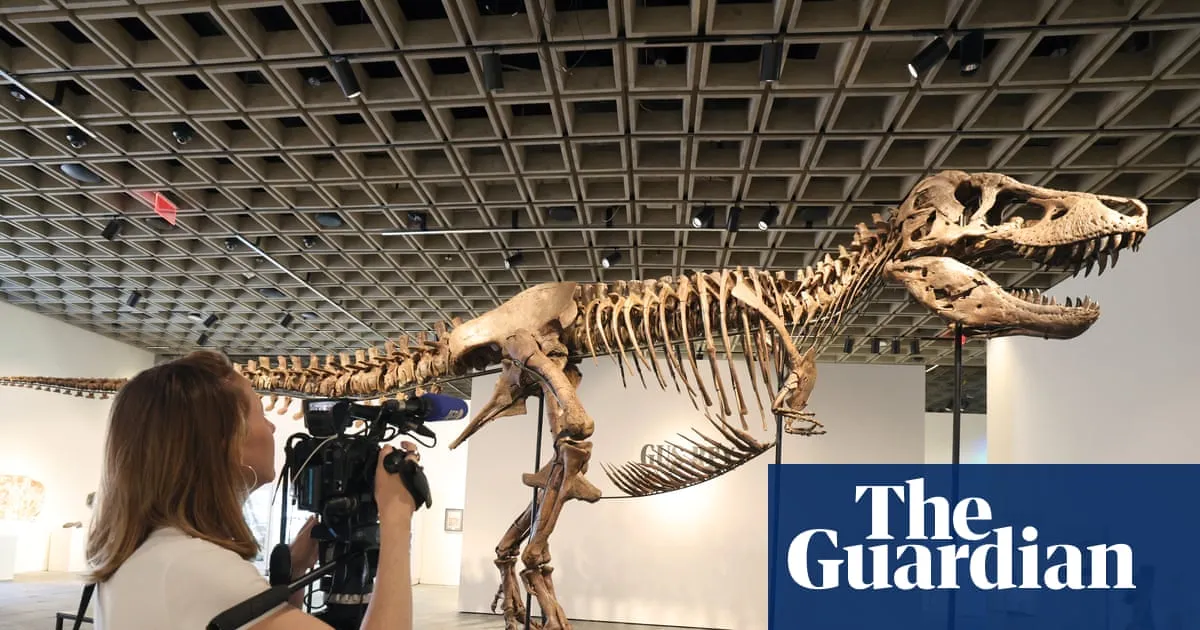
With its dagger-like teeth, bone-crushing bite and behemothic size, the fearsome Tyrannosaurus rex ruled western North America during the late Cretaceous period. Now its fossilised remains are about to dominate the auction house, with a price tag to terrify punters.On Tuesday, one of the largest and most complete T rex skeletons discovered to date is to be auctioned by Sotheby’s in New York with an estimated sale price of $20m-$30m (£15m-£22.4m).It could even fetch more: a Stegosaurus called Apex currently holds the record, selling at a Sotheby’s auction in 2024 for $44.6m – 11 times its listing price.Nicknamed “Gus”, the T rex is thought to be about 67m years old, and stands – ready mounted in a predatory pose – at about 3.8 metres (12.5ft) tall. “The huge teeth are displayed within the gaping jaws,” the auction listing notes.Thought to be the remains of a large, robust adult, it was discovered – and excavated over a three-year period from 2021 – on a ranch in Harding County, South Dakota, by the commercial outfit Theropoda Expeditions, with permission from the owner of the land, Gary “Gus” Licking.Cole Jacobs, a field prospector for the company, said in a promotional video from Sotheby’s: “I straddled the road, walked up, and it was the very first thing I laid eyes on on the first day. I saw the metatarsal poking out of the ground.”The cheery name of the T rex is a nod to Licking, who died before the excavation was finished.While Gus is undoubtedly a huge find, he also represents a big problem – at least for scientists.“The current trend towards dinosaur fossils being marketed and sold like rare artworks at vast prices by auction houses is very concerning, as is the idea of buying dinosaur fossils as a status symbol or a commodity,” said Prof Richard Butler, a vertebrate palaeontologist at the University of Birmingham.“A fossil not in a recognised museum collection cannot be studied and is therefore lost to research. Fossils have been bought and sold for hundreds of years, but prices are increasingly out of the reach of museums, much to the detriment of science.”Prof Stephen Brusatte, of the University of Edinburgh, agreed. “As this dinosaur was found in the USA, and in America you can do what you want with what you find on your land, the auction looks to be legal. But as a scientist it still concerns me,” he said. In some countries, such as Brazil or Mongolia, all fossils belong to the state.“If a dinosaur like this fetches tens of millions of dollars at auction, then there’s little that scientists or museums or universities can do. Those prices can only be paid by the super-rich,” Brusatte said.The first T rex sold at auction was Sue, a 4-metre-tall specimen found in South Dakota that was bought in 1997 for $8m by the Field Museum in Chicago, with support from private donors and companies including McDonald’s Corporation.Since then, fossil collecting has become a hobby for wealthy celebrities – including the actor Leonardo DiCaprio.Gus is thought to be about 67m years old. Photograph: Lev Radin/ShutterstockMichael Benton, a professor of vertebrate palaeontology at the University of Bristol, also voiced concerns about museums and universities being priced out of auctions. But, he added: “Occasionally things can work well when the purchaser realises they can get even more pleasure from their purchase by sharing it with a wide community, for example through loaning or donating it to a museum or helping to finance a touring exhibition.”Apex is one such example: bought by the billionaire hedge fund manager Ken Griffin, it was subsequently loaned to the American Natural History Museum for four years.Dr Thomas Carr, a vertebrate palaeontologist and associate professor at Carthage College in Wisconsin, US, said it was not enough for private owners to allow scientists access to fossils.“A private collection has no guarantee that a fossil will stay in a collection for all time, whereas a public trust’s mission is to maintain, conserve and curate its collection indefinitely,” he said. “Fossils need to be available to test previous observations and to make new insights; the fossils are the data so they must always be available for study.”Museum loans were also problematic, Carr said. “The problem is that a privately owned fossil can be recalled from a museum at any moment back into an owner’s home, so the principles of availability and replicability are not guaranteed.”Indeed, many journals now stipulate that research papers must be based on fossils housed in permanent public repositories.Brusatte said: “When we publish research, we need to make sure that research is repeatable, meaning that other scientists can check our data and results and verify our conclusions, or not. The only way for our research to be repeatable is if the dinosaur fossils we study are in a museum, where other scientists are guaranteed access to them.”Carr said that as long as private fossil hunting was a pipeline to a museum or university, and not to the auction houses or fossil shops, then there was not an issue around who first finds the dinosaur.But he said fossils such as Gus would ideally have legal protection from commercial exploitation on private land – as is the case in countries like Mongolia – with rare fossils such as those of dinosaurs subject to collection only by scientific or academic institutions.Brusatte said he understood why some people bought dinosaur fossils. “If I was a billionaire, I would probably buy one too,” he said. But he would donate it to a museum where it could be studied and displayed. “I hope that is what happens here,” Brusatte said.Carr hoped Gus would eventually be donated to a public trust – with its private ownership forfeited. “A fossil in a public trust is a win for science and society all around,” he said, “rather than being hoarded in some McBillionaire’s living room.”Experts at Sotheby’s have defended the excavation of Gus by a private outfit, suggesting that without such companies some dinosaurs may never be removed from the ground, and its price, a reflection, they say, of the importance of the fossilised remains and the efforts required to recover them.
SRCThe Guardian - World News
LANGEN
LEANCenter-Left
WORDS1 026
ENT12
TUE · 2026-07-14 · 04:00 GMTBRIEF NSR-2026-0714-92857
NSR-2026-0714-92857News Report·EN·Economic Impact
Sale of multimillion-dollar T rex skeleton is big headache for scientists
A nearly complete Tyrannosaurus rex skeleton, nicknamed "Gus," is being auctioned by Sotheby's in New York with an estimated price of $20 million to $30 million. Discovered in South Dakota and excavated between 2021 and 2024, the 67-million-year-old fossil is expected to fetch a high price, potentially exceeding previous records for dinosaur fossils.
Nicola Davis Science correspondentThe Guardian - World NewsFiled 2026-07-14 · 04:00 GMTLean · Center-LeftRead · 5 min
The Guardian - World NewsFIG 01
Reading time
5min
Word count
1 026words
Sources cited
2cited
Entities identified
12entities
Quality score
100%
§ 01
Briefing Summary
AI-generatedNEWSAR · AI
A nearly complete Tyrannosaurus rex skeleton, nicknamed "Gus," is being auctioned by Sotheby's in New York with an estimated price of $20 million to $30 million. Discovered in South Dakota and excavated between 2021 and 2024, the 67-million-year-old fossil is expected to fetch a high price, potentially exceeding previous records for dinosaur fossils. Palaeontologists express concern that the increasing commercialization and high prices of dinosaur fossils are detrimental to scientific research, as fossils in private collections are inaccessible for study. While legal in the US, this trend prevents museums and universities from acquiring these specimens, hindering scientific progress and the ability to conduct repeatable research.
Confidence 0.90Sources 2Claims 5Entities 12
§ 02
Article analysis
Model · rule-basedFraming
Economic Impact
Human Interest
Tone
Mixed Tone
AI-assessed
CalmNeutralAlarmist
Factuality
0.70 / 1.00
Factual
LowHigh
Sources cited
2
Limited
FewMany
§ 03
Key claims
5 extracted01
The first T rex sold at auction, 'Sue', was bought in 1997 for $8m by the Field Museum.
statistic
Confidence
1.00
02
In the USA, owners can legally sell fossils found on their land, even if it concerns scientists.
quoteProf Stephen Brusatte
Confidence
1.00
03
The sale of dinosaur fossils at high prices is concerning to scientists as it removes them from research collections.
quoteProf Richard Butler
Confidence
1.00
04
A T rex skeleton named 'Gus' is being auctioned by Sotheby's with an estimated sale price of $20m-$30m.
statistic
Confidence
1.00
05
Fossil collecting has become a hobby for wealthy celebrities, including Leonardo DiCaprio.
factual
Confidence
0.90
§ 04
Full report
5 min read · 1 026 words§ 05
Entities
12 identifiedKey playerOppositionContextPositiveNeutralNegative
Organizations2
§ 06
Keywords & salience
9 termst rex skeleton
1.00
fossil sale
0.90
auction house
0.80
scientific research
0.80
paleontology
0.70
museum collection
0.60
sotheby's
0.50
late cretaceous period
0.40
south dakota
0.40
§ 07
Topic connections
Interactive graph No topic relationship data available yet. This graph will appear once topic relationships have been computed.