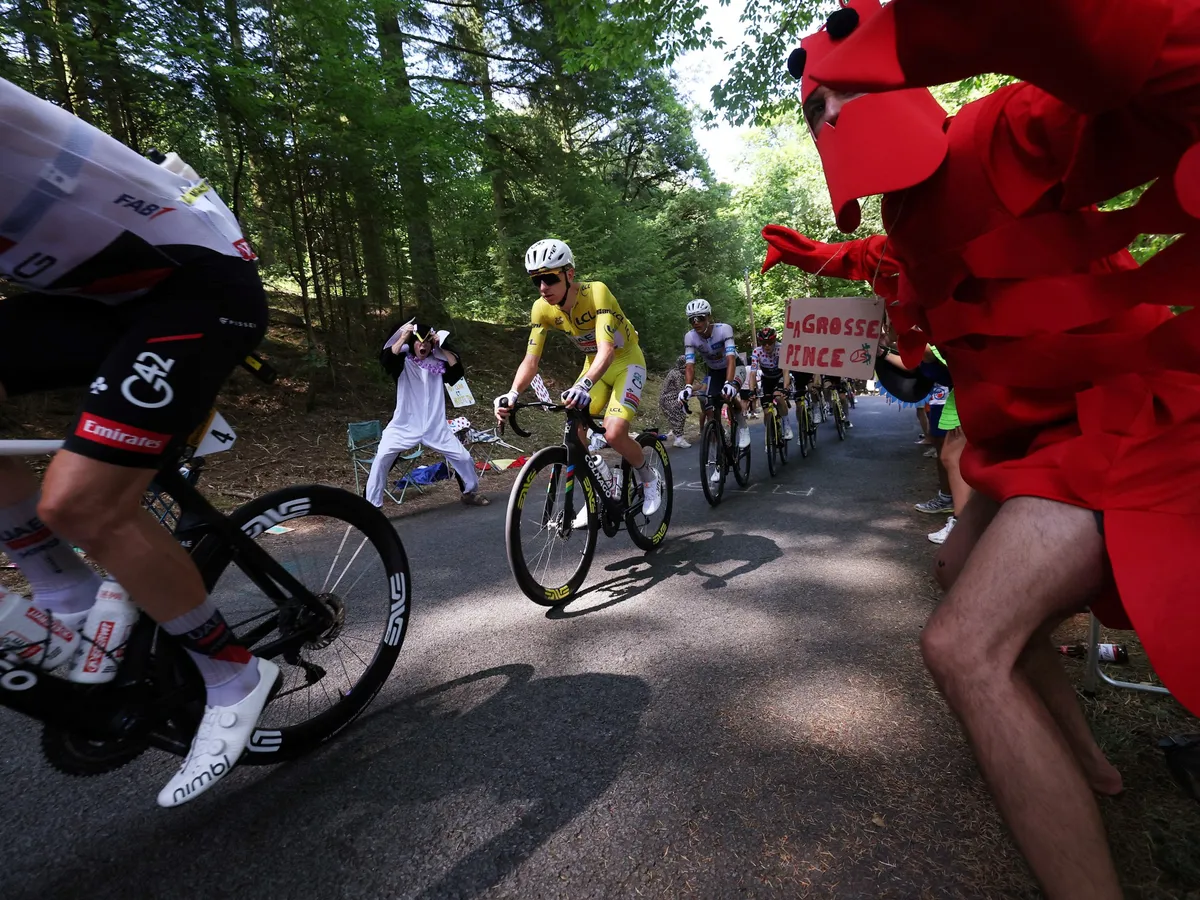
Three of the eight riders who have abandoned the France" class="entity-link entity-event" data-entity-id="12008" data-entity-type="event">Tour de France in the opening week have suffered concussions.Riders in action as a spectator dressed in a costume cheers on during stage nine of the 2026 France" class="entity-link entity-event" data-entity-id="12008" data-entity-type="event">Tour de France, Malemort, France, July 12, 2026 [Gonzalo Fuentes/Reuters]Published On 14 Jul 2026As happens every year, crashes have punctuated the opening week of the France" class="entity-link entity-event" data-entity-id="12008" data-entity-type="event">Tour de France, with several incidents highlighting how difficult it remains to manage concussion in a sport where the clock is always ticking.Of the eight riders who have abandoned the race since it began in Barcelona, Spain, on July 4, three withdrew because of concussion: Frenchman Clement Berthet of Groupama-FDJ United, Dutch rider Alex Molenaar of Caja Rural-Seguros RGA and Norway’s Torstein Traeen of Uno-X Mobility, who briefly wore the yellow jersey.Recommended Stories list of 4 itemslist 1 of 4Best birthday present for Yamal? World Cup semifinal win over Francelist 2 of 4‘Kylian is fine’: France ready, full-strength for Spain World Cup semifinallist 3 of 4Norway ‘rows’ at the royal palace to welcome back World Cup heroeslist 4 of 4Haaland’s Norway receive heroes’ welcome in Oslo after World Cup exitend of listAll three had one thing in common: they crashed, completed the stage and then withdrew later that evening once the diagnosis had been made.Berthet went down heavily during the opening team time trial, Molenaar crashed 5km (3 miles) from the finish of stage five, while Traeen hit the ground the following day on the descent of the Col du Tourmalet while wearing the race leader’s yellow jersey.“It is never very satisfactory for us to see riders diagnosed with concussion after they have resumed racing,” Xavier Bigard, medical director of the International Cycling Union (UCI), told the Reuters news agency.The UCI introduced a concussion protocol at the start of the 2021 season. A year earlier, French rider Romain Bardet had covered almost 90km (56 miles) despite suffering concussion in a crash at more than 60km/h (37mph).“We have come a long way,” said Bigard, who began working on a protocol after joining the UCI in 2018.Under the current procedure, a rider who crashes must be assessed by the first person to reach them, often a mechanic from their team.If that person detects at least two observable signs of concussion – such as nausea, head or neck pain, weakness in the limbs, disorientation or impaired balance – the rider must be taken out of the race.If not, the rider may continue before undergoing a further assessment during the race from the medical car or a team vehicle. That examination involves answering a number of relatively simple questions about the context of the race, and the rider may still be withdrawn.Where concussion is suspected, a more complete examination lasting about 10 minutes must then be carried out after the stage.“The roadside protocol is much shorter,” said Mathieu Le Strat, medical director of Groupama-FDJ United. “It is carried out in the heat of the moment, so it is much harder to make an assessment.“You have a rider who is caught up in the race and immediately wants to get back on the bike, so it is not easy.“A proper concussion protocol takes 10 to 15 minutes and involves several tests. You cannot do that on the side of the road.”Florence Pommerie, the France" class="entity-link entity-event" data-entity-id="12008" data-entity-type="event">Tour de France’s chief doctor since 2010, also stressed how difficult concussion can be to diagnose.“You cannot see it,” she said. “There is no single defining sign, only a combination of indicators.”Pommerie added that she had not seen any of the three riders in question come back to the medical car after their respective crashes.“Some signs appear immediately but disappear after a few hours, while others only emerge later,” Bigard said, explaining why a roadside assessment may differ from the diagnosis made after the stage.All those interviewed agreed that cycling had taken the issue far more seriously in recent years.“There is now a full awareness of it,” said Pascal Chanteur, vice president of the CPA international riders’ union.The central problem, however, remains the understandable urgency to get back on the bike in a sport where every second matters, particularly for a rider fighting for the overall classification in a three-week race.“We are in a situation that is far from perfect, and we are trying to make it the least imperfect as possible,” Bigard said.He added that education remained “a real challenge” in elite cycling, a sport inevitably driven by performance.“It is a long-term process that will take time, but it is essential.”
SRCAl Jazeera
LANGEN
LEANCenter
WORDS751
ENT12
TUE · 2026-07-14 · 11:12 GMTBRIEF NSR-2026-0714-92895
NSR-2026-0714-92895News Report·EN·Public Health
Tour de France crash and concussion cases expose limits of roadside checks
Three riders have withdrawn from the Tour de France in its opening week due to concussions sustained in crashes. Clement Berthet, Alex Molenaar, and Torstein Traeen all completed their stages after crashing before being diagnosed with concussions later that evening.
By ReutersAl JazeeraFiled 2026-07-14 · 11:12 GMTLean · CenterRead · 4 min
Al JazeeraFIG 01
Reading time
4min
Word count
751words
Sources cited
2cited
Entities identified
12entities
Quality score
100%
§ 01
Briefing Summary
AI-generatedNEWSAR · AI
Three riders have withdrawn from the Tour de France in its opening week due to concussions sustained in crashes. Clement Berthet, Alex Molenaar, and Torstein Traeen all completed their stages after crashing before being diagnosed with concussions later that evening. This highlights the limitations of current roadside concussion protocols, which are brief and conducted under pressure, making accurate assessment difficult. While the UCI implemented a concussion protocol in 2021 and awareness has increased, riders' urgency to continue racing complicates diagnosis. Medical professionals acknowledge that some concussion symptoms appear later, making immediate roadside checks insufficient.
Confidence 0.90Sources 2Claims 5Entities 12
§ 02
Article analysis
Model · rule-basedFraming
Public Health
Human Interest
Tone
Measured
AI-assessed
CalmNeutralAlarmist
Factuality
0.80 / 1.00
Factual
LowHigh
Sources cited
2
Limited
FewMany
§ 03
Key claims
5 extracted01
Mathieu Le Strat states that the roadside protocol is much shorter.
quoteMathieu Le Strat
Confidence
1.00
02
Xavier Bigard states that it is never very satisfactory to see riders diagnosed with concussion after they have resumed racing.
quoteXavier Bigard
Confidence
1.00
03
Under the current procedure, a rider who crashes must be assessed by the first person to reach them, often a mechanic from their team.
factual
Confidence
1.00
04
The UCI introduced a concussion protocol at the start of the 2021 season.
factual
Confidence
1.00
05
Three of the eight riders who have abandoned the Tour de France in the opening week have suffered concussions.
statistic
Confidence
1.00
§ 04
Full report
4 min read · 751 words§ 05
Entities
12 identifiedKey playerOppositionContextPositiveNeutralNegative
People4
Organizations4
§ 06
Keywords & salience
9 termsconcussion
1.00
tour de france
1.00
roadside checks
0.90
cycling
0.80
rider safety
0.70
concussion protocol
0.60
uci
0.60
crashes
0.50
medical director
0.40
§ 07
Topic connections
Interactive graph No topic relationship data available yet. This graph will appear once topic relationships have been computed.