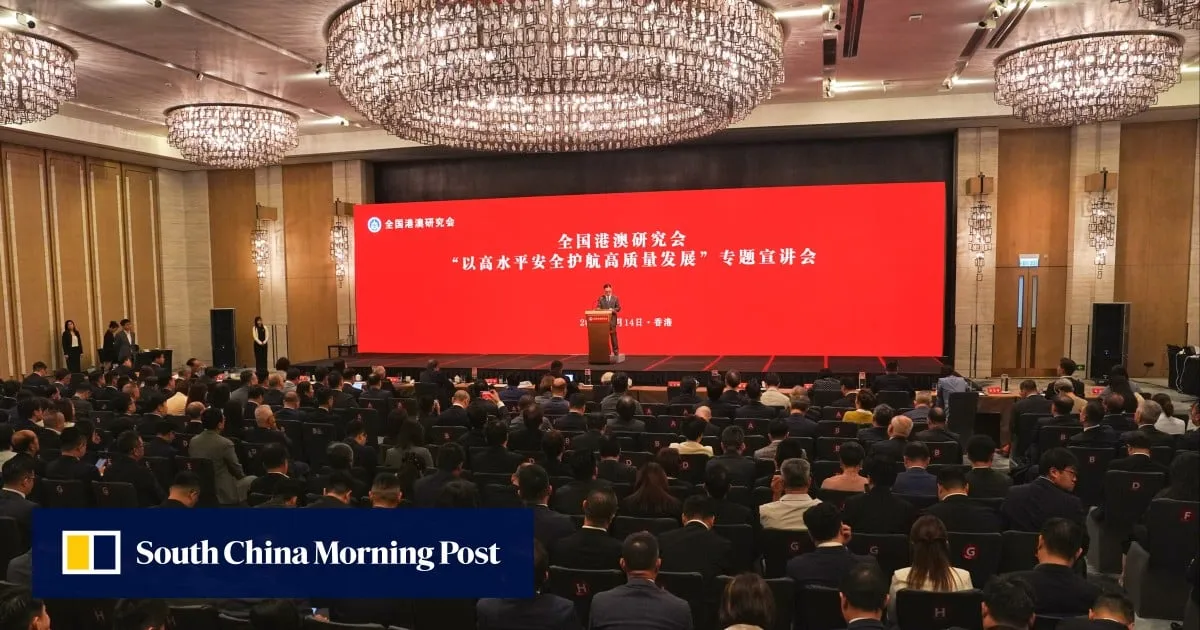
Hong Kong’s national security laws must be continually improved to address risks and close loopholes amid geopolitical tensions, a former senior mainland Chinese official overseeing the city’s affairs has said, while insisting they are less stringent than those in the United States and the United Kingdom.Wang Zhenmin, former bureau chief of the State Council’s Hong Kong and Macau Office (HKMAO), made the remarks at a seminar organised by the semi-official Chinese Association of Hong Kong and Macau Studies think tank, where mainland legal experts discussed ongoing security developments.“Building a national security legal system in any country is a long process. It is not something that can be completed by enacting a single law once and for all. Whenever loopholes are discovered, legislation must be introduced promptly,” said Wang, a law professor at Tsinghua University and vice-president of the think tank.
SRCSouth China Morning Post
LANGEN
LEANCenter-Right
WORDS140
ENT10
TUE · 2026-07-14 · 10:02 GMTBRIEF NSR-2026-0714-92920
NSR-2026-0714-92920News Report·EN·National Security
Hong Kong national security laws must be continually improved: ex-Beijing official
A former senior mainland Chinese official overseeing Hong Kong affairs, Wang Zhenmin, stated that Hong Kong's national security laws require continuous improvement to address risks and close loopholes, particularly amidst geopolitical tensions. Speaking at a seminar organized by the Chinese Association of Hong Kong and Macau Studies think tank, Wang, who is also a law professor at Tsinghua University, emphasized that establishing a national security legal system is an ongoing process.
Matthew ChengSouth China Morning PostFiled 2026-07-14 · 10:02 GMTLean · Center-RightRead · 1 min
South China Morning PostFIG 01
Reading time
1min
Word count
140words
Sources cited
1cited
Entities identified
10entities
Quality score
100%
§ 01
Briefing Summary
AI-generatedNEWSAR · AI
A former senior mainland Chinese official overseeing Hong Kong affairs, Wang Zhenmin, stated that Hong Kong's national security laws require continuous improvement to address risks and close loopholes, particularly amidst geopolitical tensions. Speaking at a seminar organized by the Chinese Association of Hong Kong and Macau Studies think tank, Wang, who is also a law professor at Tsinghua University, emphasized that establishing a national security legal system is an ongoing process. He argued that legislation must be promptly introduced whenever loopholes are discovered. Wang also asserted that Hong Kong's national security laws are less stringent than those in the United States and the United Kingdom. Mainland legal experts participated in the seminar to discuss security developments.
Confidence 0.85Sources 1Claims 5Entities 10
§ 02
Article analysis
Model · rule-basedFraming
National Security
Legal & Judicial
Tone
Measured
AI-assessed
CalmNeutralAlarmist
Factuality
0.60 / 1.00
Mixed
LowHigh
Sources cited
1
Limited
FewMany
§ 03
Key claims
5 extracted01
Wang Zhenmin is a law professor at Tsinghua University and vice-president of the Chinese Association of Hong Kong and Macau Studies think tank.
factual
Confidence
1.00
02
Wang Zhenmin is a former bureau chief of the State Council’s Hong Kong and Macau Office (HKMAO).
factual
Confidence
1.00
03
Building a national security legal system is a long process and requires prompt legislation when loopholes are discovered.
quoteWang Zhenmin
Confidence
1.00
04
National security laws in Hong Kong are less stringent than those in the United States and the United Kingdom.
quoteWang Zhenmin
Confidence
1.00
05
Hong Kong's national security laws must be continually improved to address risks and close loopholes.
quoteWang Zhenmin
Confidence
1.00
§ 04
Full report
1 min read · 140 words§ 05
Entities
10 identifiedKey playerOppositionContextPositiveNeutralNegative
Organizations3
Locations4
§ 06
Keywords & salience
8 termsnational security laws
1.00
hong kong
0.90
legal system
0.80
geopolitical tensions
0.70
loopholes
0.60
legislation
0.50
mainland chinese official
0.40
security developments
0.40
§ 07
Topic connections
Interactive graph Network visualization showing 51 related topics
View Full Graph Person Organization Location Event|Click node to navigate|Edge numbers = shared articles