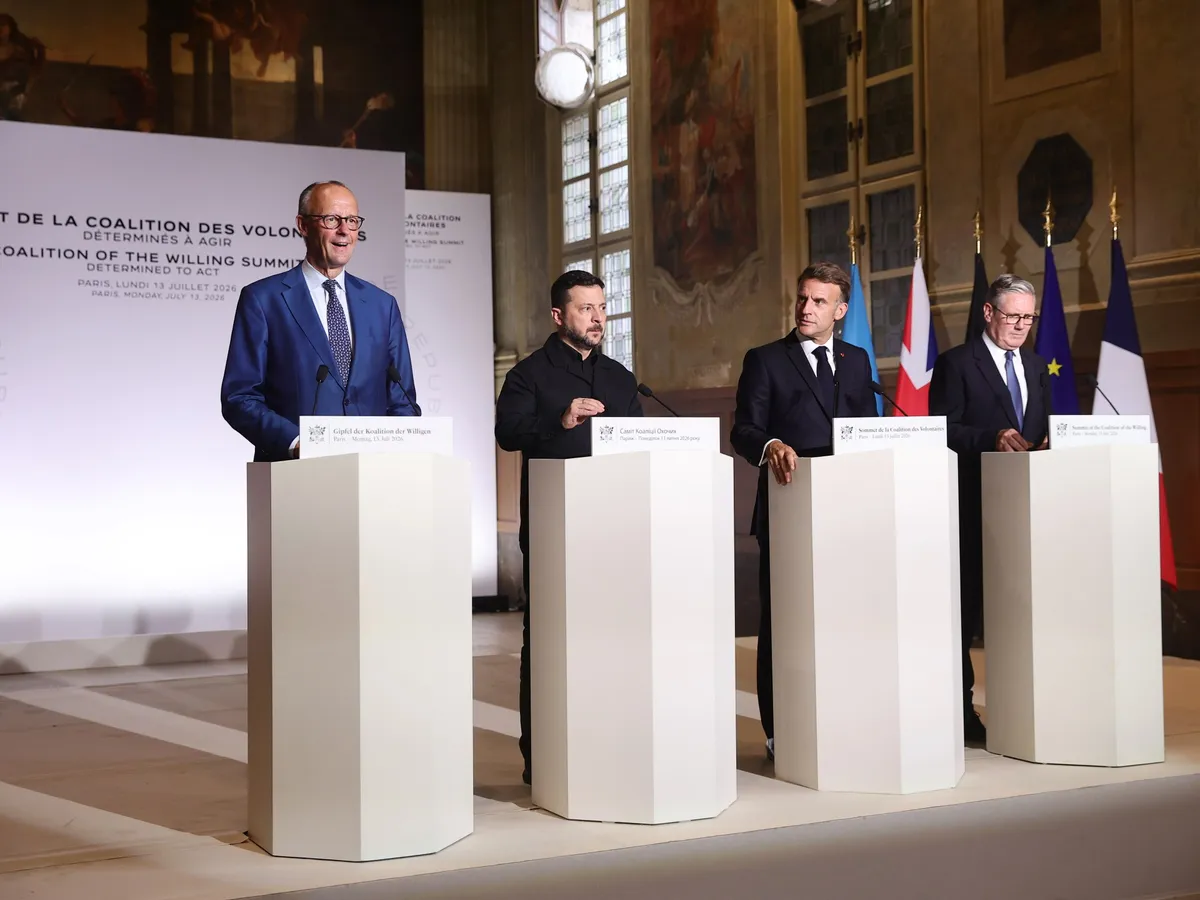
EXPLAINERNine European countries and Ukraine have launched a coalition to build Europe’s own defence against ballistic missiles.From left, German Chancellor Friedrich Merz, Ukrainian President Volodymyr Zelenskyy, French President Emmanuel Macron, and British Prime Minister Keir Starmer address a news conference after the Coalition of the Willing summit on security guarantees for Ukraine in Paris [Teresa Suarez/Pool via AP]Published On 14 Jul 2026On Monday, the leaders of nine European countries and Ukraine gathered in Paris and announced a joint programme to develop Europe’s own Integrated Anti-Ballistic Missile Coalition.In a declaration, they promised an integrated missile defence architecture, built through collective effort and shared industrial capacity.Recommended Stories list of 4 itemslist 1 of 4Ukraine’s Zelenskyy announces cabinet reshuffle, replaces PM Svyrydenkolist 2 of 4Nine dead as Russia and Ukraine trade drone and missile salvoslist 3 of 4EU sanctions nine people over alleged Russian cyber-spying campaignlist 4 of 4Kyiv attacked after Ukraine launches coalition to tackle Russia missilesend of listThe framing is careful – “purely defensive” – but the context is unmistakable: Russia’s ballistic missile campaign against Ukraine has exposed how thin Europe’s defences are, how scarce and expensive US-made interceptors have become, and how dependent the continent remains on Washington’s goodwill.Here’s what the new coalition is actually planning and how it plans to do it.Who’s in the coalition — and who isn’t?The announcement came on the sidelines of a summit of the “Coalition of the Willing” – a much larger grouping of 35 nations, led by the UK and France, that has coordinated military support for Ukraine since March 2025 and is planning security guarantees for any eventual peace deal.About 25 heads of state and government attended the Paris meeting, which also covered further arms deliveries, sanctions pressure on Russia, and support for Ukraine’s energy sector before winter.The 10 founding members who signed up to the Ballistic Missile Shield Plan are: Denmark, France, Germany, Italy, the Netherlands, Norway, Spain, Sweden, the UK and Ukraine – a mix of Europe’s biggest defence industries and, in Ukraine, the only country on the continent with real combat experience against ballistic missile attacks.The absences are notable; Poland, the Baltic states and Finland – the countries closest to Russia – are not among the signatories, and neither is the US.Why does Europe need its own missile shield?The declaration itself points to the growing threat posed by ballistic missiles – the weapons Russia has launched in volume against Ukrainian cities, and which only a handful of expensive, mostly US-made systems can intercept.“We believe that the protection of Europe requires a global solution of integrated missile defence architecture to deter and defeat future missile threats, developed through collective effort, technological openness and trusted industrial cooperation,” the leaders of the Integrated Anti-Ballistic Missile Coalition said in a statement.“Faced with the ballistic threat, we are making a clear choice: protect Ukraine, strengthen our collective security, and build the Europe of defence,” French President Emmanuel Macron wrote on X, adding that with the programme “we are strengthening the capabilities Europe needs”.Ukraine’s president, Volodymyr Zelenskyy, was blunter about the shortfall, acknowledging that at times Kyiv lacks the missiles needed to intercept ballistic targets. This, he said, was the reason Ukraine had joined the programme.Does Europe already have missile defence?Yes, but it’s patchy, expensive and largely foreign-made.Several countries field the US-built Patriot, the workhorse against ballistic missiles, but its interceptors cost millions of dollars apiece and production cannot keep pace with global demand.The Franco-Italian SAMP/T is Europe’s homegrown alternative, though it has seen more limited combat use and its missiles have also run short in Ukraine.Since 2022, there has also been the German-led European Sky Shield Initiative, which pools procurement of existing systems – but its reliance on American Patriots and Israeli Arrow 3s drew criticism from France, which stayed out.“This is not a replacement for existing systems… nor is it a substitute for the European Sky Shield initiative, which operates through coordinated procurement and integration into NATO-compatible systems”, Olesia Horiainova, deputy head of the Kyiv-based think tank Ukrainian Security and Cooperation Centre, told Al Jazeera.“It can be described as the formation of a new European air defence architecture, in which Ukraine currently plays a significant role, outside the scope of NATO and the EU”, she said.Ukrainian service members walk next to a launcher of a Patriot air defence system in an undisclosed location, Ukraine [File: Valentyn Ogirenko/Reuters]What role does Ukraine play?A central one.“Ukraine has unique experience in countering ballistic and missile weapons,” Horiainova said, pointing out that even the US, the world’s biggest superpower, does not have “the same experience as Ukraine of constantly countering massive barrages of high-tech ballistic weapons whilst facing an enemy with superior firepower.”That know-how – what works against Russia’s Iskander and Kinzhal missiles, and what does not – is something no other partner can offer.Ukraine also brings industry. Zelenskyy has promoted its domestically developed Freyja interceptor programme as a potential “European model”, and Washington has separately pledged to license Ukraine to manufacture Patriot interceptors.Ukrainian-made interceptors could cost a fraction of the price of a Patriot missile, according to their developer, Fire Point – a key part of the coalition’s economic logic, though the system has yet to prove itself in combat.What happens next – and how long will it take?The declaration commits the 10 countries to agreeing on common operational requirements, joint technical working groups, and a roadmap towards first operational capabilities – but gives no timeframe, according to The Associated Press.Zelenskyy was more bullish. He told leaders in Paris that Ukraine and its partners could jointly develop a mass-produced, low-cost anti-ballistic system within the next 12 months, built around Ukraine’s Freyja programme. “We need to move as quickly as possible,” he wrote on X after the meeting.But Horiainova said that Europe’s ability to deploy the interception system soon would depend on decision-making speed and the EU’s bureaucracy.Sceptics also note that even funded programmes take years: Germany ordered Israel’s Arrow 3 in 2023, activated its first battery in December 2025, and does not expect the full system to be operational before 2030.
SRCAl Jazeera
LANGEN
LEANCenter
WORDS1 004
ENT12
TUE · 2026-07-14 · 14:03 GMTBRIEF NSR-2026-0714-92969
NSR-2026-0714-92969Analysis·EN·National Security
Russia-Ukraine war: What is Europe’s new ballistic missile shield plan?
Nine European countries and Ukraine have launched a coalition to develop an integrated anti-ballistic missile defense architecture. Announced in Paris on July 14, 2026, the initiative aims to build Europe's own defense capabilities against ballistic missiles, driven by Russia's campaign against Ukraine and the scarcity of existing interceptors.
Nils AdlerAl JazeeraFiled 2026-07-14 · 14:03 GMTLean · CenterRead · 5 min
Al JazeeraFIG 01
Reading time
5min
Word count
1 004words
Sources cited
0cited
Entities identified
12entities
Quality score
100%
§ 01
Briefing Summary
AI-generatedNEWSAR · AI
Nine European countries and Ukraine have launched a coalition to develop an integrated anti-ballistic missile defense architecture. Announced in Paris on July 14, 2026, the initiative aims to build Europe's own defense capabilities against ballistic missiles, driven by Russia's campaign against Ukraine and the scarcity of existing interceptors. The founding members include Denmark, France, Germany, Italy, the Netherlands, Norway, Spain, Sweden, the UK, and Ukraine. This program seeks to enhance collective security and strengthen Europe's defense industry through shared effort and industrial capacity. While Europe has existing, but limited and expensive, missile defense systems, this new coalition aims to create a more comprehensive and integrated solution, with Ukraine playing a significant role due to its combat experience.
Confidence 0.90Claims 4Entities 12
§ 02
Article analysis
Model · rule-basedFraming
National Security
Diplomatic
Tone
Measured
AI-assessed
CalmNeutralAlarmist
Factuality
0.70 / 1.00
Factual
LowHigh
Sources cited
0
No named sources
FewMany
§ 03
Key claims
4 extracted01
The 10 founding members are Denmark, France, Germany, Italy, the Netherlands, Norway, Spain, Sweden, the UK and Ukraine.
factual
Confidence
1.00
02
The new coalition aims to develop an integrated missile defence architecture through collective effort and shared industrial capacity.
factual
Confidence
1.00
03
Nine European countries and Ukraine have launched a coalition to build Europe’s own defence against ballistic missiles.
factual
Confidence
1.00
04
Russia’s ballistic missile campaign against Ukraine has exposed how thin Europe’s defences are and how scarce US-made interceptors have become.
factual
Confidence
0.90
§ 04
Full report
5 min read · 1 004 words§ 05
Entities
12 identifiedKey playerOppositionContextPositiveNeutralNegative
People4
Organizations1
Locations6
§ 06
Keywords & salience
8 termsballistic missile shield
1.00
europe defence
0.90
ukraine war
0.80
missile defence architecture
0.70
coalition of the willing
0.60
security guarantees
0.50
collective effort
0.40
us-made interceptors
0.40
§ 07
Topic connections
Interactive graph Network visualization showing 51 related topics
View Full Graph Person Organization Location Event|Click node to navigate|Edge numbers = shared articles