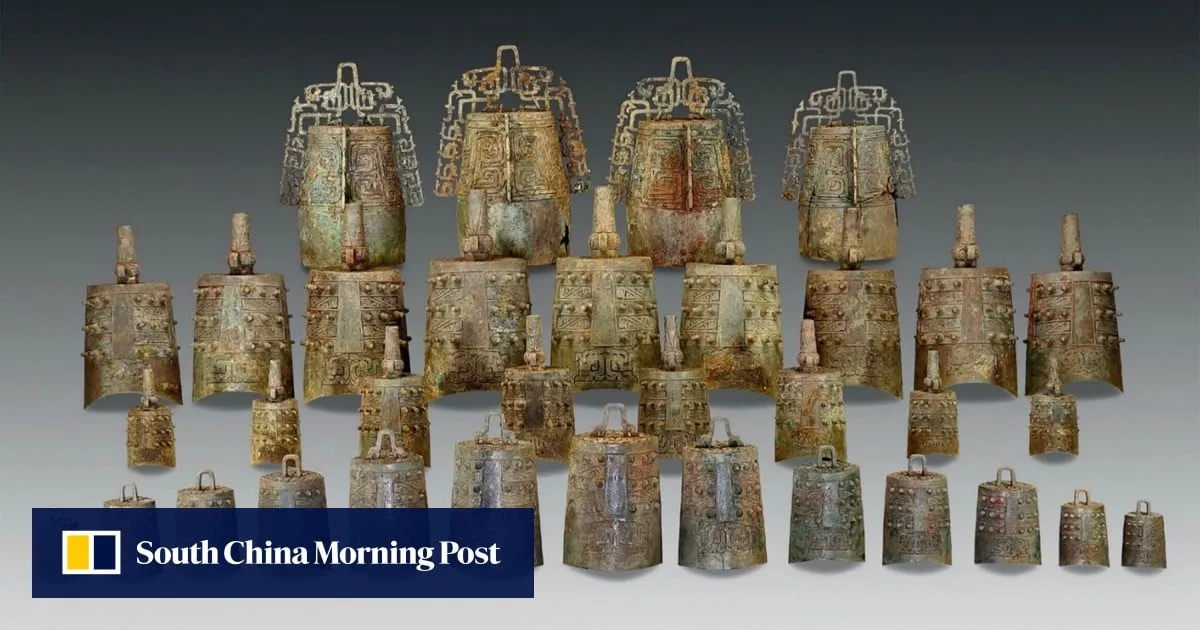
Imagine, for a moment, that you lived in ancient China, with a rival state threatening your people’s very existence. In the quest for any advantage, one strategy might involve performing a ceremony to invoke assistance from the ancestors.However, life and politics are not static; old rivals can transform into close allies. This transformation raises an intriguing question: do ancient war ceremonies simply fade away when they lose relevance? A recent discovery in China indicates that, at least during the Zhou dynasty (1046–256 BC), people believed the answer was “no,” suggesting that old ceremonies needed to be “turned off.”The research, published by Cambridge University Press, indicates that individuals – excluding thieves – had intentionally tampered with the resting place of Lord Qiu, a member of the political elite from the state of Zeng.Chinglong Tse, the study’s author and a PhD candidate at the Institute of Archaeology, University College London, posited that these intruders likely sought to “turn off” a connection to ancient ancestors established by Qiu, which had become politically inconvenient amid shifting social dynamics.These authentic, 2,600-year-old bronze bells are ritual artefacts excavated directly from the tomb of Lord Qiu of Zeng. Photo: Cambridge University Press“It mattered a lot whether particular ceremonial instruments coupled with the dead because it determined which kind of ritual capacities the mourners wanted the deceased to sustain in his/her afterlife,” Tse stated.“In Lord Qiu’s case, the evidence suggests that the capacities of his first bell set were deliberately deactivated during burial,” he told the SCMP.Archaeologists uncovered an array of bronze bells within Qiu’s tomb, inscribed with the names of his ancestors. The deceased were depicted as perfect beings who shared the Mandate of Heaven with Zhou kings.Qiu likely commissioned the production of bells specifically to emulate those ancient ancestors, aspiring to demonstrate to them that he embodied their culture and values. He hoped that the ceremony would bestow upon him their characteristics as he confronted an impending threat from the rival Chu state.Qiu’s intention was probably to prove his moral capacity to receive ancestral mandates – which, for him, would have meant ruling over portions of China. Notably, historical records reveal that Qiu addressed his ancestors in the form of a small child, highlighting his devotion and humility.To engage with these ancestors, Qiu could not simply request their guidance over tea; he needed to invoke their presence through rituals conducted at designated locations.“To attract and engage these ancestral persons, their histories had to be recounted through the recitation of prayers accompanied by the ornithomorphic sounds of the bells,” Tse noted in his study.Cast masterfully into the bronze, these ancient inscriptions served to communicate directly with ancestral spirits. Photo: Cambridge University PressNonetheless, life and politics are ever-evolving, and Qiu’s invocation of his ancestors against the Chu state became problematic after Zeng and Chu formed an alliance through marriage.Further ReadingThis political shift raised a significant concern: Qiu had sought ancestral guidance to pursue a strategy antagonistic to the Chu state, which was no longer suitable within the new alliance.According to Tse, the mystical essence of the bells was “deactivated” by disassembling them and carefully distributing the parts in a deliberate pattern around the tomb.Interestingly, the Chu-Zeng alliance was established before Qiu’s death, and he seemingly commissioned a new set of ritual bronze bells arranged in parallel lines. Tse contended that this was intended to afford Qiu the ritual advantages of the bronze bells in the afterlife while neutralising the old bells’ capacity to disrupt the new political order.Tse emphasised that his research serves as an important reminder to consider ancient China within its unique context.“For Lord Qiu and his contemporaries, they lived in worlds where ancestors, wandering spirits, Heaven, and chimerical creatures were active participants capable of influencing the course of historical events.”Instead of dismissing these beliefs as mere superstitions, Tse argued, understanding them is essential to grasping the motivations behind the creation of certain objects and their specific uses.“Similarly, practices that seem entirely rational to some of us, including astrology, cryptocurrency, or even our confidence in certain scientific authorities and tools, may have appeared strange to Lord Qiu and his contemporaries,” he remarked.“Studying past worlds thus requires us to be reflective on the societies of others as well as our own.”
SRCSouth China Morning Post
LANGEN
LEANCenter-Right
WORDS704
ENT10
WED · 2026-07-15 · 01:00 GMTBRIEF NSR-2026-0715-93082
NSR-2026-0715-93082News Report·EN·Political Strategy
Ancient Chinese lord buried with bells meant to silence ancestral war rituals
A recent discovery in China, dating to the Zhou dynasty (1046–256 BC), suggests that ancient Chinese elites believed war rituals needed to be actively "turned off" when they lost political relevance. Archaeologists found evidence that the tomb of Lord Qiu of the state of Zeng was intentionally tampered with, specifically his set of 2,600-year-old bronze bells.
Kevin McSpaddenSouth China Morning PostFiled 2026-07-15 · 01:00 GMTLean · Center-RightRead · 3 min
South China Morning PostFIG 01
Reading time
3min
Word count
704words
Sources cited
1cited
Entities identified
10entities
Quality score
100%
§ 01
Briefing Summary
AI-generatedNEWSAR · AI
A recent discovery in China, dating to the Zhou dynasty (1046–256 BC), suggests that ancient Chinese elites believed war rituals needed to be actively "turned off" when they lost political relevance. Archaeologists found evidence that the tomb of Lord Qiu of the state of Zeng was intentionally tampered with, specifically his set of 2,600-year-old bronze bells. The study's author, Chinglong Tse, posits that intruders likely sought to deactivate the connection to ancestors established by Qiu, which had become politically inconvenient due to a new alliance between Zeng and the rival Chu state. Qiu had commissioned these bells to invoke ancestral assistance against Chu, but after the alliance, this invocation became problematic. The bells' ritual capacities were seemingly deactivated by disassembling and rearranging their parts, possibly to neutralize their disruptive potential while allowing Qiu to retain other afterlife ritual advantages.
Confidence 0.90Sources 1Claims 5Entities 10
§ 02
Article analysis
Model · rule-basedFraming
Political Strategy
Human Interest
Tone
Measured
AI-assessed
CalmNeutralAlarmist
Factuality
0.70 / 1.00
Factual
LowHigh
Sources cited
1
Limited
FewMany
§ 03
Key claims
5 extracted01
The bells' ornithomorphic sounds were used in prayers to attract and engage ancestral spirits.
factualChinglong Tse
Confidence
0.90
02
Ancient Chinese people believed old war ceremonies needed to be 'turned off' when they lost relevance.
factualCambridge University Press research / Chinglong Tse
Confidence
0.90
03
The capacities of Lord Qiu's first bell set were deliberately deactivated during burial.
factualChinglong Tse
Confidence
0.85
04
Intruders intentionally tampered with the tomb of Lord Qiu to 'turn off' a connection to ancestors.
factualChinglong Tse
Confidence
0.80
05
Lord Qiu commissioned bells to emulate ancestors and prove his moral capacity to receive ancestral mandates.
factualArticle interpretation of Tse's study
Confidence
0.70
§ 04
Full report
3 min read · 704 words§ 05
Entities
10 identifiedKey playerOppositionContextPositiveNeutralNegative
Organizations2
§ 06
Keywords & salience
10 termsancestral war rituals
1.00
ancient china
1.00
zhou dynasty
0.90
lord qiu
0.90
state of zeng
0.80
bronze bells
0.70
ritual artefacts
0.70
mandate of heaven
0.60
chu state
0.50
archaeology
0.40
§ 07
Topic connections
Interactive graph Network visualization showing 51 related topics
View Full Graph Person Organization Location Event|Click node to navigate|Edge numbers = shared articles