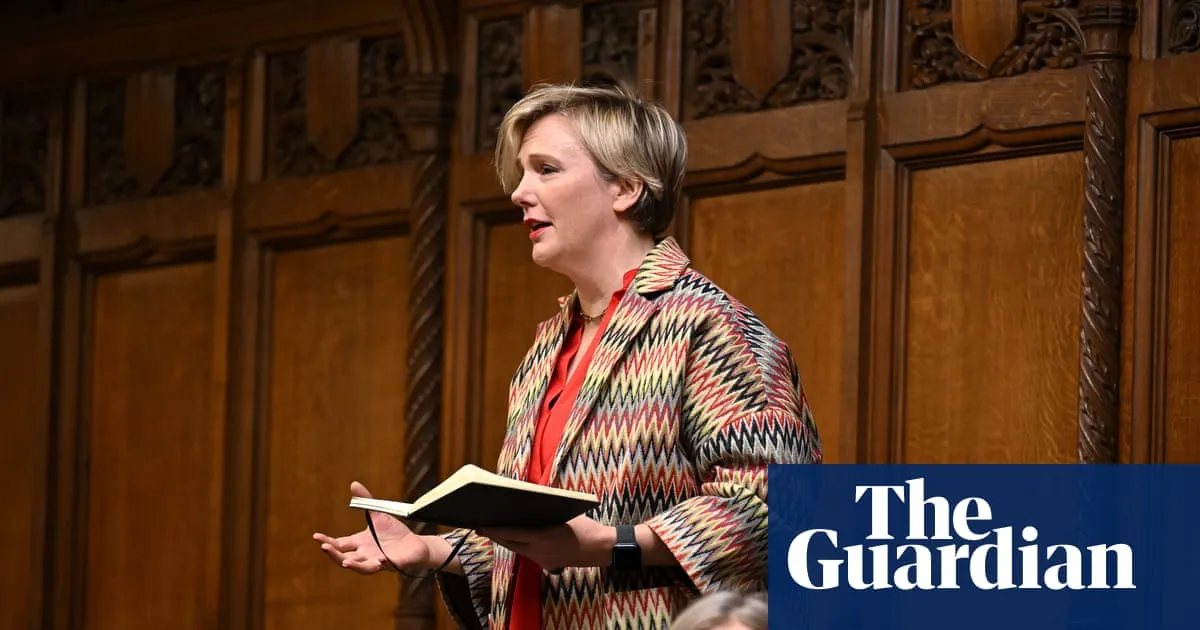
Stella Creasy is one of the MPs who wants to see a cap on political donations to UK parties. Photograph: House of Commons View image in fullscreen Stella Creasy is one of the MPs who wants to see a cap on political donations to UK parties. Photograph: House of Commons Wednesday briefing: Do MPs have the will to stop mega-donors interfering in UK politics? In today’s newsletter: The Representation of the People Bill has become a test of whether Britain can curb the surge in billionaire‑backed donations trying to influence how we run the country Good morning. I’m Hettie O’Brien, and I’ll be arriving in your inbox regularly from today, rounding out the First Edition team alongside Libby and Michael. I’ve spent much of my time at the Guardian writing about who is pulling the strings in Britain: I enjoy illuminating knotty subjects for our readers, exposing how power works, and helping to make sense of the stories defining our world. I’d love to hear what you think – just reply to this email – we want you to play a part in shaping First Edition. But go easy, it’s my first day. This morning I’ll be looking at a new law that could dramatically change Britain’s political landscape. The Representation of the People Bill – supposedly one of Keir Starmer’s final acts as prime minister – contains numerous proposals, including the extension of the franchise to 16 and 17-year-olds and new rules on voter registration. But thanks to the ongoing questions raised by the Guardian’s reporting into Nigel Farage’s finances, particularly the £5m donation he received from the Thailand-based cryptocurrency billionaire Christopher Harborne (a gift that Farage insists was “personal”, not political), one aspect of the bill has become potentially explosive: the role that big money plays in British politics. And perhaps that is why the soon to be prime minister, Andy Burnham, hit pause on the bill that was due to be debated yesterday, to allow for his new administration to shape what is ultimately passed into law. Given that delay – and the fact I’m sure our new PM is a loyal reader – I spoke to Steve Goodrich, head of research at Transparency International, about how the rise of mega-donations is undermining democracy, and what Burnham should do about it. That’s after the headlines. UK news | The police investigation into the death of Ann Widdecombe is examining whether a leftwing or single-issue cause may lie behind her killing, the Guardian has learned. Middle East | Donald Trump has threatened to expand US strikes on Iran next week to target power plants and bridges if Tehran does not agree to a deal amid a continuing dispute over the strait of Hormuz. UK politics | Boris Johnson’s government wasted £10bn of public money because of the way it went about buying PPE during the coronavirus pandemic, an official inquiry has concluded. Europe news | A spokesperson for the EU has pushed back against the Trump administration’s assertion that the international criminal court poses a threat to US sovereignty. US news | The man killed by Immigration and Customs Enforcement (ICE) agents in Maine on Monday has been identified as Joan Sebastian Guerrero, according to local news outlets. In depth: ‘Money talks the loudest’ View image in fullscreen The British public feel that big money has too much sway in politics. Illustration: Guardian Design/Getty The Representation of the People Bill was due to have its third reading in parliament yesterday. But it has now been delayed until after the summer recess, giving the incoming prime minister ample opportunity to shape the legislation. The death of Ann Widdecombe has sparked a wider conversation about the security of politicians, and Reform UK (the party for which she was immigration and justice spokesperson at the time of her death) hasn’t missed an opportunity to argue that restricting party finances could imperil the lives of its representatives. But many MPs now believe that ever-larger donations are corrupting our political system. Here’s just one example: in 2025, Harborne gave £9m to Reform, the largest single donation by a living donor a British party has ever received. It would take the average person 3,000 years to save enough to match it. You might assume – given Farage’s humiliating decision to call a byelection in which he’ll be campaigning against a talking bin – that Reform is losing its touch. But the party’s fortunes are closely tied to those of its wealthy friends. The vast majority of its funding comes from just a handful of donors, among them Harborne, who has donated more than £22m, Ben Delo, founder of a crypto exchange, and Nick Candy, the billionaire property developer. The rich have always sought to influence politics, but they’re now doing so at an unprecedented scale, says Goodrich, who has spent years uncovering the influence of big money on British politics. “What you’re seeing is an increasing Americanisation of British politics, where money talks the loudest.” In 2015, only 1% of private donations to UK parties came from companies and individuals giving £1m or more: by 2024, this had risen to over a third. “This ballooning of big money is encouraging parties to listen less to their voters and members at large, and more to a small clique of uber-wealthy people who are gaining an outsize influence on our political system.” This rise in mega-donations stems from a 2023 decision by the Conservative government to quietly hike the election spending cap by 80%, which has locked parties into a vicious cycle. As campaign expenditure has increased (in 2024, parties and their candidates spent over £90m on the general election, the highest figure in modern British history), fundraisers have attempted to raise greater amounts of money than ever before. “If you’re a fundraiser who has to raise £100m for an election, the quickest way you’re going to do that is to tap up a bunch of billionaires rather than trying to make the case to your membership or the public for funds,” Goodrich says. The problem is far greater than a single party: it reflects how the super-rich are remodelling politics to suit their interests, funnelling money towards parties that promise tax cuts, deregulation, and the destruction of government oversight. As the Institute for Public Policy Research recently observed, there is a troubling affinity between men who made fortunes from cryptocurrencies and tech platforms, and a global network of right-wing politicians who can appear hostile to democracy. Whatever happens next with Farage, the new British right will be counting on the continued support of its deep-pocketed funders. The Representation of the People Bill was an opportunity to stem this flood of money, but some MPs think it is overly timid. Among its reforms are an annual £100,000 limit on donations from British citizens living abroad, and new checks to stop foreign actors from using UK shell companies to make political donations. The government has also put in place a (temporary) moratorium on political donations made in cryptocurrencies. A number of Labour MPs want it to go further. Some have proposed amendments to the bill including a permanent ban on cryptocurrency donations and a sizeable reduction in campaign spending limits. But such a reduction would do nothing to prohibit the type of gigantic donation that Delo and Harborne have made to Reform (or the £2m that Labour received from David Sainsbury in 2023, for that matter). “One of the major issues is that we currently have no limit on how much UK individuals or companies are allowed to donate to parties,” Goodrich tells me. MPs Stella Creasy and Alex Sobel have proposed capping donations at £100k and £1m, respectively. Under Creasy’s £100k cap, Reform would have lost an estimated 85% of its registered donations in 2025. Still, those hoping the Labour government might be swayed by her proposal will probably be disappointed. “There’s always been a standoff between Labour and the Conservatives about limiting donations,” said Kiran Stacey, the Guardian’s policy editor, who has been following this story closely. The Conservative party has historically benefited from large donations made by individual wealthy donors and Labour has benefited from sizeable donations from the unions, giving neither party a reason to adopt a cap. “Each of the major parties has tried to avoid talking about this substantively, because it raises awkward questions about where they get their money from,” Goodrich says. Burnham might take a different view. In emails with a grassroots campaigner that he sent while campaigning in the Makerfield byelection, he suggested he would back a £500k cap on political spending – though he has since gone rather quiet on the issue. Here, Burnham could perhaps take note of what other countries already do: Australia, Italy, Belgium and the Netherlands all impose caps on political donations. The gold standard is arguably set by Canada, which bans corporations (and trade unions) from making donations to parties, and sets strict limits on how much can be donated: the maximum an individual can give to any party is just $1,775 per year. The failure of successive governments to cap political donations has made the UK an outlier among western democracies in Europe, and is cutting Westminster adrift from public opinion. The majority of people in Britain feel that big money has too much sway in politics, and voters from all the major parties (including Reform) are united on this issue. Introducing a cap would be popular, Goodrich says, restoring faith in the idea that politicians are ultimately elected to serve us, the general public. “It’s the only way of protecting democracy from big money – before public trust crumbles.” What else we’ve been enjoying View image in fullscreen Pangolins are especially vulnerable to trafficking. Photograph: Frances Rankin/The Guardian Robyn Vinter has gone undercover in Laos to make this incredible film about how Chinese tourism is fuelling animal trafficking. Libby After reading this piece about Enid Marx, the textile designer behind some of the London Underground’s cheerful fabrics, I’ve gained a new appreciation for my seat on the tube. Hettie When I spoke to Melissa Hellman for First Edition about America’s 250th birthday celebrations, she told me about this play retelling the revolutionary war from the perspective of former slaves. Libby World Cup 2026 View image in fullscreen Spain’s Pedro Porro celebrates after scoring his side’s second goal against France goalkeeper Mike Maignan. Photograph: Jessica Tobias/AP France 0 - 2 Spain | Goals from Mikel Oyarzabal and Pedro Porro gave Spain a win in the World Cup semi-final against France. They now await England or Argentina in the final. England| Whatever the result of the semi-final clash with Argentina, it’ll be a career-defining night for England captain Harry Kane. Jacob Steinberg looks at what’s at stake. Penalties | To date, 342 World Cup players have faced the most nerve-wracking test in football. This anxiety-inducing gallery captures the agony – and ecstasy – of stepping up to the spot. Sport View image in fullscreen Tadej Pogacar went solo with a little over 15km remaining of the stage into Le Lioran. Photograph: Dario Belingheri/Getty Images Cycling | Tadej Pogacar extended his lead in the Tour de France with another imperious solo victory on the 10th stage to Le Lioran, in the Massif Central. Cricket | Axar Patel and Washington Sundar both score unbeaten half-centuries to lead India to a six-wicket win against England at Edgbaston. LA Olympic Games | The six-time Olympic medalist gymnastics star Suni Lee, announced she is returning to the sport, about two years out from the Los Angeles Games. The front pages View image in fullscreen Photograph: The Guardian “Police examine possible leftwing motive for Widdecombe murder”, is the Guardian’s front page headline today, while the Times has “Widdecombe suspect ‘may have targeted other MPs’”, the Mail says “Widdecombe suspect probed over Left-wing extremism”, and the i Paper writes “Widdecombe killed in targeted attack, UK counter-terror police chief reveals”. Elsewhere, the Telegraph leads with “Alzheimer’s drug could stop disease”. The FT says “Wall Street banks reap record profits as AI frenzy powers trading bonanza”. On the World Cup, the Express urges its readers to “Roar them on!”, the Sun says “It’s in YOUR hands now, lads”, the Mirror says “You can do this” and Metro writes “Don’t jinx it, Keir”. The US government has been forced to pay billions in refunds to companies that were hit by Trump’s ‘Liberation Day’ tariffs. The US has paid out $81bn (£61bn) this fiscal year, after the supreme court ruled the tariffs were illegal. Lucy Hough speaks to international editor for Guardian US, Chris Michael. Cartoon of the day | Ella Baron View image in fullscreen Illustration: Ella Baron/The Guardian The Upside A bit of good news to remind you that the world’s not all bad View image in fullscreen Nasa astronaut Sally Ride in her sleep restraint on the space shuttle Challenger, 1983. Photograph: Space Frontiers/Getty Images Can humans hibernate their way to Mars? A growing group of scientists thinks so. Certain animal species can survive months without food or water, thanks to a specific area of their brain. Turns out we have one, too – and with the help of technology, humans might also be able to safely shut down. “It could absolutely transform the future of space travel,” says Christiane Hahn, from the European Space Agency. Hibernation could shrink the provisions needed for deep space travel, while reducing its potential health risks. Plus, there’s hope this research could one day treat all sorts of diseases. “This has so much therapeutic potential,” says physician professor Matteo Cerri. “It’s just an incredibly exciting area.” And finally, the Guardian’s puzzles are here to keep you entertained throughout the day. Until tomorrow. Explore more on these topics Politics First Edition newsletter Nigel Farage Reform UK Party funding Tax and spending Christopher Harborne Andy Burnham newsletters Share Reuse this content
SRCThe Guardian - World News
LANGEN
LEANCenter-Left
WORDS2 315
ENT12
WED · 2026-07-15 · 05:47 GMTBRIEF NSR-2026-0715-93137
NSR-2026-0715-93137Analysis·EN·Political Strategy
Wednesday briefing: Do MPs have the will to stop mega-donors interfering in UK politics?
The Representation of the People Bill, which includes proposals like extending voting rights to 16 and 17-year-olds, has become a focal point for debate on curbing the influence of large political donations in the UK. The bill's progress has been delayed, allowing the incoming prime minister to shape its final form.
Hettie O'BrienThe Guardian - World NewsFiled 2026-07-15 · 05:47 GMTLean · Center-LeftRead · 10 min
The Guardian - World NewsFIG 01
Reading time
10min
Word count
2 315words
Sources cited
2cited
Entities identified
12entities
Quality score
100%
§ 01
Briefing Summary
AI-generatedNEWSAR · AI
The Representation of the People Bill, which includes proposals like extending voting rights to 16 and 17-year-olds, has become a focal point for debate on curbing the influence of large political donations in the UK. The bill's progress has been delayed, allowing the incoming prime minister to shape its final form. This delay comes amid increased scrutiny of billionaire-backed donations, such as a £5 million gift to Nigel Farage's party from Christopher Harborne, and a £9 million donation to Reform UK from the same donor. Experts suggest this trend is leading to an "Americanisation of British politics" where money holds significant sway.
Confidence 0.90Sources 2Claims 4Entities 12
§ 02
Article analysis
Model · rule-basedFraming
Political Strategy
Economic Impact
Tone
Mixed Tone
AI-assessed
CalmNeutralAlarmist
Factuality
0.60 / 1.00
Mixed
LowHigh
Sources cited
2
Limited
FewMany
§ 03
Key claims
4 extracted01
The rise of mega-donations is undermining democracy.
quoteSteve Goodrich (Transparency International)
Confidence
1.00
02
The Representation of the People Bill contains proposals for extending the franchise to 16 and 17-year-olds and new rules on voter registration.
factual
Confidence
1.00
03
Boris Johnson’s government wasted £10bn of public money on PPE during the coronavirus pandemic.
factualofficial inquiry
Confidence
0.90
04
Nigel Farage received a £5m donation from cryptocurrency billionaire Christopher Harborne.
factualThe Guardian
Confidence
0.90
§ 04
Full report
10 min read · 2 315 words§ 05
Entities
12 identifiedKey playerOppositionContextPositiveNeutralNegative
People7
Locations1
§ 06
Keywords & salience
9 termsmega-donors
1.00
political donations
1.00
uk politics
0.90
representation of the people bill
0.80
influencing politics
0.70
transparency international
0.60
democracy
0.50
nigel farage
0.50
cryptocurrency billionaire
0.40
§ 07
Topic connections
Interactive graph Network visualization showing 51 related topics
View Full Graph Person Organization Location Event|Click node to navigate|Edge numbers = shared articles