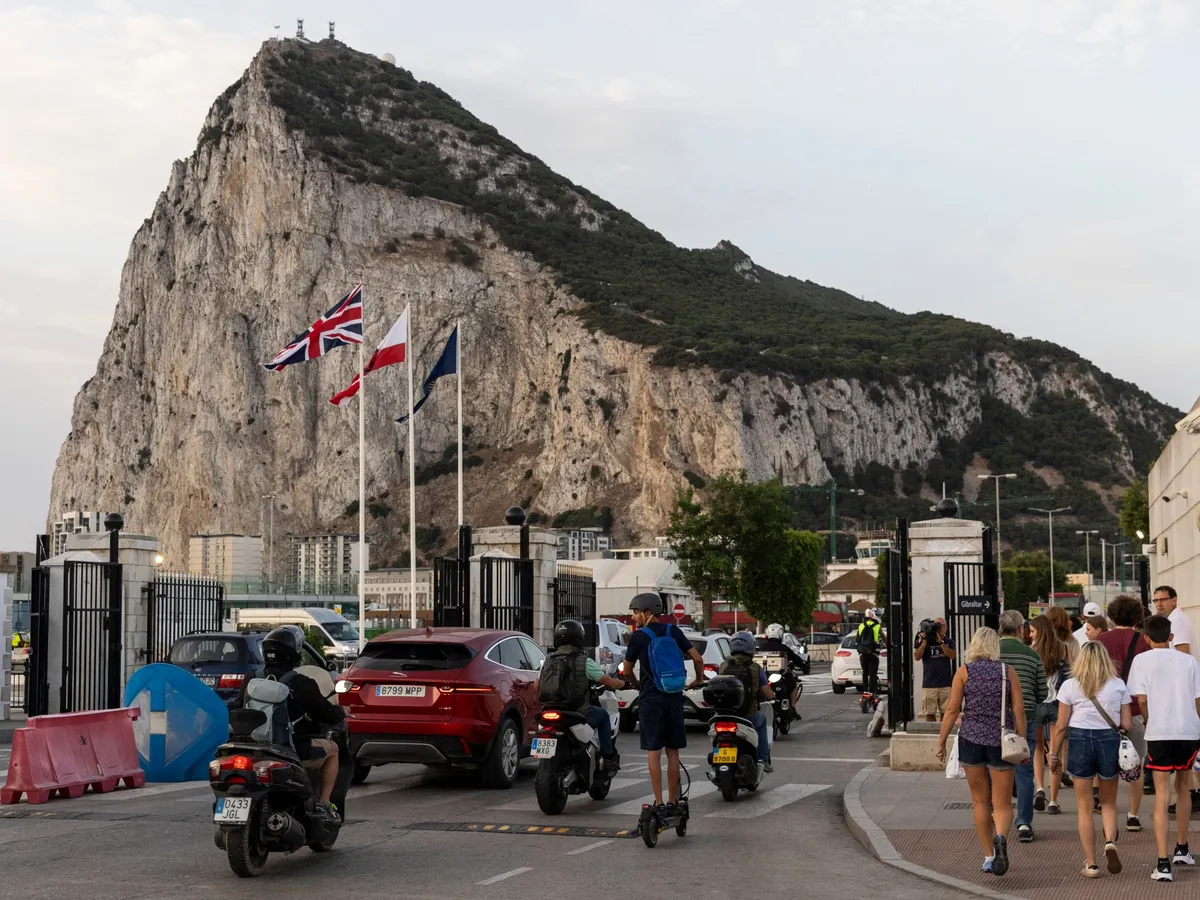
EXPLAINERA new treaty signed by Britain and the EU includes the removal of border checks between Spain and Gibraltar. Workers cross the border into Gibraltar on the morning of July 15, 2026, soon after the new Spain-Gibraltar border agreement came into effect [Pablo Blazquez Dominguez/Getty Images]Published On 15 Jul 2026Thousands of people who travel every day between the southern tip of Spain and the British territory of Gibraltar will no longer have to cross a physical border from Wednesday.This came after the European Union and United Kingdom on Tuesday signed a treaty that delivers “economic and trade certainty for the people and businesses of Gibraltar, safeguards British sovereignty and protects the autonomous operation of UK military facilities”.Recommended Stories list of 4 itemslist 1 of 4‘Brexit has not been the economic disaster many claimed’list 2 of 4Mapping the 10 countries with the most overseas territorieslist 3 of 4Andy Burnham in line to become British PM after securing party supportlist 4 of 4Murder of UK politician Ann Widdecombe was ‘targeted attack’, police sayend of listThe treaty was signed in Brussels by the European Trade Commissioner Maros Sefcovic, British Minister of State for Europe Stephen Doughty, Spanish Foreign Minister Jose Manuel Albares and Gibraltar Chief Minister Fabian Picardo.“Gibraltar was left out of the UK-EU Trade and Cooperation Agreement following Brexit, creating the prospect of a devastating ‘hard border’ for the 15,000 people – more than half of Gibraltar’s workforce – who cross the land border between Spain and Gibraltar every day,” the treaty said.Here’s what we know about the treaty:What does the treaty include?Britain secured Gibraltar, a strategically important enclave at the southern tip of Spain, in the 1713 Treaty of Utrecht, which ended the War of Spanish Succession.The contested British overseas territory of 38,000 people is perched at a strategic location, only 8 nautical miles (15km) from Morocco where the Atlantic Ocean meets the Mediterranean Sea.The new agreement allows residents of Gibraltar to cross into Spain using residence cards without needing to have their passports stamped. In return, Spanish citizens will be allowed to enter Gibraltar using a government ID card.The treaty in effect brings Gibraltar into the EU’s Schengen free-travel area, which allows people from 29 countries to move among them freely without needing visas.At Gibraltar’s airport and port, entry and exit checks will be conducted by both British and Spanish border officials. The arrangement is similar to what’s in place at Eurostar train stations in London and Paris, where both British and French officials check passports.Travellers to Gibraltar from countries outside the Schengen area, including the UK, will have to contend with the EU Entry/Exit System, which was rolled out in Europe in April and replaced passport stamps with biometric data collected through photographs and digital fingerprints.Under the older system, every person had to face two border checks, one by Gibraltarian border agents and the other by Spanish officials when entering or exiting the Schengen area. The checks caused long queues, heavily impacting the workers who made the crossing daily.The British government said the agreement brings “fluidity for people and goods crossing the Gibraltar-Spain border to support economic growth and jobs in the region”.What was the motivation behind the treaty, and how does Brexit feature in it?In a 2016 referendum in which UK voters approved leaving the EU, 96 percent of voters on “the Rock”, as Gibraltar is popularly known in English, supported remaining in the bloc.When Britain eventually left the EU in 2020, the relationship between Gibraltar and the bloc was left unresolved. Previous talks on a deal to ensure people and goods could keep flowing across the border had made halting progress.While the Trade and Cooperation Agreement, which came into force in 2021, broadly covered relations between the bloc and Britain, it was decided that Gibraltar would be addressed in separate negotiations because of its unique situation because it’s not in the EU customs union or the Schengen area.In 2025, the EU and UK announced an agreement on those issues after more than three and a half years of negotiations.Does the treaty place Gibraltar in a special position, and do any other British overseas territories have the same privileges?Yes, Gibraltar is in a unique position because it has now gained EU privileges without being an actual EU member.Still, it is under British sovereignty, and the treaty solely seeks to resolve post-Brexit cooperation with the EU and border management due to its open land border with the EU.None of Britain’s other overseas territories, which include 14 territories scattered across the Caribbean and the Antarctic, has a deal similar to Gibraltar’s due to the shared land border.Some of the territories have international arrangements, including Bermuda, which has its own immigration and tax systems, and the Falkland Islands, which govern themselves.
SRCAl Jazeera
LANGEN
LEANCenter
WORDS790
ENT12
WED · 2026-07-15 · 10:45 GMTBRIEF NSR-2026-0715-93185
NSR-2026-0715-93185News Report·EN·Diplomatic
Gibraltar border controls lifted: Is it part of Schengen, the UK – or both?
A new treaty between the UK and the EU has removed border checks between Spain and Gibraltar, effective July 15, 2026. This agreement allows residents of Gibraltar to enter Spain using residence cards and Spanish citizens to enter Gibraltar with government ID cards, effectively bringing Gibraltar into the EU's Schengen free-travel area.
Edna MohamedAl JazeeraFiled 2026-07-15 · 10:45 GMTLean · CenterRead · 4 min
Al JazeeraFIG 01
Reading time
4min
Word count
790words
Sources cited
4cited
Entities identified
12entities
Quality score
100%
§ 01
Briefing Summary
AI-generatedNEWSAR · AI
A new treaty between the UK and the EU has removed border checks between Spain and Gibraltar, effective July 15, 2026. This agreement allows residents of Gibraltar to enter Spain using residence cards and Spanish citizens to enter Gibraltar with government ID cards, effectively bringing Gibraltar into the EU's Schengen free-travel area. British and Spanish officials will jointly conduct entry and exit checks at Gibraltar's airport and port. The treaty aims to provide economic and trade certainty for Gibraltar, which had faced the prospect of a "hard border" after Brexit, as 96% of its residents voted to remain in the EU. Gibraltar's unique situation, with its land border to the EU, necessitated separate negotiations from the broader UK-EU Trade and Cooperation Agreement.
Confidence 0.90Sources 4Claims 5Entities 12
§ 02
Article analysis
Model · rule-basedFraming
Diplomatic
Economic Impact
Tone
Measured
AI-assessed
CalmNeutralAlarmist
Factuality
0.80 / 1.00
Factual
LowHigh
Sources cited
4
Well sourced
FewMany
§ 03
Key claims
5 extracted01
Border checks at Gibraltar’s airport and port will be conducted by both British and Spanish officials.
factual
Confidence
1.00
02
Residents of Gibraltar can cross into Spain using residence cards without passport stamps; Spanish citizens can enter Gibraltar with ID cards.
factual
Confidence
1.00
03
The treaty delivers economic and trade certainty for Gibraltar, safeguards British sovereignty, and protects UK military facilities.
quoteEU and UK
Confidence
1.00
04
A new treaty between Britain and the EU removes border checks between Spain and Gibraltar.
factual
Confidence
1.00
05
The treaty brings Gibraltar into the EU’s Schengen free-travel area.
factual
Confidence
0.90
§ 04
Full report
4 min read · 790 words§ 05
Entities
12 identifiedKey playerOppositionContextPositiveNeutralNegative
People4
Organizations1
Locations4
Topics1
§ 06
Keywords & salience
10 termsgibraltar border controls
1.00
schengen area
0.90
uk-eu treaty
0.90
brexit
0.80
spain-gibraltar relations
0.70
border agreement
0.70
free travel
0.60
treaty of utrecht
0.50
british sovereignty
0.40
eu military facilities
0.40
§ 07
Topic connections
Interactive graph No topic relationship data available yet. This graph will appear once topic relationships have been computed.