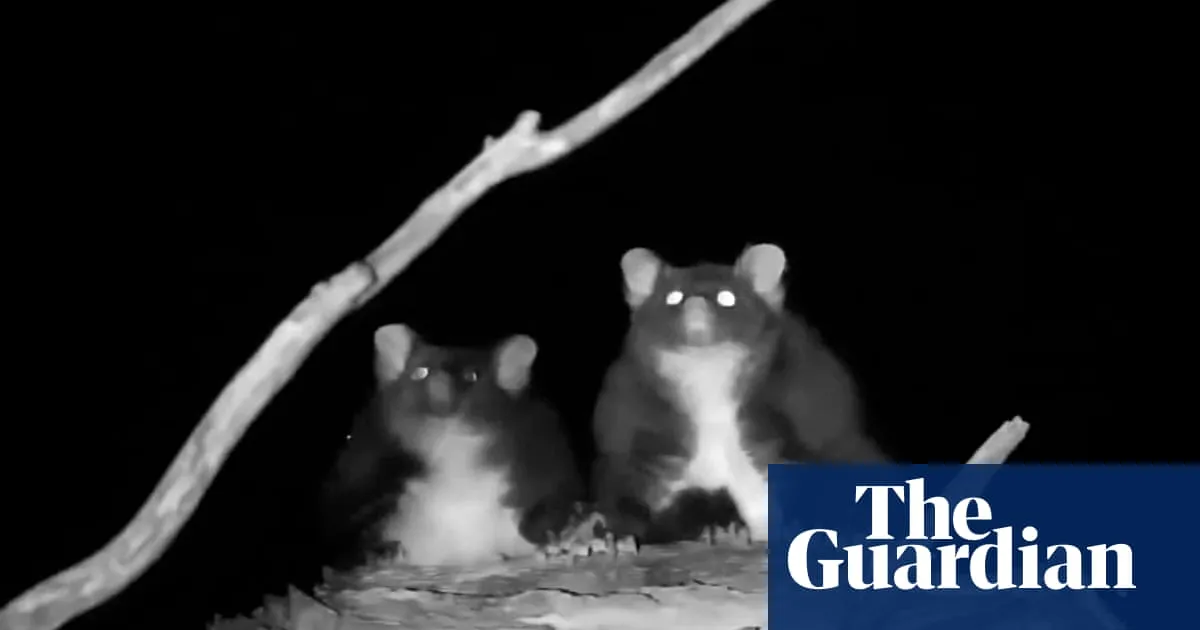
They may look like a fluffy flying carpet, but greater gliders are not as great at gliding as previously thought, Australian researchers have discovered.The first study to measure the aerial ability of Australia’s largest gliding marsupial has found they soar across an average distance of 19 metres – far shorter than the 100 metres suggested in an 85-year-old study.With the help of infrared binoculars, lasers and tape measures, researchers tracked 41 “flights” in New South Wales forests. They recorded data, such as launch and landing heights, horizontal distance and glide angle, publishing their findings in Australian Mammalogy.The lead author, Dr Ana Gracanin, a conservation biologist at the Australian National University, said the results challenged assumptions about how far the endangered animals could travel.“The term ‘greater’ refers to their large body size,” she said, rather than the distance they traversed.The longest flight captured in the study was just under 50 metres.Two greater gliders launch from a treeEven so, she said witnessing a Greater glider in action could still take your breath away.On average, the gliders jump off trees at about 22 metres above the ground, before landing on another tree’s trunk at about 5 metres.“It goes from being this hunched-over ball of fluff at the top of a tree looking down at you, to suddenly spreading out its limbs and flying over your head like a magical flying carpet, or this weird stingray-UFO thing in the sky,” Gracanin said.To stay aloft, they use a membrane stretching from their elbows to their ankles. “They get to the top a tree, launch, spread out their elbows, tuck their paws under their chin and soar through the air.”Taller trees might allow for longer glides, the study found, but it was questionable whether the animals could regularly achieve distances of 100 metres, as reported in a 1941 paper. That detail could be a case of mistaken identity, the authors said, and most likely referred to a Yellow-bellied glider.Australia is home to several gliding marsupial species.The “greatest” – in terms of flight distance – is the aerodynamic Yellow-bellied glider, which covers 40 metres on average, and has been observed cruising up to 145 metres.skip past newsletter promotionafter newsletter promotionIn contrast, squirrel gliders typically sail about 12 metres.The findings are significant, given greater gliders are endangered and spend their whole lives up in the canopy, relying on tree cover to travel and forage for eucalyptus leaves. Gaps created as a result of logging or infrastructure development could stymie that movement.Dr Benjamin Wagner, an expert in Greater glider habitats at the University of Melbourne and who was not an author of the paper, said the findings had practical implications for conserving the species.“It means that disturbances to their habitat or habitat loss might be more severe than we thought,” Wagner said.In fragmented or less dense forests, there would be more gaps to cross, he said.“The vantage tree and the one that’s the target have to be closer together than we thought before. In a continuous forest that’s probably not so much of an issue, but it becomes an issue for them in scenarios where there are gaps to cross, like roads and maybe clearings from previous fires or timber harvesting.”
SRCThe Guardian - World News
LANGEN
LEANCenter-Left
WORDS532
ENT8
WED · 2026-07-15 · 15:01 GMTBRIEF NSR-2026-0715-93256
NSR-2026-0715-93256News Report·EN·Environmental
Greater gliders not as great at gliding as thought – but still look like magic carpets, experts say
A new study by Australian researchers has found that greater gliders, the largest gliding marsupial in Australia, glide an average of 19 meters, significantly less than the 100 meters previously suggested by an 85-year-old study. Using infrared binoculars, lasers, and tape measures in New South Wales forests, scientists tracked 41 flights, with the longest recorded at just under 50 meters.
Petra StockThe Guardian - World NewsFiled 2026-07-15 · 15:01 GMTLean · Center-LeftRead · 3 min
The Guardian - World NewsFIG 01
Reading time
3min
Word count
532words
Sources cited
2cited
Entities identified
8entities
Quality score
100%
§ 01
Briefing Summary
AI-generatedNEWSAR · AI
A new study by Australian researchers has found that greater gliders, the largest gliding marsupial in Australia, glide an average of 19 meters, significantly less than the 100 meters previously suggested by an 85-year-old study. Using infrared binoculars, lasers, and tape measures in New South Wales forests, scientists tracked 41 flights, with the longest recorded at just under 50 meters. This research challenges assumptions about their travel distances, with the "greater" in their name referring to their size, not their gliding ability. The findings have important implications for conservation, as habitat fragmentation from logging or development could more severely impact their ability to move and forage in the tree canopy. Experts suggest that previous reports of longer glides might have been a case of mistaken identity with other glider species.
Confidence 0.90Sources 2Claims 5Entities 8
§ 02
Article analysis
Model · rule-basedFraming
Environmental
Human Interest
Tone
Measured
AI-assessed
CalmNeutralAlarmist
Factuality
0.80 / 1.00
Factual
LowHigh
Sources cited
2
Limited
FewMany
§ 03
Key claims
5 extracted01
The term ‘greater’ in greater glider refers to their large body size, rather than the distance they traversed.
quoteDr Ana Gracanin
Confidence
1.00
02
The yellow-bellied glider is the 'greatest' gliding marsupial, covering 40 metres on average and up to 145 metres.
statisticAustralian researchers
Confidence
0.90
03
Disturbances to greater glider habitat or habitat loss might be more severe than we thought.
quoteDr Benjamin Wagner
Confidence
0.90
04
The longest flight captured in the study was just under 50 metres.
statisticAustralian researchers
Confidence
0.90
05
Greater gliders soar across an average distance of 19 metres, far shorter than the 100 metres suggested in an 85-year-old study.
statisticAustralian researchers
Confidence
0.90
§ 04
Full report
3 min read · 532 words§ 05
Entities
8 identifiedKey playerOppositionContextPositiveNeutralNegative
People1
Organizations2
§ 06
Keywords & salience
10 termsgreater glider
1.00
gliding ability
0.90
marsupial
0.80
flight distance
0.70
conservation biologist
0.60
endangered animals
0.60
australian researchers
0.50
aerial ability
0.50
yellow-bellied glider
0.40
tree canopy
0.40
§ 07
Topic connections
Interactive graph No topic relationship data available yet. This graph will appear once topic relationships have been computed.