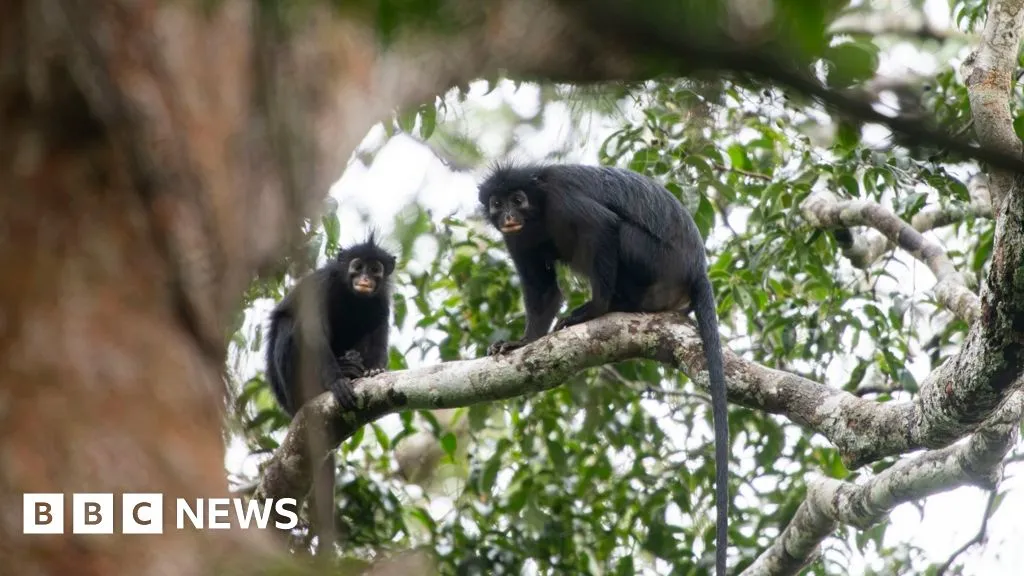
A monkey that has striking pinkish-orange lips and a black face - and lives in the forests of the Democratic Republic of Congo - has been confirmed as a new species to science.The black-furred primate was spotted and photographed hidden away in the high tree canopy of dense tropical forests in Lomami National Park, in the central east of the country.Conservationists working there first reported seeing this unusual-looking animal back in 2008. But they captured just one blurry photograph.After another sighting 10 years later, an international team set out to find and study the monkey and revealed that it was a previously unknown species.This is only the fifth African monkey species to be discovered in the last 75 years. Junior Amboko, a PhD student at Florida Atlantic University, played a leading role in the search, which involved audio recordings, photography and detailed genetic studies.The findings were published in the journal Plos One.Amboko told BBC News it was an "amazing feeling" to look into the face of an animal that so few people knew existed.
SRCBBC News - World
LANGEN
LEANCenter
WORDS174
ENT7
WED · 2026-07-15 · 23:02 GMTBRIEF NSR-2026-0716-93356
NSR-2026-0716-93356News Report·EN·Environmental
New monkey species with orange lips found 'hiding' in DRC forest
Scientists have confirmed the discovery of a new monkey species in the Democratic Republic of Congo. This black-furred primate, distinguished by its striking pinkish-orange lips and black face, was found in the high tree canopy of Lomami National Park.
58 minutes agoShareSaveAdd as preferred on GoogleVictoria GillScience correspondentBBC News - WorldFiled 2026-07-15 · 23:02 GMTLean · CenterRead · 1 min
BBC News - WorldFIG 01
Reading time
1min
Word count
174words
Sources cited
2cited
Entities identified
7entities
Quality score
100%
§ 01
Briefing Summary
AI-generatedNEWSAR · AI
Scientists have confirmed the discovery of a new monkey species in the Democratic Republic of Congo. This black-furred primate, distinguished by its striking pinkish-orange lips and black face, was found in the high tree canopy of Lomami National Park. Conservationists first reported sightings in 2008, but it wasn't until a decade later that an international team, including Florida Atlantic University PhD student Junior Amboko, undertook a comprehensive study. Their research, involving audio recordings, photography, and genetic analysis, revealed the monkey to be previously unknown to science. This marks the fifth African monkey species discovered in the last 75 years, with findings published in the journal PLoS One.
Confidence 0.90Sources 2Claims 5Entities 7
§ 02
Article analysis
Model · rule-basedFraming
Environmental
Human Interest
Tone
Measured
AI-assessed
CalmNeutralAlarmist
Factuality
0.90 / 1.00
Factual
LowHigh
Sources cited
2
Limited
FewMany
§ 03
Key claims
5 extracted01
Junior Amboko described the discovery as an 'amazing feeling' to look into the face of an animal so few people knew existed.
quoteJunior Amboko
Confidence
1.00
02
This is the fifth African monkey species discovered in the last 75 years.
factual
Confidence
1.00
03
Conservationists first reported seeing the animal in 2008, but it was confirmed as a new species after further study.
factual
Confidence
1.00
04
The monkey was found in the high tree canopy of dense tropical forests in Lomami National Park.
factual
Confidence
1.00
05
A new monkey species with pinkish-orange lips and a black face has been discovered in the Democratic Republic of Congo.
factual
Confidence
1.00
§ 04
Full report
1 min read · 174 words§ 05
Entities
7 identifiedKey playerOppositionContextPositiveNeutralNegative
Organizations3
§ 06
Keywords & salience
8 termsnew monkey species
1.00
democratic republic of congo
0.90
lomami national park
0.80
tropical forests
0.70
conservationists
0.60
primate
0.50
genetic studies
0.50
scientific discovery
0.40
§ 07
Topic connections
Interactive graph No topic relationship data available yet. This graph will appear once topic relationships have been computed.