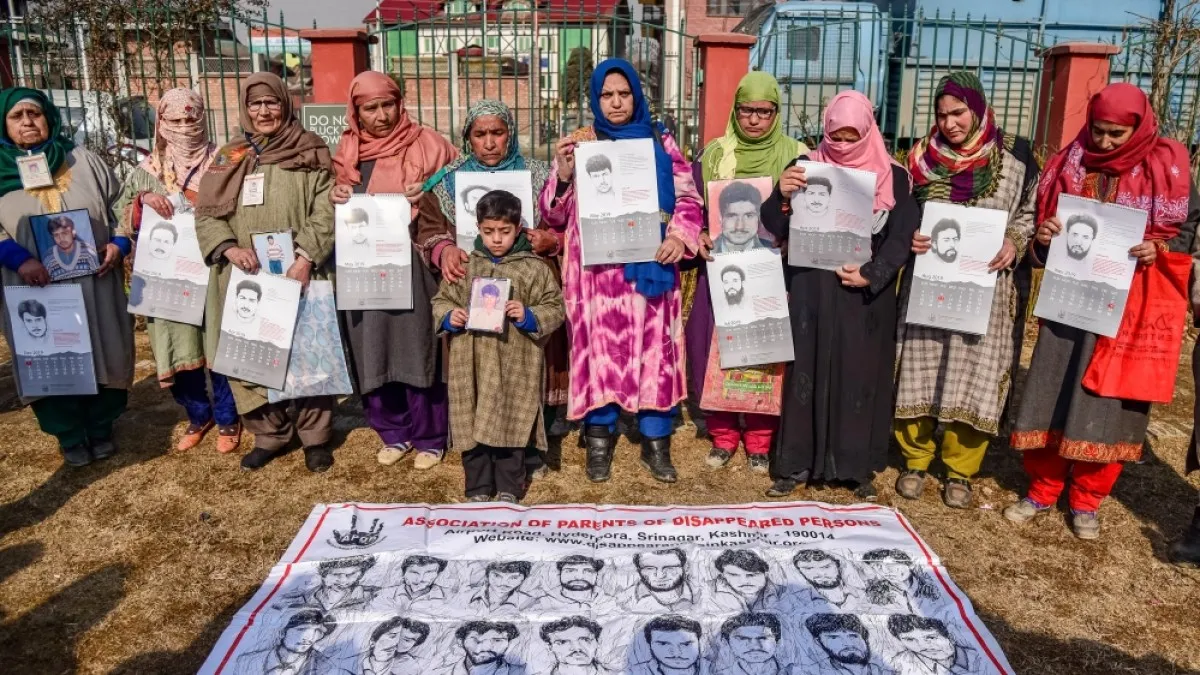
After years of searching and court battles, a judge declares what Junaid Rashid already believed: His father, Abdul Rashid Wani, was dead.Family members hold photographs of their disappeared loved ones during a protest in Srinagar [File: Idrees Abbas/SOPA Images/LightRocket/Getty Images]Published On 16 Jul 2026Junaid Rashid was five when his father vanished from military custody nearly three decades ago, one of the thousands who disappeared during the armed rebellion in India-administered Kashmir.But after years of the family searching for him and fighting court battles, a judge in the contested Himalayan territory declared in April what Rashid already believed: His father, Abdul Rashid Wani, was dead.Recommended Stories list of 4 itemslist 1 of 4Wave of Kashmir disappearances, mystery deaths spook tribal communitylist 2 of 4Kashmiri rights activist wins partial court victory but remains behind barslist 3 of 4Two Kashmir brothers: One killed by rebels, another by army 26 years laterlist 4 of 4‘Limited damage’: Upcoming Bollywood film angers Kashmir pellet gun victimsend of listIt was the first such ruling among thousands of petitions for the disappeared, marking a rare recognition that many other families still don’t have of their loss.The judgement ordered the issuance of a “death certificate” and also acknowledged a police investigation that identified the army officer who took Wani into custody in July 1997.army major ‘murdered Wani’Wani, a timber trader, was stopped near his home in the city of Srinagar while carrying “a good amount of cash” on his way to pay suppliers, according to his family and the police investigation.That evening, his wife and two children sat “all dressed up”, waiting for him to return to take them to a wedding reception.“He never came back,” Rashid told the AFP news agency.The ruling, citing the inquiry, said the accused, an army major, “had murdered Abdul Rashid Wani in his custody and had disposed of his corpse”.It records the date of Wani’s death as the same day that he vanished but gives no information as to where his body lies.“The government has now, after 29 years, acknowledged in court that such an atrocity was done,” said Rashid, now 34.In Kashmir, the wives of the missing men are known as “half-widows” – unable to mourn fully until they know their husbands are dead.“If this had happened earlier, I think Kashmir would look different,” Rashid added. “Our lives would look different, and my mother’s health would be something else.”Muslim-majority Kashmir has been divided between India and Pakistan since their independence from British rule in 1947. Both claim the Himalayan territory in full, and the nuclear-armed neighbours have fought multiple conflicts since – the most recent last year.In 1989, after failed political struggles for the right of self-determination, rebel groups began an armed struggle. They sought Kashmir’s independence or its merger with Pakistan.New Delhi deployed its soldiers, accusing Pakistan of backing the rebels – an allegation Islamabad denies.The scenic tourist destination was transformed into one of the most militarised spots in the world. Tens of thousands of people, mostly civilians, have been killed since.Today, the rebellion has been largely crushed, but at least 500,000 Indian soldiers remain stationed there.Rights groups say 8,000 missingThe People’s Union for Democratic Rights, a civil liberties group based in New Delhi, said Wani’s judicial declaration of death “encapsulates the human rights story” in Kashmir since violence surged in 1989.It said Wani was just one case among many of “enforced disappearance”.There could be as many as 8,000 disappeared people, according to the rights group Association of Parents of Disappeared Persons (APDP). Some of them, it said, were likely abducted by rebels.It mapped in 2009 what it said were 2,700 unmarked graves in remote mountain zones along the de facto border with Pakistan. It also quoted residents alleging they had buried mutilated bodies left by security forces.Among those sites was Kupwara, where residents showed AFP rows of graves marked by rusting metal numbered signs.A woman brings flowers to a graveyard in Sonamarg, a remote mountainous resort in Indian-administered Kashmir, on November 3, 2020 [Aijaz Hussain/AP]One man in his mid-40s said that from 1990 to 2000, he and the villagers buried an estimated 500 bodies left by the police as “humanitarian work”. The police left the bodies, without saying who they were, he said.“Later, we opened graves for relatives of missing Kashmiris,” he said, adding that some families were able to identify the bodies.New Delhi and security authorities insisted the bodies were of fighters killed in clashes who they could not identify. They said the missing men were likely to have crossed into Pakistan.Kashmir’s State Human Rights Commission also examined the graves. In 2011, it found bodies buried at 38 locations identified by the APDP and said the government had identities for only 464 of the 2,730 bodies at the sites.The commission said it was possible that “many disappeared persons” may be found in the unmarked graves.DNA testing it has called for has not been carried out, and the commission was shut down in 2019 after New Delhi’s central government took direct control of Kashmir.‘Midnight knock’Rashid said his family had “spared no effort” to find Wani, including selling their family home to raise funds.They faced pressure to stop, saying they were offered cash from army officers to abandon their search after being told privately by them that “what has happened has happened”, Rashid said.“I remember my grandmother telling a colonel at our home, ‘Just give me my son back,'” Rashid said.They were also asked to pay for help to secure Wani’s release by a group of former rebels that has since surrendered and sided with the government. Instead, the family pursued the case in court.Rashid, who visited an army camp with his mother searching for Wani, said he met the officer whom the police investigation named as ordering Wani’s detention. “I was very young, but I still remember his face,” Rashid said.A protest in Kashmir demands the return of bodies of civilians for proper burial in Srinagar on November 18, 2021 [Mukhtar Khan/AP]Wani’s case is just one among many.In 2002, Jana Begum, her husband, Manzoor Ahmed Dar, and their four children were awoken by soldiers hammering on their door at midnight. They detained Dar.“It felt like a bird of prey snatched him from us,” Begum told AFP at her home in Srinagar.His family never saw or heard from him again.The authorities, after protests and legal challenges, organised an identification parade. Begum pointed to the officer she said took Dar away, but years of legal battles since have proved fruitless in finding out what happened to Dar.The family performed symbolic funeral rites in 2016 after police officers told them privately that Dar had died “during interrogation”, his daughter Bilkees Manzoor said.She was 15 when her father vanished.“I know my father is not in this world,” she told AFP. “The only justice possible is for them to tell us what exactly they did with my father and his body.”Three other families of disappeared men told AFP of similar traumatic campaigns for answers, but they did not want to be identified because they fear reprisals.“Generations of our children will have to silently endure this pain and injustice,” one man said, mourning his missing son.
SRCAl Jazeera
LANGEN
LEANCenter
WORDS1 190
ENT10
THU · 2026-07-16 · 09:39 GMTBRIEF NSR-2026-0716-93444
NSR-2026-0716-93444News Report·EN·Human Rights
Decades of denial: Death certificate for disappeared reopens Kashmir wounds
A judge in Indian-administered Kashmir has officially declared Abdul Rashid Wani, who disappeared in military custody nearly three decades ago, as dead. This ruling, the first of its kind for thousands of missing persons petitions, acknowledges that Wani was murdered by an army major in 1997.
By AFPAl JazeeraFiled 2026-07-16 · 09:39 GMTLean · CenterRead · 5 min
Al JazeeraFIG 01
Reading time
5min
Word count
1 190words
Sources cited
2cited
Entities identified
10entities
Quality score
100%
§ 01
Briefing Summary
AI-generatedNEWSAR · AI
A judge in Indian-administered Kashmir has officially declared Abdul Rashid Wani, who disappeared in military custody nearly three decades ago, as dead. This ruling, the first of its kind for thousands of missing persons petitions, acknowledges that Wani was murdered by an army major in 1997. Wani's son, Junaid Rashid, who was five when his father vanished, pursued legal battles for years to obtain this recognition. The judgment also identified the army officer responsible for Wani's abduction and death, though the location of his body remains unknown. This case highlights the plight of "half-widows" and the broader issue of enforced disappearances in Kashmir, with rights groups estimating up to 8,000 people have gone missing since the armed rebellion began in 1989.
Confidence 0.90Sources 2Claims 5Entities 10
§ 02
Article analysis
Model · rule-basedFraming
Human Rights
Legal & Judicial
Tone
Mixed Tone
AI-assessed
CalmNeutralAlarmist
Factuality
0.70 / 1.00
Factual
LowHigh
Sources cited
2
Limited
FewMany
§ 03
Key claims
5 extracted01
Wives of missing men in Kashmir are known as 'half-widows' until they know their husbands are dead.
factualarticle
Confidence
1.00
02
The ruling stated the accused army major 'had murdered Abdul Rashid Wani in his custody and had disposed of his corpse'.
quotearticle
Confidence
1.00
03
A police investigation identified an army major who allegedly murdered Abdul Rashid Wani in custody.
factualarticle
Confidence
1.00
04
The court ruling ordered the issuance of a death certificate for Abdul Rashid Wani.
factualarticle
Confidence
1.00
05
A judge declared Abdul Rashid Wani dead after his family searched for him for nearly three decades.
factualarticle
Confidence
1.00
§ 04
Full report
5 min read · 1 190 words§ 05
Entities
10 identifiedKey playerOppositionContextPositiveNeutralNegative
People3
Organizations1
Locations4
§ 06
Keywords & salience
8 termskashmir conflict
1.00
disappeared persons
1.00
death certificate
0.90
military custody
0.80
armed rebellion
0.70
half-widows
0.60
court battles
0.50
human rights
0.40
§ 07
Topic connections
Interactive graph Network visualization showing 8 related topics
View Full Graph Person Organization Location Event|Click node to navigate|Edge numbers = shared articles