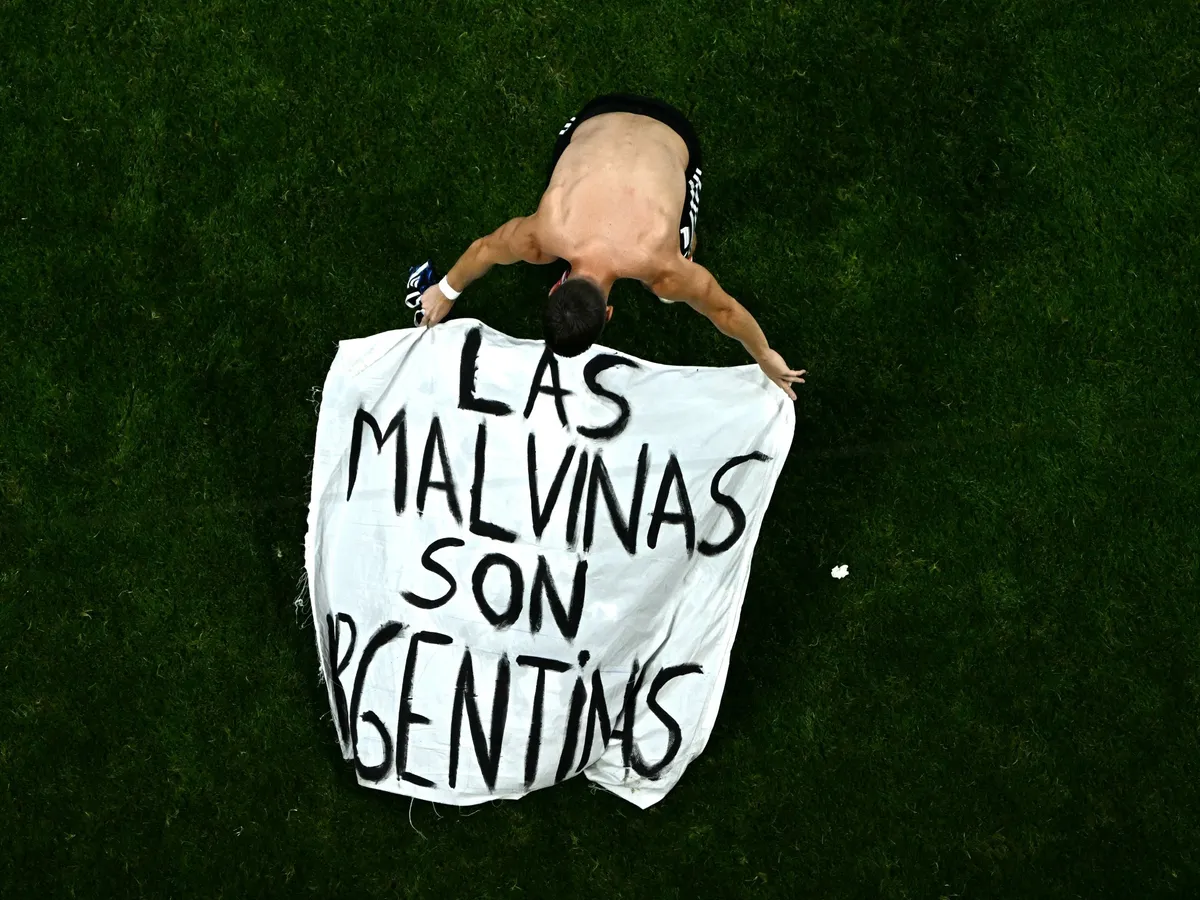
FIFA says its disciplinary committee will assess match reports and consider relevant circumstances before taking action.Argentina's Giovani Lo Celso adjusts a banner reading 'The Malvinas [Falkland Islands] belong to Argentina', after winning the semifinal against England in Atlanta on Wednesday [AFP]Published On 16 Jul 2026FIFA has opened an investigation into Argentinian players’ display of a political banner after their World Cup semifinal victory over England, a move that violated its stadium code of conduct and struck a nerve in the United Kingdom over political sovereignty.Defender Lisandro Martinez and unused substitute Giovani Lo Celso held up a banner reading “Las Malvinas son Argentinas”, meaning “The Falklands are Argentinian”, as they celebrated the win on the pitch, grinning and waving to fans in the stands after securing a dramatic comeback win on Wednesday.Recommended Stories list of 4 itemslist 1 of 4Breaking down the first half of England vs Argentina World Cup semifinallist 2 of 4Tuchel defends tactics after Argentina send England packing from World Cuplist 3 of 4‘Epic squared’: Scaloni lauds Argentina’s back-to-back World Cup comebackslist 4 of 4World Cup: All to know before Sunday’s Spain vs Argentina blockbuster finalend of listThe move sparked a row in the UK, where top government officials urged FIFA to investigate the matter and the global governing body confirmed it had launched a probe as a “standard procedure”.“FIFA’s independent disciplinary committee is currently assessing the match reports and considering the relevant circumstances before deciding on potential further steps based on the FIFA disciplinary code,” a FIFA spokesperson told Al Jazeera on Thursday.It was unclear where the banner in question had come from, but FIFA can prosecute Argentina’s players and football federation for violating its disciplinary code at stadiums, which prohibits any “message that is not appropriate for a sports event”, including those of “a political, ideological, religious or offensive nature”.FIFA’s fines for political messaging range from about $5,000 to $20,000.Argentina will defend their World Cup title when they take on Spain in the World Cup final on Sunday at New York New Jersey Stadium.When asked on Wednesday if the banner could have stirred deep emotions for veterans of the conflict, Martinez said: “We couldn’t let the Argentine people down.” Martinez has played his club football in England for the past four years with Manchester United.UK calls for FIFA to investigate ‘egregious violation’Earlier on Thursday, British Business Minister Peter Kyle had called on FIFA to investigate the “egregious violation” of FIFA rules.“The World Cup might not be ours, but the Falkland Islands definitely are,” a Downing Street spokesperson said. “Self-determination rests with the islanders and our commitment to the Falklands will never waver.”Argentina invaded the British overseas territory in the South Atlantic in 1982.But the United Kingdom regained the archipelago in a brief war after then-Prime Minister Margaret Thatcher dispatched a naval force.Kyle urged football’s global governing body to “thoroughly” investigate the banner incident after Wednesday’s match in Atlanta in the US state of Georgia.“Politics needs to be separate from football. In fact, the World Cup has one of its central tenets that politics is separate from football,” he told BBC television.“That is now a matter for FIFA. … We expect FIFA to undertake an investigation into this,” he added.Britain occupied the Falklands in the 19th century, but Argentina claims the islands are part of its territory.Argentina’s players hold a banner reading ‘The Malvinas [Falkland Islands] belong to Argentina’, after winning the 2026 World Cup semifinal match between England and Argentina at the Atlanta Stadium in Atlanta on July 15, 2026 [AFP]Argentina’s President Javier Milei described the players’ celebration with the banner as “perfectly valid”, saying the message “reflects a sentiment shared by all Argentinians”. But he said he expected FIFA to sanction the team with a fine.“What the players do is understandable; they get carried away by their emotions, they act on impulse, and that will likely lead to discussions about a fine,” Milei told a local Buenos Aires radio station.Argentinian Vice President Victoria Villarruel upped the tensions before Wednesday’s kickoff by calling the English “usurping pirates“.The 1982 conflict ended with the deaths of 649 Argentinians and 255 Britons.After their World Cup semifinal victory, Argentina’s foreign minister said Buenos Aires had filed a formal protest over a British warship near the Falkland Islands.Pablo Quirno posted on X to express “the strongest rejection” of the UK’s HMS Medway’s “unconsulted and illegal” passage through Argentinian territorial waters, alleging a lack of proper notification.Quirno said the Medway, which is based in the Falkland Islands, was accused of violating bilateral agreements in a diplomatic note of protest dated on Monday and submitted to the UK embassy in Buenos Aires.Argentina players showed the same “Las Malvinas son Argentinas” slogan at a warm-up game in June 2014 in Buenos Aires for the World Cup that started days later in Brazil.FIFA’s disciplinary panel ruling in that case was published after the tournament finished and fined the Argentina federation 30,000 Swiss francs ($37,000).A FIFA disciplinary case under previous leadership banned a South Korean player for two 2014 World Cup qualifying games because he held up a similar banner about a territorial claim against Japan at the 2012 London Olympics. Park Jong-woo took a fan banner with the slogan “Dokdo is our territory” after South Korea beat Japan in the men’s bronze medal game. FIFA’s ruling said the conduct of the South Korea player “cannot be tolerated”.At the 2022 World Cup, FIFA fined the Serbia federation 20,000 Swiss francs ($24,800) for hanging a political banner about neighbouring independent state Kosovo in the locker room before playing Brazil. It showed a map of Serbia that included the territory of Kosovo, which has been an independent state since 2008, and the slogan “No Surrender”.
SRCAl Jazeera
LANGEN
LEANCenter
WORDS947
ENT11
THU · 2026-07-16 · 21:23 GMTBRIEF NSR-2026-0716-93619
NSR-2026-0716-93619News Report·EN·Diplomatic
FIFA to probe Argentina’s Falklands banner display at World Cup semifinal
FIFA has launched an investigation into Argentinian players displaying a political banner after their World Cup semifinal win against England. The banner, reading "The Falklands are Argentinian," violated FIFA's stadium code of conduct, which prohibits political messages.
Anushe EngineerAl JazeeraFiled 2026-07-16 · 21:23 GMTLean · CenterRead · 4 min
Al JazeeraFIG 01
Reading time
4min
Word count
947words
Sources cited
3cited
Entities identified
11entities
Quality score
100%
§ 01
Briefing Summary
AI-generatedNEWSAR · AI
FIFA has launched an investigation into Argentinian players displaying a political banner after their World Cup semifinal win against England. The banner, reading "The Falklands are Argentinian," violated FIFA's stadium code of conduct, which prohibits political messages. The move has drawn criticism from UK officials, who have urged FIFA to investigate the "egregious violation." FIFA's disciplinary committee will assess match reports and relevant circumstances before deciding on any potential action, which could include fines. Argentinian President Javier Milei acknowledged the players' sentiment but anticipated a fine, while Argentina's foreign minister also filed a protest over a British warship's passage near the Falkland Islands.
Confidence 0.90Sources 3Claims 5Entities 11
§ 02
Article analysis
Model · rule-basedFraming
Diplomatic
Conflict
Tone
Measured
AI-assessed
CalmNeutralAlarmist
Factuality
0.80 / 1.00
Factual
LowHigh
Sources cited
3
Well sourced
FewMany
§ 03
Key claims
5 extracted01
Argentina invaded the British overseas territory in the South Atlantic in 1982.
factualarticle
Confidence
1.00
02
British government officials urged FIFA to investigate the banner display as an 'egregious violation' of FIFA rules.
factualBritish Business Minister Peter Kyle and Downing Street spokesperson
Confidence
1.00
03
The display of the banner violated FIFA's stadium code of conduct, which prohibits political, ideological, religious, or offensive messages.
factualarticle
Confidence
1.00
04
Argentina's players displayed a banner reading 'Las Malvinas son Argentinas' after their World Cup semifinal victory over England.
factualarticle
Confidence
1.00
05
FIFA's disciplinary committee will assess match reports and consider relevant circumstances before taking action regarding Argentina's banner display.
factualFIFA spokesperson
Confidence
1.00
§ 04
Full report
4 min read · 947 words§ 05
Entities
11 identifiedKey playerOppositionContextPositiveNeutralNegative
Locations5
§ 06
Keywords & salience
8 termsfalklands banner display
1.00
fifa investigation
0.90
political sovereignty
0.80
world cup semifinal
0.70
argentina
0.60
fifa disciplinary code
0.50
england
0.50
political messaging
0.40
§ 07
Topic connections
Interactive graph Network visualization showing 51 related topics
View Full Graph Person Organization Location Event|Click node to navigate|Edge numbers = shared articles