Ukraine is ramping up short-, medium- and long-range drone production to bring Russia’s war to a standstill.A woman stands in front of a damaged confectionery factory following an attack, what Russian-installed authorities called a Ukrainian strike, in the course of the Russia-Ukraine conflict in the town of Horlivka (Gorlovka) in the Donetsk region, a Russian-controlled area of Ukraine, July 17, 2026 [Alexander Ermochenko/Reuters]Published On 17 Jul 2026Crimea’s energy crisis deepened during the past week, as Ukraine demonstrated it could exercise fire control over the peninsula to cut off its fuel and electricity, and Russian occupation authorities said there was no schedule for a return to normality despite Moscow’s help.Ukraine’s operation, named “Molochka”, began on July 6. Ukraine’s commander of unmanned forces, Robert “Madyar” Brovdi, said it “paralyzes the feeder fleet of Russian courier tankers”, in comments on his Telegram messaging channel.Recommended Stories list of 3 itemslist 1 of 3How Syria is redefining ties with Russialist 2 of 3China’s support for North Korea will ‘never change’: Top officiallist 3 of 3Did China steal 2020 US election data, as Trump claims?end of listThese flat-bottomed tankers and barges ferry oil from the shallow waters of the Volga-Don Canal and Sea of Azov to larger tankers waiting in the Black Sea on the other side of the Kerch Strait, he said.“It essentially prevents the export of ‘black gold’,” said Brovdi, and “restricts the delivery of scarce gasoline to Crimea via the narrow channel of the shallow Sea of Azov, leaving the main and very dangerous method of delivery as rail and road tank cars.”During the first 10 days of the operation until July 16, Brovdi said, Ukraine had struck 147 tankers of the Russian shadow fleet. The majority, 117, were feeder tankers in the Sea of Azov. The rest were in the Black Sea.By Monday, July 13, Brovdi declared that “movement through the strait has been stopped,” and unloading of oil to Crimea “has been reduced to a minimum”.Crimean occupation governor Sergey Aksyonov admitted the state of emergency in a public post, saying, “We cannot guarantee daily sales of gasoline at gas stations, nor can we provide precise schedules for fuel distribution.”He said fuel shortages “will likely continue for some time”, despite Russian President Vladimir Putin’s approval of subsidies to the peninsula.On the night of July 13, Ukraine’s Security Service (SBU) also struck several ferries used to transport military materiel across the Kerch Strait, as well as oil storage and trans-shipment points.“The simultaneous striking of dozens of targets in various remote locations in a single night indicates that the SBU is increasing the scale of its long-range special operations,” it said.Ukraine also targeted the Crimean electricity supply, striking the Saky thermal power plant on July 9, five electricity substations on July 10 and nine more substations and the Kuban-Crimea electricity transfer point in Russia on July 13.“There will be no precise schedules for electricity delivery,” said Aksyonov.“A deep and total blackout is inevitable,” said Brovdi.Crimean occupation authorities were switching off street lighting to conserve energy, and distributing generators to communities that had been without power the longest.Aksyonov also said he was distributing 4,000 free canisters of pressurised gas to households over a period of a week.He announced a series of emergency measures to help businesses, including a discount on public land leases, a deferral of payments until November, a deferral of loan repayments and a programme of microloans.Crimea seems set for more suffering, however, as Ukraine’s campaign appears to be mounting.The strikes against it and the Sea of Azov are part of a campaign of mid-range strikes begun this year to starve Russia’s front line of fuel and weapons, and the Kremlin of export revenue from fossil fuels.Ukrainian commander-in-chief Oleksandr Syrskii said there had been 7,028 successful mid-range strikes in 2026, but the campaign has clearly only just taken off, with 2,000 of those strikes taking place in May and almost double that number – 3,800 – in June, according to Syrskii; and Ukraine clearly has greater ambitions.On July 7, Russia said Ukraine tried to blow up the main compressor station on its TurkStream gas pipeline, which supplies 16.5 billion cubic metres of gas to Turkiye a year, and has a similar capacity designed to serve Southeast Europe.Gazprom, the pipeline’s owner, said it thwarted three similar attacks in March and April.“What the Ukrainian regime is doing isn’t even piracy any more,” said Russian Foreign Minister Sergey Lavrov to reporters in Moscow. “This is pure terrorism.”Ukraine’s economic warYet Ukraine says its campaign has very specific goals. It has also sustained a campaign of long-range strikes deep inside Russia, designed to shut down its fuel refining capacity and bring its war machine and economy to a standstill.Long-range drones struck the Ilskiy refinery in the western region of Krasnodar Krai on July 10, igniting at least two of its refining columns. On the same day, they caused fires and explosions at an oil terminal and oil depot in the Rostov region, said Ukraine’s General Staff.Two days later, Ukraine struck the larger Syrzan refinery in Samara, 700km (435 miles) from Ukraine, setting two processing units on fire.On Tuesday, July 14, Ukraine struck the Neftekhim Salavat refinery in Bashkortostan, 1,200km (746 miles) from Ukraine, and the Afipsky refinery in Krasnodar Krai, its General Staff said.Ukraine struck 172 similar long-range targets in June, said Syrskii, and almost 700 in the first six months of the year, causing damage estimated at $6.1bn.Russian Deputy Prime Minister Alexander Novak admitted on July 10 that the campaign was working. Petrol shortages in Russia, he said, were due to the fact that “our oil refineries are partially out of service due to incursions.”Those supply problems have been worsening, according to several reports.Russian petrol production now reaches only two-thirds of seasonal needs, said the Reuters news agency, citing two industry sources and its own calculations.According to the Russian statistical service, Rosstat, monthly petrol inflation jumped by 6.9 percent in June, following single-digit increases in previous months.“Everyone is well aware of the difficulties our economy is facing. Those difficulties are not critical,” said Kremlin spokesman Dmitry Peskov on Thursday, July 16, describing the economy as “generally stable”.A view shows a heavily damaged confectionery factory following a recent attack, which local Russian-installed officials called a Ukrainian strike, in the town of Horlivka in the Donetsk region, Russian-controlled Ukraine, on July 17, 2026 [AFP]Russia grinding to a haltThe war isn’t going well for Russia on the ground in Ukraine, either.Syrskii said Russia’s rate of advance in the first half of this year had “more than halved” compared with last year, and that Ukrainian forces were now conducting two-thirds as many offensive actions as the Russians, partly thanks to their growing advantage in short-range drones.The ratio of Ukrainian production over Russian increased last month to 1.6:1, from 1.5:1 in May, he said.“In terms of the pace of advance, the sides have practically reached parity. There is a steady trend of increasing the ratio of territory liberated,” he said.That parity was due to the apparent exhaustion and starvation of the Russian war effort, Syrskii implied. “Previously, the Russian army was conducting active offensive operations on 13 operational fronts, but now there are only a maximum of six or seven,” he said.“But,” Syrskii warned, “a turning point in the war is still far off.”Ukrainian President Volodymyr Zelenskyy was busy bringing that turning point closer on Monday, July 13, inaugurating a ballistic missile programme with France, Denmark, Germany, Italy, the Netherlands, Norway, Spain, Sweden and the United Kingdom.
SRCAl Jazeera
LANGEN
LEANCenter
WORDS1 245
ENT12
FRI · 2026-07-17 · 13:10 GMTBRIEF NSR-2026-0717-93788
NSR-2026-0717-93788News Report·EN·Conflict
Ukraine ‘cuts off’ Crimea from Russia, plunging it into an energy crisis
Ukraine has intensified its drone production and launched an operation named "Molochka" to disrupt Russia's energy supply to Crimea. Beginning July 6, Ukrainian forces have targeted Russian tankers in the Sea of Azov and Black Sea, significantly reducing fuel deliveries to the peninsula.
John T PsaropoulosAl JazeeraFiled 2026-07-17 · 13:10 GMTLean · CenterRead · 5 min
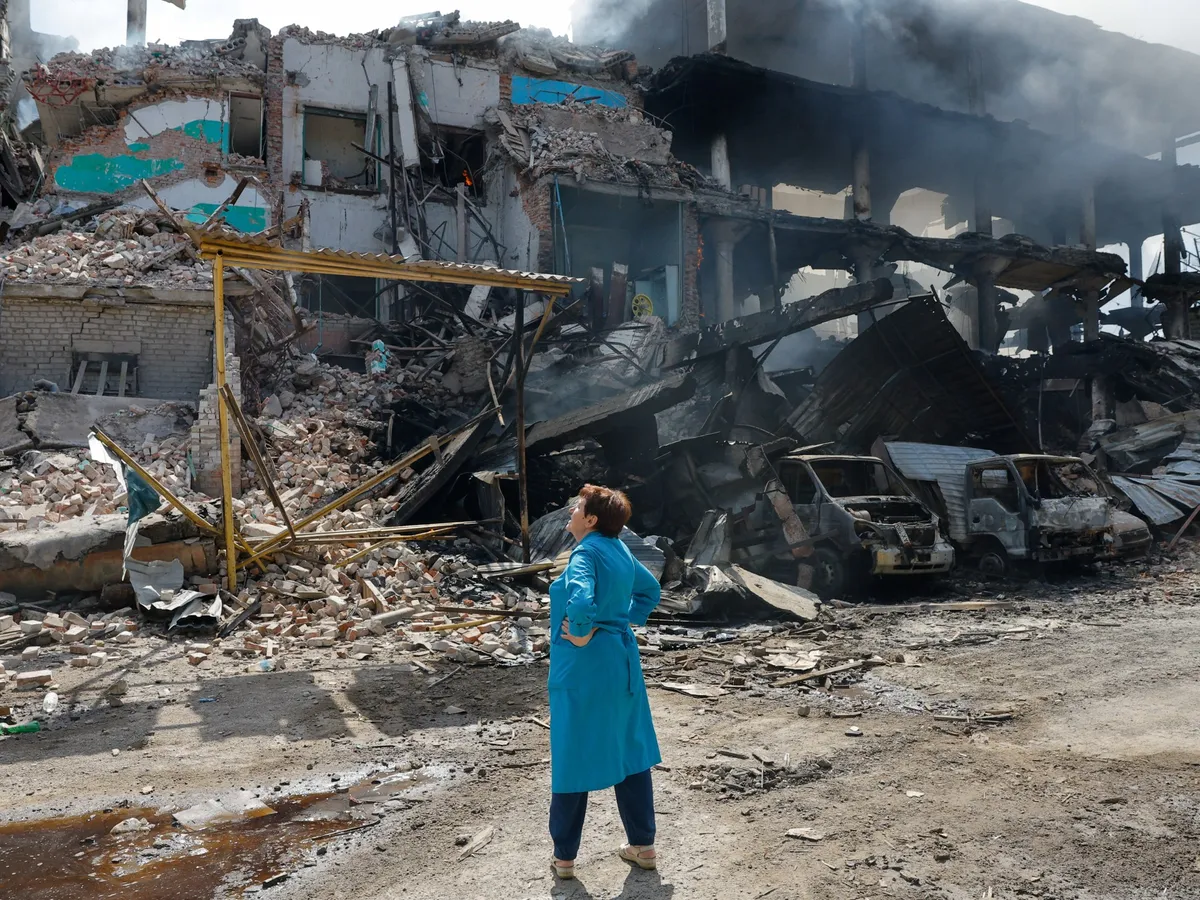
Al JazeeraFIG 01
Reading time
5min
Word count
1 245words
Sources cited
3cited
Entities identified
12entities
Quality score
100%
§ 01
Briefing Summary
AI-generatedNEWSAR · AI
Ukraine has intensified its drone production and launched an operation named "Molochka" to disrupt Russia's energy supply to Crimea. Beginning July 6, Ukrainian forces have targeted Russian tankers in the Sea of Azov and Black Sea, significantly reducing fuel deliveries to the peninsula. Crimean occupation authorities have declared a state of emergency, admitting they cannot guarantee fuel or electricity supplies and that shortages will likely persist. Ukraine also struck ferries transporting military equipment and oil facilities, as well as power plants and substations in Crimea and Russia. These actions are part of a broader Ukrainian campaign to impact Russia's war effort and export revenue.
Confidence 0.90Sources 3Claims 5Entities 12
§ 02
Article analysis
Model · rule-basedFraming
Conflict
Economic Impact
Tone
Mixed Tone
AI-assessed
CalmNeutralAlarmist
Factuality
0.70 / 1.00
Factual
LowHigh
Sources cited
3
Well sourced
FewMany
§ 03
Key claims
5 extracted01
Crimean occupation governor Sergey Aksyonov admitted the state of emergency and inability to guarantee daily gasoline sales.
quoteCrimean occupation governor Sergey Aksyonov
Confidence
0.95
02
Ukraine’s Security Service (SBU) also struck several ferries and oil storage points across the Kerch Strait on the night of July 13.
factualUkraine’s Security Service (SBU)
Confidence
0.90
03
During the first 10 days of the operation until July 16, Ukraine had struck 147 tankers of the Russian shadow fleet.
statisticUkraine’s commander of unmanned forces, Robert “Madyar” Brovdi
Confidence
0.90
04
Ukraine’s operation, named “Molochka”, began on July 6 and aims to paralyze the feeder fleet of Russian courier tankers.
factualUkraine’s commander of unmanned forces, Robert “Madyar” Brovdi
Confidence
0.90
05
Ukraine is ramping up short-, medium- and long-range drone production to bring Russia’s war to a standstill.
factual
Confidence
0.80
§ 04
Full report
5 min read · 1 245 words§ 05
Entities
12 identifiedKey playerOppositionContextPositiveNeutralNegative
Locations9
Events1
§ 06
Keywords & salience
10 termscrimea energy crisis
1.00
ukraine drone production
0.90
russia-ukraine conflict
0.80
fire control
0.70
fuel and electricity cutoff
0.70
shadow fleet
0.60
kerch strait
0.50
sea of azov
0.50
state of emergency
0.40
security service of ukraine (sbu)
0.40
§ 07
Topic connections
Interactive graph Network visualization showing 21 related topics
View Full Graph Person Organization Location Event|Click node to navigate|Edge numbers = shared articles